Important Information
You are visiting the international Vantage Markets website, distinct from the website operated by Vantage Global Prime LLP
( www.vantagemarkets.co.uk ) which is regulated by the Financial Conduct Authority ("FCA").
This website is managed by Vantage Markets' international entities, and it's important to emphasise that they are not subject to regulation by the FCA in the UK. Therefore, you must understand that you will not have the FCA’s protection when investing through this website – for example:
- You will not be guaranteed Negative Balance Protection
- You will not be protected by FCA’s leverage restrictions
- You will not have the right to settle disputes via the Financial Ombudsman Service (FOS)
- You will not be protected by Financial Services Compensation Scheme (FSCS)
- Any monies deposited will not be afforded the protection required under the FCA Client Assets Sourcebook. The level of protection for your funds will be determined by the regulations of the relevant local regulator.
If you would like to proceed and visit this website, you acknowledge and confirm the following:
- 1.The website is owned by Vantage Markets' international entities and not by Vantage Global Prime LLP, which is regulated by the FCA.
- 2.Vantage Global Limited, or any of the Vantage Markets international entities, are neither based in the UK nor licensed by the FCA.
- 3.You are accessing the website at your own initiative and have not been solicited by Vantage Global Limited in any way.
- 4.Investing through this website does not grant you the protections provided by the FCA.
- 5.Should you choose to invest through this website or with any of the international Vantage Markets entities, you will be subject to the rules and regulations of the relevant international regulatory authorities, not the FCA.
Vantage wants to make it clear that we are duly licensed and authorised to offer the services and financial derivative products listed on our website. Individuals accessing this website and registering a trading account do so entirely of their own volition and without prior solicitation.
By confirming your decision to proceed with entering the website, you hereby affirm that this decision was solely initiated by you, and no solicitation has been made by any Vantage entity.
I confirm my intention to proceed and enter this website Please direct me to the website operated by Vantage Global Prime LLP regulated by the FCA in the United KingdomImportant Information
By providing your email and proceeding to create an account on this website, you acknowledge that you will be opening an account with Vantage Global Limited, regulated by the Vanuatu Financial Services Commission (VFSC), and not the UK Financial Conduct Authority (FCA).
-
Please enter a valid email address
-
Please tick the checkbox to proceed
-
Please tick the checkbox to proceed
Please tick all to proceed

Access Restricted
Your access to this website is restricted.
Our website and services are not available to, and are not intended for, individuals who are citizens or residents of the United States, or entities incorporated in or conducting business within the United States.
If this does not apply to you and you believe you have received this message in error, please contact us at support@vantagemarkets.com for further assistance.
If you fall into any of the above categories, please exit the site.
Important Information
Thank you for visiting the Vantage Markets website. Please note that this website is intended for individuals residing in jurisdictions where accessing it is permitted by Vantage and its affiliated entities do not operate in your home jurisdiction.
By clicking 'I CONFIRM MY INTENTION TO PROCEED AND ENTER THIS WEBSITE', you confirm that you are entering this website solely based on your initiative and not as a result of any specific marketing outreach. You wish to obtain information from this website based on reverse solicitation principles, in accordance with the applicable laws of your home jurisdiction.
I CONFIRM MY INTENTION TO PROCEED AND ENTER THIS WEBSITE
-

-


Download App
-


-

-

-
Search query too short. Please enter a full word or phrase.
-

Keywords
Popular Search








Language


60 Day Trading Terms: A Glossary for Beginners

Vantage Editorial Team >
28 October 2026 | Academy | 19 min read
Vantage Editorial Team >
Vantage is a global, multi-asset broker with a team of experienced in-house writers, analysts, and market professionals. Together, they craft trusted, educational, and market-driven content tailored for traders at every stage—from beginner to pro.

Day trading has its own vocabulary, and much of it appears on screen the moment you open a trading platform. Words such as bid, ask, margin level, and trailing stop describe exactly what an order will do or what your account can support, so knowing them precisely matters before any money is at stake.
This glossary covers 60 day trading terms and explains each one in plain English. The entries are grouped by theme for easier reference: core concepts, orders and execution, pricing, leverage and margin, charts and price action, and risk and position management.
The definitions are written with Contracts for Difference (CFDs) in mind, since CFDs are a common way for retail traders to trade intraday price movements without owning the underlying asset.
Disclaimer: This article seeks to explain trading terminology only and is not intended as investment or trading advice.
Key Points
- Most day trading terms fall into a handful of families, and learning them by theme is designed to make each one easier to remember.
- Order vocabulary is where precision counts most because a stop order, a stop-limit order, and a limit order each behave differently when prices move quickly.
- Leverage and margin terms describe how much exposure an account carries and when a provider may close positions, which is why regulators set specific retail rules around them.
10 Core Day Trading Concepts to Add to Your Trading Vocabulary
These are the foundational terms the rest of the glossary builds on.
- Day Trading: Opening and closing positions within the same trading day, so that no trade is held overnight. The aim is to respond to short-term price movements rather than longer trends.
- Intraday: Anything that happens within a single trading session. An intraday chart, for example, shows price movement over minutes or hours rather than days.
- Contract for Difference (CFD): A derivative contract between a trader and a provider that tracks the price of an underlying market. You exchange the difference in price between opening and closing the trade, without owning the underlying share, currency, or commodity.
- Long Position: A trade that gains in value if the price of the market rises. Going long is also commonly known as buying.
- Short Position: A trade that gains in value if the price falls. With CFDs, a short position can be opened without first owning the asset.
- Bullish: A view or market mood that expects prices to rise.
- Bearish: A view or market mood that expects prices to fall.
- Liquidity: How easily a market can be bought or sold without the price moving much. Highly liquid markets tend to have many active participants and narrower pricing.
- Volatility: The size and speed of price changes over a given period. Higher volatility means larger and faster swings in either direction.
- Trading Session: The hours during which a particular market is open and most active, such as the London or New York session for currencies or the opening hours of a stock exchange.
11 Order and Execution Terms to Master
Orders are the instructions you send to your provider. Each type handles price and timing in its own way [1].
11. Market Order: An instruction to buy or sell straight away at the best price on offer. It generally executes at or near the current bid or ask, although the final price can differ in a fast market [1].
12. Limit Order: An instruction to buy at or below a set price, or to sell at or above a set price [1]. It gives control over price but may not be filled if the market never reaches that level.
13. Stop Order: An order that activates once the market reaches a chosen level, called the stop price, and then becomes a market order [1][2].
14. Stop-Loss Order: A stop order placed to close a position if the price moves against it by a chosen amount, helping to limit the loss in normal conditions. It does not guarantee the exit price.
15. Stop-Limit Order: A stop order that turns into a limit order, rather than a market order, once the stop price is reached [1]. The trade will only fill at the limit price or better.
16. Trailing Stop: A stop that follows the market at a fixed distance as the price moves in your favour, and stays put when the price moves against you [1].
17. Take-Profit Order: A limit order attached to an open position that closes it automatically once the price reaches a chosen target level.
18. Day Order: An order that is cancelled automatically at the end of the trading day if it has not been filled [1].
19. Good Till Cancelled (GTC): An order that stays active until it is either filled or cancelled by the trader [1].
20. Fill: The completion of an order. A partial fill means only part of the requested size has been executed.
21. Slippage: The difference between the price you expected and the price at which your order was actually executed. It is most common in fast or thin markets, and a triggered stop can be filled well away from its stop price [2].
| Order Type | When It Executes | Price Certainty |
| Market order | Straight away, at the best price currently available | Execution is expected, but the exact price is not fixed |
| Limit order | Only when the market reaches your chosen price or better | Price is controlled, but the order may never fill |
| Stop order | Once the market touches your stop price, it becomes a market order | Can fill at a price quite different from the stop in fast markets |
| Stop-limit order | Once the stop price is touched, it becomes a limit order | Price is capped, but the order may remain unfilled |
| Trailing stop | When price reverses by a set distance from its best level | Same fill risk as a stop order once triggered |
Table 1: How the main order types differ in timing and price certainty
9 Pricing and Cost Terms You’d Want to Know
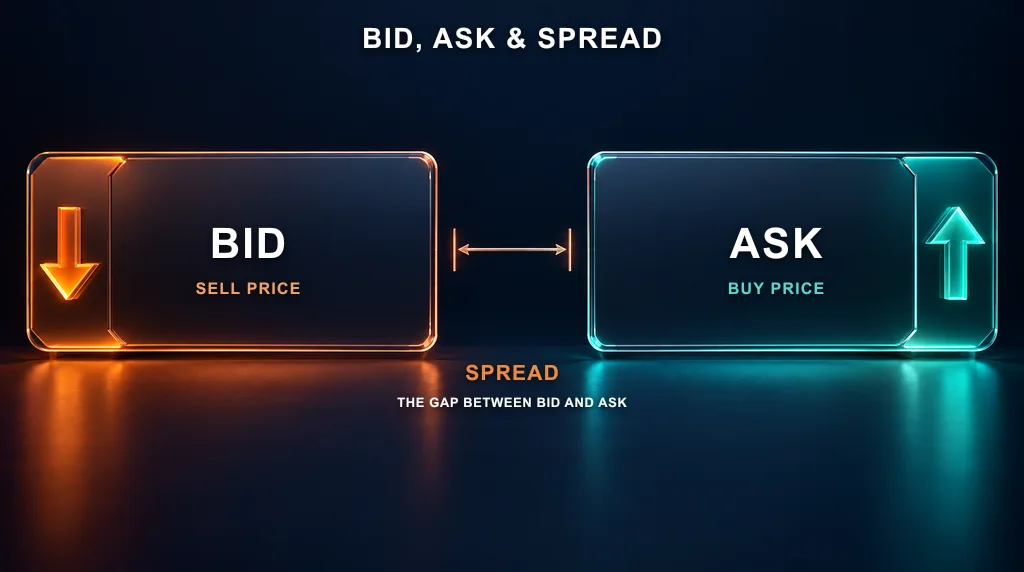
22. Bid Price: The price at which the market will buy from you. You sell or open a short position at the bid.
23. Ask Price: The price at which the market will sell to you, sometimes called the offer. You buy or open a long position at the ask.
24. Spread: The gap between the bid and ask prices. It is one of the costs built into every trade.
25. Pip: A standard unit of movement in a currency pair. For most pairs, it’s the fourth decimal place (0.0001), and for pairs quoted in Japanese yen, it’s the second decimal place (0.01).
26. Point: The unit used to measure price moves in markets such as stock indices, where one point is usually a move of one whole number in the quoted price.
27. Tick: The smallest price increment a market can move by. Tick size varies from one instrument to another.
28. Lot: A standard unit of trade size. In forex, one standard lot usually represents 100,000 units of the base currency, while mini and micro lots are smaller fractions.
29. Commission: A fee charged per trade on some account types, typically in addition to a tighter spread.
30. Overnight Financing: A charge or credit applied to positions held open past the daily cut-off time, also known as a swap or rollover. Positions closed within the same day are not normally subject to it.
10 Leverage and Margin Terms to Explore
These terms describe how much of your own money supports a position and when a provider may step in. Leverage magnifies both gains and losses.
31. Leverage: Using a smaller deposit to control a larger position. Retail CFD leverage in Europe and the UK is limited to a maximum of 1:30, falling to 1:2 for the most volatile asset classes [3][4]. Other jurisdictions may set different limits.
32. Margin: The deposit needed to open and keep a leveraged position. It’s typically expressed as a percentage of the full position value.
33. Used Margin: The part of your account currently set aside to support open positions.
34. Free Margin: The amount available to open new positions, calculated as your equity minus the margin already in use.
35. Equity: Your account balance plus or minus the unrealised gain or loss on open positions. It changes in real time as prices move.
36. Margin Level: Equity divided by used margin, shown as a percentage. A falling margin level shows that less of your own money is supporting your positions.
37. Margin Call: A warning from your provider that your equity has dropped close to the minimum needed to keep positions open.
38. Margin Close-Out: The automatic closing of one or more positions once equity falls to a set proportion of required margin. European and UK rules set that point at half of the required margin for retail accounts [3][4]. Other jurisdictions may set different levels.
39. Negative Balance Protection: A protection, required for retail clients under EU and UK rules, that is designed to stop losses from exceeding the funds in a CFD account [3][4]. Whether and how it applies depends on the provider, the entity and the client’s terms.
40. Unrealised Gain or Loss: The paper result of a position that is still open. It becomes realised only when the position is closed.
12 Chart and Price Action Terms Traders Often Talked About

41. Candlestick: A chart bar that shows the open, high, low, and close for a chosen period. The body covers the open-to-close range and the thin lines, called wicks or shadows, mark the extremes.
42. Timeframe: The period each bar or candle represents, such as one minute, five minutes, or one hour. Day traders usually view shorter timeframes.
43. Trend: The general direction of price over a period. An uptrend shows higher highs and higher lows, and a downtrend shows the reverse.
44. Range: A period in which price moves sideways between a fairly steady upper and lower boundary.
45. Support: A price area where buying interest has previously stopped a decline.
46. Resistance: A price area where selling interest has previously capped a rise.
47. Breakout: A move through a support or resistance level, or out of a range. A false breakout is one that quickly reverses.
48. Gap: A jump between one price and the next with no trading in between, often after news or a market open. Orders can be filled at the next available price beyond the gap [2].
49. Volume: The amount traded over a period. It’s often used alongside price to judge how much participation lies behind a move.
50. Moving Average: A line that shows the average price over a set number of periods, smoothing out short-term noise.
51. Technical Analysis: Studying price charts, patterns, and indicators to form a view on possible future price behaviour.
52. Fundamental Analysis: Assessing economic data, interest rates, company results, and news to judge what may move a market.
8 Risk and Position Management Terms to Remember
53. Position Size: How large a trade is, measured in lots, units, or amount per point. It determines how much each price move changes your account.
54. Risk per Trade: The amount a trader is prepared to lose on a single position if the stop-loss is reached, often expressed as a share of the account.
55. Risk-Reward Ratio: The potential loss on a trade compared with its potential gain, based on the distance to the stop-loss and the target.
56. Drawdown: A decline in account value from a peak to a later low. Maximum drawdown is the largest such fall over a given period.
57. Trading Plan: A written set of rules covering which markets you trade, when you trade, how trades are entered and exited, and how much can be risked.
58. Trading Journal: A record of each trade and the reasoning behind it that’s kept so that results can be reviewed later.
59. Overtrading: Placing more trades, or larger trades, than a trading plan allows, often driven by boredom, excitement, or a wish to recover losses.
60. Demo Account: A practice account that uses virtual funds and live or simulated prices, so no real money is at risk.
Why a Shared Vocabulary Matters in Intraday Trading
Day trading decisions often happen in seconds, and a misunderstood term can mean an order that behaves differently from what you intended. Regulators warn that most individual traders are not prepared for the losses day trading can bring [5], and ESMA’s 2018 review put the share of loss-making retail CFD accounts at 74% to 89% [3].
Knowing the language will not change those odds on its own—but it can help you read platform screens, risk disclosures, and account statements with a greater level of understanding of how they affect you as a day trader.
Once these definitions are familiar, check out our guide to day trading tips to see how planning, position sizing, and record-keeping fit together in practice.
Frequently Asked Questions About Day Trading Terms
Here are short answers to questions beginners often ask about day trading terminology.
What Are the Most Important Day Trading Terms for Beginners?
Start with the words that affect every trade: bid, ask, spread, market order, limit order, stop-loss, leverage, and margin. These describe the price you pay, how your order behaves, and how much exposure you’re taking on. Chart vocabulary such as support, resistance, and timeframe comes next, followed by position-sizing terms like equity, free margin, and margin level.
What Is the Difference Between a Stop-Loss and a Stop-Limit Order?
A stop-loss becomes a market order once its stop price is reached, so it will normally close the position. But the fill price can differ from the stop, especially in fast markets or after a gap [2]. A stop-limit order becomes a limit order instead, so it will not fill worse than the limit price [1]. The trade-off is that it may not fill at all if the market moves straight past it.
What Does a Margin Call Mean in CFD Trading?
A margin call is a warning that your account equity is getting close to the minimum needed to keep your positions open. If equity keeps falling, the provider may close positions automatically. Under ESMA and FCA rules, a retail account reaches that close-out point when equity drops to 50% of the margin required [3][4]. Other jurisdictions may apply different levels, so check your provider’s terms.
What Is Slippage and Why Does It Happen?
Slippage is the difference between the price you expected and the price you actually received. It happens because prices can change between the moment an order is sent and the moment it is executed. It tends to happen more commonly around major news, at market opens, and in less liquid instruments. Once a stop order is triggered, it can be filled at a price noticeably different from the stop level [2].
What Is the Difference Between a Pip and a Point?
Both measure price movement, but in different markets. A pip is used for currency pairs and is usually the fourth decimal place, or the second decimal place for pairs quoted in Japanese yen. A point is common for stock indices and other instruments quoted in larger whole numbers. Your platform’s contract specifications show which unit applies to each instrument and how its value is calculated.
What Does Going Short Mean in Day Trading?
Going short means opening a position that gains in value if the market price falls—and loses value if the price rises. With CFDs, you can open a short position without owning or borrowing the underlying asset because you are trading a contract on its price movements. Losses on a short trade grow as the price rises, so the same risk controls apply as with long positions.
RISK WARNING: CFDs are complex financial instruments and carry a high risk of losing money rapidly due to leverage. You should ensure you fully understand the risks involved and carefully consider whether you can afford to take the high risk of losing your money before trading.
Disclaimer: The information is provided for educational purposes only and doesn’t take into account your personal objectives, financial circumstances, or needs. It does not constitute investment advice. We encourage you to seek independent advice if necessary. The information has not been prepared in accordance with legal requirements designed to promote the independence of investment research. No representation or warranty is given as to the accuracy or completeness of any information contained within. This material may contain historical or past performance figures and should not be relied on. Furthermore estimates, forward-looking statements, and forecasts cannot be guaranteed. The information on this site and the products and services offered are not intended for distribution to any person in any country or jurisdiction where such distribution or use would be contrary to local law or regulation.
References
- “Order Types – FINRA” https://www.finra.org/investors/investing/investment-products/stocks/order-types. Accessed on 28 September 2026.
- “Stop Orders: Factors to Consider During Volatile Markets – FINRA” https://www.finra.org/investors/insights/stop-orders-factors-consider-during-volatile-markets. Accessed on 28 September 2026.
- “ESMA agrees to prohibit binary options and restrict CFDs to protect retail investors – ESMA” https://www.esma.europa.eu/press-news/esma-news/esma-agrees-prohibit-binary-options-and-restrict-cfds-protect-retail-investors. Accessed on 28 September 2026.
- “FCA confirms permanent restrictions on the sale of CFDs and CFD-like options to retail consumers – FCA” https://www.fca.org.uk/news/press-releases/fca-confirms-permanent-restrictions-sale-cfds-and-cfd-options-retail-consumers. Accessed on 28 September 2026.
- “Day Trading: Your Dollars at Risk – SEC” https://www.sec.gov/about/reports-publications/investorpubsdaytipshtm. Accessed on 28 September 2026.
Key Points In This Article

Latest Academy Articles


Market News Tags
- # Asian Market News Today
- # Crude Oil News Today
- # Earnings News Today
- # Economic News Today
- # Featured News
- # Federal Reserve News
- # Commodity Market News
- # Interest Rate News
- # Financial News
- # Forex News Today
- # Gold News Today
- # Market News Today
Related Articles
- Gold Trading Hours: When Does the Gold Market Open in Peru?
- Gold Trading Hours: When Does the Gold Market Open in Chile?
- Gold Trading Hours: When Does the Gold Market Open in Argentina?
- Gold Trading Hours: When Does the Gold Market Open in Mexico?
- 20 Chart Patterns: How They Form and How to Read Them
- What Is Trading Psychology? 5 Habits & 5 Pitfalls (Free PDF)
- What Moves Synthetic Indices? Unpacking Their Algorithmic Nature
- Best Copy Trading Apps and Platforms in Mexico: 8 Compared