Important Information
You are visiting the international Vantage Markets website, distinct from the website operated by Vantage Global Prime LLP
( www.vantagemarkets.co.uk ) which is regulated by the Financial Conduct Authority ("FCA").
This website is managed by Vantage Markets' international entities, and it's important to emphasise that they are not subject to regulation by the FCA in the UK. Therefore, you must understand that you will not have the FCA’s protection when investing through this website – for example:
- You will not be guaranteed Negative Balance Protection
- You will not be protected by FCA’s leverage restrictions
- You will not have the right to settle disputes via the Financial Ombudsman Service (FOS)
- You will not be protected by Financial Services Compensation Scheme (FSCS)
- Any monies deposited will not be afforded the protection required under the FCA Client Assets Sourcebook. The level of protection for your funds will be determined by the regulations of the relevant local regulator.
If you would like to proceed and visit this website, you acknowledge and confirm the following:
- 1.The website is owned by Vantage Markets' international entities and not by Vantage Global Prime LLP, which is regulated by the FCA.
- 2.Vantage Global Limited, or any of the Vantage Markets international entities, are neither based in the UK nor licensed by the FCA.
- 3.You are accessing the website at your own initiative and have not been solicited by Vantage Global Limited in any way.
- 4.Investing through this website does not grant you the protections provided by the FCA.
- 5.Should you choose to invest through this website or with any of the international Vantage Markets entities, you will be subject to the rules and regulations of the relevant international regulatory authorities, not the FCA.
Vantage wants to make it clear that we are duly licensed and authorised to offer the services and financial derivative products listed on our website. Individuals accessing this website and registering a trading account do so entirely of their own volition and without prior solicitation.
By confirming your decision to proceed with entering the website, you hereby affirm that this decision was solely initiated by you, and no solicitation has been made by any Vantage entity.
I confirm my intention to proceed and enter this website Please direct me to the website operated by Vantage Global Prime LLP regulated by the FCA in the United KingdomImportant Information
By providing your email and proceeding to create an account on this website, you acknowledge that you will be opening an account with Vantage Global Limited, regulated by the Vanuatu Financial Services Commission (VFSC), and not the UK Financial Conduct Authority (FCA).
-
Please enter a valid email address
-
Please tick the checkbox to proceed
-
Please tick the checkbox to proceed
Please tick all to proceed

Access Restricted
Your access to this website is restricted.
Our website and services are not available to, and are not intended for, individuals who are citizens or residents of the United States, or entities incorporated in or conducting business within the United States.
If this does not apply to you and you believe you have received this message in error, please contact us at support@vantagemarkets.com for further assistance.
If you fall into any of the above categories, please exit the site.
Important Information
Thank you for visiting the Vantage Markets website. Please note that this website is intended for individuals residing in jurisdictions where accessing it is permitted by Vantage and its affiliated entities do not operate in your home jurisdiction.
By clicking 'I CONFIRM MY INTENTION TO PROCEED AND ENTER THIS WEBSITE', you confirm that you are entering this website solely based on your initiative and not as a result of any specific marketing outreach. You wish to obtain information from this website based on reverse solicitation principles, in accordance with the applicable laws of your home jurisdiction.
I CONFIRM MY INTENTION TO PROCEED AND ENTER THIS WEBSITE
-

-


Download App
-


-

-

-
Search query too short. Please enter a full word or phrase.
-

Keywords
Popular Search








Language


Meta Stock Forecast and Outlook: Q3 2026 Earnings, Analyst Ratings, and Risks

Vantage Editorial Team >
12 November 2026 | Academy | 39 min read
Vantage Editorial Team >
Vantage is a global, multi-asset broker with a team of experienced in-house writers, analysts, and market professionals. Together, they craft trusted, educational, and market-driven content tailored for traders at every stage—from beginner to pro.

As of the 4 November 2026 close, 37 of the 43 analysts tracked by TipRanks rated Meta stock Buy and 6 rated it Hold, with an average 12-month price target of about $857.97 against a share price of $630.00.1
That gap opened after Meta’s Q3 2026 results on 21 October, when revenue rose 26% to $64.60 billion but a $9.89 billion legal charge cut operating margin to 20% from 40% a year earlier.2 The shares fell almost 7% in the next session.3,4
This Meta stock forecast and outlook covers the Q3 results, why the shares fell, the analyst ratings and price targets published since the report, the new Class C stock dividend, and how share CFDs work. Forecasts and analyst targets are estimates rather than guarantees, and this article does not constitute investment advice.
Last reviewed: 6 November 2026. Price and analyst figures are snapshots from the dates shown and change quickly.
Key Points
- Meta reported Q3 2026 revenue of $64.60 billion, up 26% year over year and above the top of its $61–$64 billion guidance range, while a $9.89 billion legal charge cut operating margin to 20% from 40%.2,5
- TipRanks showed 37 Buy, 6 Hold, and 0 Sell ratings and an average 12-month target of about $857.97 as of the 4 November 2026 close. Targets are third-party opinions and can change within days of new information.1
- Earnings and corporate-action events can move a share price sharply, so trading them with share CFDs, which are leveraged and can lose money rapidly, is higher risk.
Meta Stock At a Glance
| Metric | Latest available figure |
| Closing price | $630.00 on 4 November 2026 (TipRanks) |
| Latest chart reading | About $605, the last price on the chart at 06:09 UTC on 6 November 2026 (not an official close) |
| 2026 price range on the chart | About $520 (end of March) to about $780 (late September), on 4-hour candles |
| Latest reported quarter | Q3 2026, released 21 October 2026 |
| Q3 revenue | $64.60 billion, up 26% year over year |
| Q3 diluted EPS | $3.83, up from $1.05; $7.40 excluding the $9.89 billion legal charge |
| Quarterly dividend | $0.525 per Class A and Class B share, declared 10 September 2026 and payable 28 September 2026 |
| Analyst consensus | 37 Buy, 6 Hold, and 0 Sell ratings from 43 analysts (TipRanks, 4 November 2026) |
| Average 12-month analyst target | About $857.97, with a $580–$1,000 range (TipRanks, 4 November 2026) |
| Class C stock dividend | One Class C share for each Class A and Class B share; certificate effective 19 January 2027; record date not yet set |
| Next earnings date | Q4 2026 date not published on Meta’s investor-events page as of 6 November 2026 |
Table 1: Meta stock at a glance. Price and analyst data are snapshots from the dates shown and change quickly; Q3 results are from Meta’s release. Sources: Meta Investor Relations,2 TipRanks,1 and TradingView.6
What Is Meta Platforms, and Where Is META Stock Listed?
For those who may not be aware, Meta Platforms is the technology company behind Facebook, Instagram, WhatsApp, Messenger, and Threads. These services sit within its Family of Apps segment. Meanwhile, the company’s Reality Labs segment contains its virtual- and augmented-reality hardware, software, and content businesses.
The business remains heavily dependent on advertising. In Q3 2026, advertising generated $63.06 billion of Meta’s $64.60 billion in total revenue, about 98%. Family of Apps produced $64.16 billion in revenue and $17.12 billion in operating income, while Reality Labs generated $443 million and recorded a $4.13 billion operating loss.2 This concentration makes the strength of Meta’s advertising tools and user engagement particularly important to the outlook for Meta Platforms stock.
Other notable information:
- Meta’s Class A shares trade on the Nasdaq Global Select Market under the ticker META, often written as NASDAQ: META.
- Facebook priced its initial public offering at $38 per share and began trading under the symbol FB on 18 May 2012.
- The company later changed its corporate name to Meta Platforms, and the ticker changed from FB to META on 9 June 2022.7,8
Did you know that Meta uses a dual-class structure?
Meta has more than one voting class. Class B shares carry greater voting power than the publicly traded Class A shares, and Meta’s 2026 proxy statement says Mark Zuckerberg, its founder and chief executive, controls a majority of the voting power.9 This structure gives him significant influence over the company’s strategic direction. A third, non-voting Class C is due in January 2027 (see the Class C section below).
Meta Stock Price Chart and History
Meta stock has swung widely in 2026. On the 4-hour chart below, META traded from about $520 at the end of March to about $780 in late September, then slid to about $605 by 6 November 2026, roughly 22% below the September peak.6
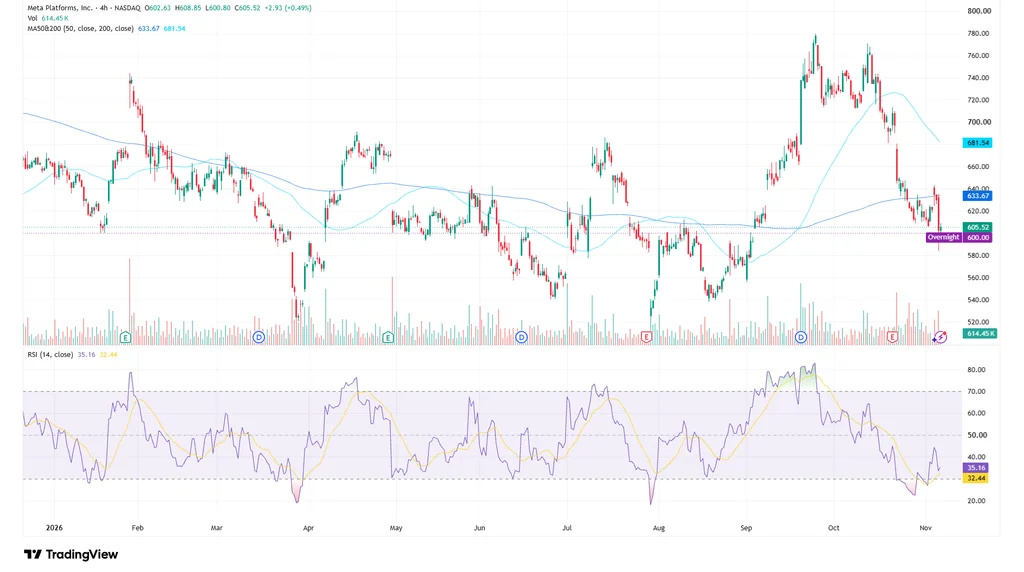
Shares closed at $648.85 on 22 October 2026, down 6.98% from $697.52 the day before, and at $642.62 on 23 October.3,4 TipRanks listed $630.00 at the 4 November close.1 On the chart, the last candle, from overnight trading, sits below both the 50- and 200-period moving averages, which end at 633.67 and 681.54, and the 14-period RSI read 35.16.
RSI is a momentum gauge on a 0 to 100 scale, and readings below 30 are conventionally described as oversold. Oversold readings can persist, though, so treat the indicator as context rather than a signal.
Bear in mind that historical performance does not determine future returns. A chart can show how the market reacted to previous information, but it cannot by itself establish whether the next move will be higher or lower.
What Did Meta’s Q3 2026 Earnings Show?
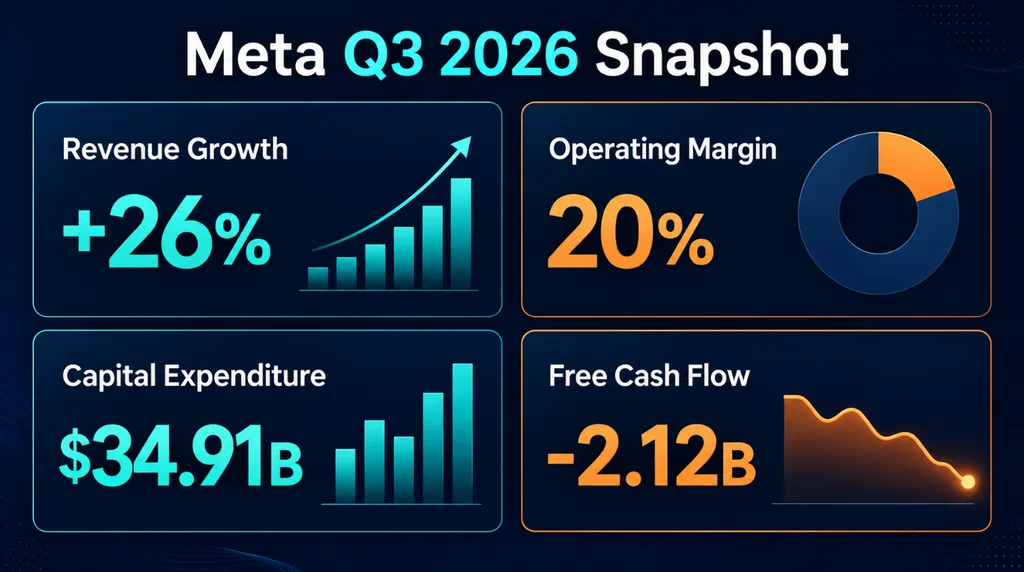
Meta’s latest earnings report showed 26% revenue growth but a sharp drop in operating profit, because of a $9.89 billion charge tied to an August 2026 agreement with US state attorneys general to resolve litigation over teen mental health and social media.2
| Q3 Metric | 2026 | 2025 | YoY Change |
| Revenue | $64.60bn | $51.24bn | +26% |
| Advertising revenue | $63.06bn | $50.08bn | +26% |
| Costs and expenses | $51.61bn | $30.71bn | +68% |
| Operating income | $12.99bn | $20.54bn | -37% |
| Operating margin | 20% | 40% | -20 percentage points |
| Net income | $9.86bn | $2.71bn | +264% |
| Diluted EPS | $3.83 | $1.05 | +265% |
Table 2: Meta’s Q3 2026 results against Q3 2025, three months ended 30 September. Source: Meta Investor Relations.2
Excluding the $9.89 billion charge, Meta’s release shows operating income of $22.88 billion and diluted earnings per share (EPS) of $7.40. Bear in mind that the year-ago comparison is distorted too: Meta’s provision for income taxes fell to $3.14 billion from $18.95 billion (an effective tax rate of 24% against 87%), which is why net income and EPS rose more than 260% while operating income fell.2
Advertising and Engagement Remained Strong
Meta reported 3.64 billion family daily active people on average for September 2026, up 3% from the prior year. Ad impressions across its Family of Apps rose 10% and the average price per ad rose 14%. Together, those figures help explain why advertising revenue increased 26%.2
Compare that with Q2, when impressions rose 14% and price per ad rose 12%.5 In Q3, price did more of the work. A higher average price per ad can indicate stronger advertiser demand, better targeting, or improved monetisation, while more impressions expand inventory.
Costs Grew Much Faster Than Revenue
Total costs and expenses rose 68% to $51.61 billion. General and administrative costs jumped to $14.86 billion from $3.51 billion, and $9.89 billion of that was the legal charge. Research and development expenses rose to $20.05 billion from $15.14 billion, and headcount stood at 66,775, down 15% year over year.2
Infrastructure spending was substantial as well. Capital expenditure (aka capex), including principal payments on finance leases, reached $34.91 billion, up from $31.08 billion in Q2. That exceeded the $32.79 billion in cash generated from operations, so free cash flow was negative $2.12 billion, against positive $784 million in Q2.2,5 Meta ended the quarter with $82.45 billion in cash, cash equivalents, and marketable securities, and long-term debt of $80.92 billion, up from $58.74 billion at 31 December 2025.2
Guidance Keeps the AI-Spending Debate Alive
Meta guided Q4 2026 revenue to $73–$76 billion, which assumes about a 1% foreign-currency headwind. It raised its full-year 2026 expense outlook to $175–$179 billion to include the legal charge, up from $165–$169 billion in the Q2 report, and narrowed expected 2026 capex to $135–$145 billion from $130–$145 billion.2,5
Management also expects Reality Labs losses of $18–$19 billion in 2026, narrowing to around $15 billion in 2027, and still expects 2026 operating income, excluding the legal charge, to exceed the 2025 level. It gave no 2027 revenue range, saying only that it expects to sustain strong overall revenue growth throughout 2027.2 The question is not simply whether Meta can grow; it’s whether revenue and operating income can grow fast enough to justify the scale and timing of the investment programme.
Why Did Meta Stock Fall After Q3 Earnings?
Meta stock fell 6.98% to $648.85 on 22 October 2026, the first full session after results.3,4 The Q3 release gave investors four pressure points to weigh against a revenue figure that landed above the top of Meta’s guidance range.
1. The Legal Charge Cut Reported Profit
The $9.89 billion charge pushed operating margin down to 20%. Excluding it, operating income would have been $22.88 billion, about 35% of revenue by calculation from the release’s figures, so the charge accounts for most of the fall in the headline margin.2 Some investors will still treat a charge of this size as a real cost, since the agreement involves payments of up to about $18.59 billion.
2. Capex Pushed Free Cash Flow Negative
Meta spent more on infrastructure than it generated from operations in the quarter. This does not mean the core advertising business stopped generating cash; rather, much of the operating cash was reinvested in property, equipment, and finance leases. The market must decide whether those investments will generate adequate future returns.2
3. Spending Guidance Moved Higher
The full-year expense range rose to $175–$179 billion, although Meta said the increase incorporates the $9.9 billion legal charge. The capex range was narrowed with its lower end raised by $5 billion, to $135–$145 billion.2
4. Debt Rose and a New Share Class Was Announced
Long-term debt reached $80.92 billion, and Meta announced a new class of non-voting Class C stock that it says can be used for capital raising, among other purposes.2 Neither item has a stated link to the 22 October move, so treat them as context rather than causes.
The weeks after the release brought more funding news. On 26 October 2026, Meta priced a $25 billion offering of Class A common stock at $625.00 per share, structured through forward sale agreements covering 40 million shares, alongside about $12.5 billion of mandatory convertible preferred stock.13,17
Underwriters exercised an option for a further 6 million Class A shares on 4 November, and Meta completed a $15 billion senior notes offering on 5 November.13 The forward sales are expected to settle on or before 19 November 2027, and any new shares Meta issues to settle them can dilute existing holders.17
Not all of the fall since late October is company-specific, though.
StockTitan, citing CNBC, reported that the S&P 500 fell 4.36% and the Nasdaq Composite 5.52% on 5 November 2026 as selling in AI chip stocks spread across the market.10 On the chart, META was near $605 at 06:09 UTC on 6 November in overnight trading, about 4% below the 4 November close, so the recent drop cannot be attributed to Meta news alone.1,6
What Is the Analyst Consensus on Meta Stock?
As of the 4 November 2026 close, TipRanks counted 37 Buy, 6 Hold, and 0 Sell ratings from 43 analysts over the past three months, with an average 12-month price target of about $857.97 and a range of $580 to $1,000.1
Against the $630.00 close, the average target is about 36% higher, the high target about 59% higher, and the low target about 8% lower. Those are arithmetic gaps between two numbers, not a prediction of where the shares will go, and the shares were lower still, at about $605, by 6 November.
| Source | As of | Analysts | Buy / Hold / Sell | Average target | High / low | Share price |
| TipRanks | 4 November 2026 close | 43 (past 3 months) | 37 / 6 / 0 | $857.97 | $1,000 / $580 | $630.00 |
| MarketScreener | 22 October 2026 close | 62 | Not shown | $840.34 | $1,050 / $600 | $648.85 |
Table 3: Analyst consensus snapshots for Meta stock. The two sources count different analyst sets, which is why the totals differ. Third-party data; ratings and targets change often. Sources: TipRanks1 and MarketScreener.11
Table 4 lists the actions firms published after the 21 October report, sorted by price target.
| Firm | Rating | Target | Prior target | Date (Oct 2026) | Source |
| Wells Fargo | Buy | $995 | $1,000 | 22 | TipRanks |
| Canaccord Genuity | Buy | $950 | n/a | 27 | TipRanks |
| Mizuho Securities | Buy | $950 | $750 | 22 to 25 | TipRanks, MarketScreener |
| J.P. Morgan | Buy | $940 | $920 | 22 | TipRanks |
| Citi | Buy | $905 | $895 | 23 | TipRanks, MarketScreener |
| KeyBanc | Buy | $905 | $900 | 22 | TipRanks |
| Rosenblatt | Not stated | $900 | $886 | 22 | MarketScreener |
| UBS | Buy | $892 | $884 | 22 | MarketScreener |
| Goldman Sachs | Buy | $885 | $860 | 22 | TipRanks |
| Barclays | Buy | $880 | $780 | 22 | TipRanks |
| Jefferies | Buy | $875 | n/a | 22 | TipRanks |
| Monness Crespi Hardt | Not stated | $875 | $830 | 22 | MarketScreener |
| Evercore ISI | Not stated | $870 | $860 | 22 | MarketScreener |
| Piper Sandler | Buy | $850 | n/a | 26 | TipRanks |
| TD Cowen | Buy | $850 | n/a | 28 | TipRanks |
| Susquehanna | Not stated | $850 | $650 | 22 | MarketScreener |
| Bernstein | Not stated | $850 | $800 | 22 | MarketScreener |
| Bank of America Securities | Buy | $845 | $810 | 22 to 27 | TipRanks, MarketScreener |
| Deutsche Bank | Buy | $840 | $820 | 22 | MarketScreener |
| Fubon Securities | Not stated | $825 | $700 | 22 | MarketScreener |
| Raymond James | Not stated | $825 | $860 | 22 | MarketScreener |
| DZ Bank | Not stated | $820 | $690 | 22 | MarketScreener |
| RBC Capital | Buy / Outperform | $800 | $770 | 26 | TipRanks, MarketScreener |
| Phillip Securities | Buy | $780 | $750 | 26 | TipRanks |
| Wedbush | Neutral | $730 | $700 | 22 | MarketScreener |
| Scotiabank | Hold | $650 | $600 | 27 | TipRanks, MarketScreener |
Table 4: Analyst actions on Meta stock after the 21 October 2026 Q3 report, sorted by price target. “Not stated” means the source did not show a rating. Morgan Stanley also published a note on 22 October with no target shown. Third-party opinions, not Vantage views. Sources: TipRanks1 and MarketScreener.11
Three things stand out.
First, only Wedbush (Neutral) and Scotiabank (Hold) show a rating below Buy in this table. Second, the summary range of $580 to $1,000 covers three months of targets, so it can include figures firms have since changed; Wells Fargo’s previous target, for example, was $1,000. Third, several firms raised targets even as the shares fell, while Wells Fargo and Raymond James lowered theirs.
Take note that ratings rest on assumptions about revenue, margins, capex, and valuation, and they can change within days. Treat the table as a record of what analysts published, not a recommendation to buy, sell, or hold Meta stock.
Hypothetical Bull, Base, and Bear Cases
The three cases below are hypothetical and for illustration only. This is not a forecast or a Meta stock price prediction.
Hypothetical Bull Case
- Advertising growth remains strong as AI improves recommendation and conversion tools.
- WhatsApp, Threads, and business messaging generate new revenue streams.
- Infrastructure investment supports enterprise AI revenue or measurable improvements in Meta’s core products.
- Legal costs normalise, allowing margins and free cash flow to recover.
Hypothetical Base Case
- Revenue continues to grow, but high capex and depreciation limit near-term margin expansion.
- The stock remains sensitive to quarterly guidance while investors wait for clearer evidence of returns on AI investment.
- Family of Apps finances the investment programme, while Reality Labs remains loss-making.
Hypothetical Bear Case
- AI and infrastructure costs rise faster than revenue for longer than expected.
- Advertising demand slows, user engagement weakens, or rival platforms capture more consumer attention and advertiser budgets.
- Regulatory and legal costs remain elevated.
- The market assigns a lower valuation multiple because of weaker free-cash-flow conversion and execution uncertainty.
Will Meta Stock Split? What the Class C Dividend Means
Meta has not announced a traditional stock split, but it has declared a one-time stock dividend of one new Class C share for each Class A and Class B share, and it expects the Class A share price to reflect the effect of a two-for-one split after the payment date.2
Here is what Meta has and has not said so far:
- Confirmed: On 19 October 2026 the Board approved a new class of publicly listed, non-voting Class C common stock, and the amended and restated certificate of incorporation takes effect on 19 January 2027.2,12
- Confirmed: The stock dividend is contingent on that certificate taking effect, and Meta says it will not change any shareholder’s voting power.2
- Not Yet Set: The Board will set the record date later. Meta’s filing says the payment date will be no later than the fifth business day after the certificate takes effect, and Meta has not stated when Class C shares will begin trading. It intends to qualify them for listing on Nasdaq upon issuance, while Class A shares continue to trade there.2,12
Meta cites capital raising, employee compensation, potential acquisitions, and other general corporate purposes as uses for the new class.2 A stock split changes the number of shares and the price per share but does not by itself change a company’s total value, and the dividend is expected to roughly double the number of shares once paid. Because the record date is not yet set, the exact timing of any price adjustment is not yet known.
What Could Drive Meta Stock Next?

Six areas could shape the next phase of the Meta stock outlook, although each would depend on execution and market conditions.
1. AI Improvements to Advertising
Meta already uses artificial intelligence (AI) to rank content, recommend Reels, improve ad targeting, and automate campaign creation. If these tools increase conversions for advertisers or improve engagement without proportionate cost growth, they may support both ad pricing and impression volume.
The Q3 figures offer evidence that the current advertising engine is working: impressions rose 10% and price per ad rose 14%.2 The next question is whether that performance can be sustained as comparisons become harder.
2. New Ways to Monetise WhatsApp, Threads & Business Messaging
Facebook and Instagram already operate at enormous scale, but WhatsApp and Threads may provide additional routes to revenue. Business messaging, click-to-message advertising, and paid commercial tools could diversify growth within the Family of Apps ecosystem.
Execution matters, however. New advertising or paid features must be introduced without weakening the user experience that makes the platforms valuable to advertisers in the first place.
3. Returns From AI Infrastructure
Meta said it launched Muse and Muse Wonder in the quarter, which it describes as its first frontier model.2 Its infrastructure could support internal products and, potentially, enterprise-facing AI services. The opportunity is significant if the company can convert computing capacity, models, and business agents into external revenue. The risk is that large fixed investments, now guided at $135–$145 billion of capex for 2026, arrive well before commercial demand.
Evidence of higher utilisation, incremental enterprise sales, or measurable improvements in ad monetisation would make the investment case easier to evaluate.
4. Greater Cost Discipline
Investors will watch whether the legal charge proves to be a one-off and whether the growth rate of recurring expenses begins to moderate. Headcount fell 15% year over year to 66,775, and Meta expects Reality Labs losses to narrow to around $15 billion in 2027 as it reallocates investment toward AI.2
Margin stabilisation could become a catalyst even if capex remains high, particularly if revenue continues to grow at a double-digit rate.
5. The Class C Listing and Funding Mix
Class C shares are due to be listed on Nasdaq after the January 2027 effective date. Meta says the new class can support capital raising and employee compensation, and since the Q3 report it has agreed to sell $25 billion of Class A shares through forward sale agreements, issued about $12.5 billion of mandatory convertible preferred stock, and completed $15 billion of senior notes.2,13,17
How Meta funds its AI spending, and how the market receives the new share class, may influence sentiment.
6. The Q4 2026 Earnings Update
The next Meta stock earnings report should show whether revenue is tracking within the $73–$76 billion Q4 guidance range. It may also provide new information on capital expenditure, operating margin, legal exposure, 2027 spending, and the commercial progress of Meta’s AI initiatives.2
As of 6 November 2026, Meta had not published its Q4 reporting date. Fourth-quarter results typically arrive in late January or early February, but check Meta’s investor-events page for the confirmed date.14
What Are the Biggest Risks to Meta Stock?
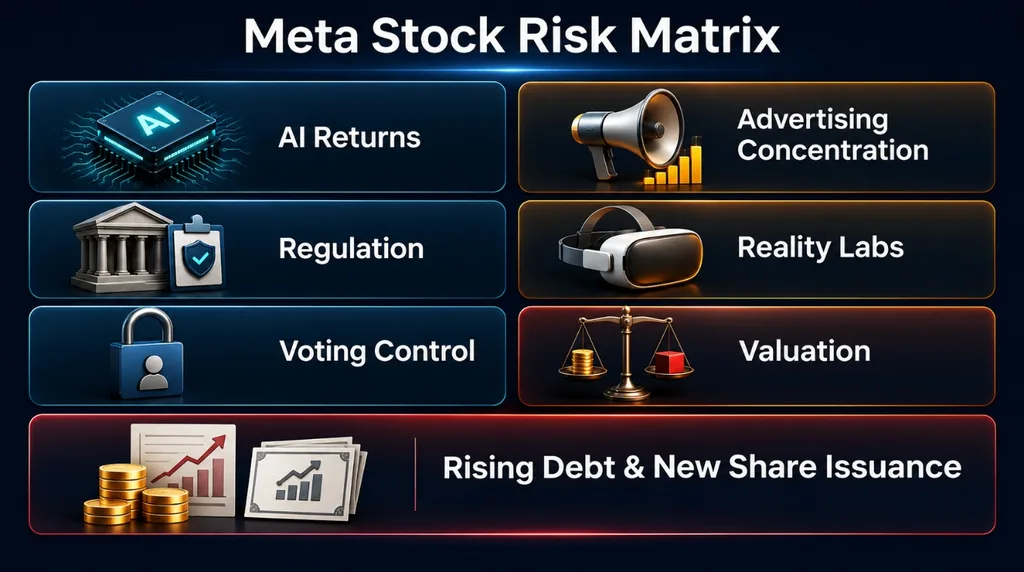
The same factors that could support growth can also create material uncertainty, so the following risks should be assessed alongside the potential catalysts.
1. AI Investment May Not Generate Sufficient Returns
Meta is committing substantial capital before the full revenue model for some AI investments is proven. If utilisation, advertising benefits, or enterprise demand disappoint, depreciation and operating expenses may continue to weigh on margins and free cash flow.
2. Advertising Remains Highly Concentrated
In Q3 2026, advertising generated $63.06 billion of the $64.60 billion in total revenue, about 98%.2 This creates sensitivity to economic cycles, advertiser demand, platform-policy changes, and competition for consumer attention.
3. Regulation and Litigation Can Create Material Costs
Meta said it continues to face scrutiny involving privacy, competition, content, youth safety, and advertising practices. The $9.89 billion Q3 charge for the August 2026 agreement with state attorneys general, which involves payments of up to about $18.59 billion, shows that such costs can move beyond headlines and affect reported earnings.2
4. Reality Labs Continues to Lose Money
Reality Labs produced $443 million of quarterly revenue and a $4.13 billion operating loss, and Meta expects a loss of $18–$19 billion for 2026.2 Its products may support a longer-term computing platform, but ongoing losses raise the hurdle for the Family of Apps business and Meta’s newer AI projects.
5. Dual-Class Control Limits Outside Shareholder Influence
Meta’s voting structure gives its founder substantial control. This can support long-term decision-making, but it also means public Class A shareholders have limited ability to redirect strategy if they disagree with the pace or scale of investment. The new Class C shares carry no vote.2
6. Rising Debt and New Share Issuance
Long-term debt rose to $80.92 billion at 30 September 2026 from $58.74 billion at 31 December 2025, and the new Class C stock can be used for capital raising.2 Since the Q3 report, Meta has also agreed to sell 46 million Class A shares through forward sale agreements and issued mandatory convertible preferred stock and new senior notes.13,17 Higher borrowing can raise interest costs, and any issuance of new shares can dilute existing holders.
7. Valuation and Market Expectations Can Change Quickly
The 22 October fall and the slide into early November show that expectations can reset quickly. A strong business result does not necessarily lead to a higher share price if the result falls short of what the market had already priced in.
Is Meta Stock a Buy? Factors Analysts Weigh
Whether Meta stock is a buy or a sell for any individual depends on their objectives, time horizon, and tolerance for volatility, and Vantage does not give a personal recommendation. The Q3 report provides credible evidence for both an optimistic and a cautious reading, and the targets in Table 4 run from $650 to $995 even though most stated ratings are Buy.
| Factors That May Support a Buy Rating | Factors That May Support a Sell Rating |
| 26% revenue growth | 68% increase in costs and expenses |
| Ad impressions up 10% and price per ad up 14% | Operating margin down from 40% to 20% |
| 3.64 billion family daily active people | Free cash flow of negative $2.12 billion |
| Large and profitable Family of Apps ecosystem | $135bn–$145bn full-year capex outlook |
| Potential for new AI, messaging, and enterprise revenue | Legal, regulatory, and execution risks |
| Dividend provides a modest cash return | Reality Labs continues to record large losses |
Table 5: Factors analysts may weigh on Meta stock, based on Meta’s Q3 2026 results. This is not a recommendation. Source: Meta Investor Relations.2
For readers asking “Is Meta a good stock to buy?”, the key issue is not simply whether Meta owns strong platforms; it does. The harder question is whether the future cash flows created by its investment programme will compensate for the cost and uncertainty involved. Potential factors to weigh include:
- Time horizon: A long-term view may be more tolerant of near-term capital spending, while a short-term position may be dominated by earnings volatility.
- Evidence threshold: Investors can monitor advertising growth, operating margin, capital expenditure, free cash flow, and new AI-related revenue.
- Valuation: A lower share price does not automatically mean a stock is inexpensive; expected earnings and cash flow matter as well.
- Concentration: Exposure to one company, sector, or earnings event can increase portfolio risk.
- Scenario risk: Bull, base, and bear cases can all be weighed before a position is opened.
This framework is educational and does not provide a personal recommendation. If you’re interested to learn more, Vantage’s guide to risk management techniques covers ways to assess exposure and loss capacity.
Does Meta Stock Pay a Dividend?
Yes, Meta stock does pay dividends. In fact, the latest Meta stock dividend declared before this update was $0.525 per share of outstanding Class A and Class B common stock. Meta announced it on 10 September 2026, payable on 28 September 2026 to shareholders of record at the close of business on 21 September.15 Meta’s Q3 release reports $1.36 billion of dividend payments in the quarter but does not announce a new declaration.2
At the $630.00 close on 4 November, four quarterly payments at that rate would equal $2.10 per year and an indicative yield of about 0.33%.1 This is a backward-looking illustration, not a guarantee that future dividends will be declared at the same rate. Note that the one-time Class C stock dividend is separate from this cash dividend.
Take note that Meta only began paying a dividend in 2024. The current yield is modest, so the investment case remains more closely tied to earnings growth, cash generation, and valuation than to dividend income.
How Does Meta Compare With Alphabet?
Alphabet (NASDAQ: GOOGL) is a useful peer to Meta because both companies operate large digital-advertising ecosystems and are investing heavily in artificial intelligence.
| Q3 2026 comparison | Meta | Alphabet |
| Revenue | $64.60bn | $127.58bn |
| Revenue growth | 26% | 25% |
| Operating margin | 20% | 32% |
| Capital expenditure* | $33.94bn | $51.36bn |
| Free cash flow | -$2.12bn | -$9.07bn |
Table 6: Q3 2026 comparison, three months ended 30 September. *Purchases of property and equipment. Meta’s broader capital-expenditure figure, including finance-lease principal, was $34.91 billion. Meta’s margin includes the $9.89 billion legal charge. Sources: Meta Investor Relations2 and Alphabet Investor Relations.16
As the table shows, Meta grew slightly faster than Alphabet in Q3 2026 but remained more dependent on advertising income. Alphabet’s Google Cloud revenue increased 103% to $30.71 billion, about 24% of its total, which gives it a more substantial source of diversification.16 Both companies reported negative free cash flow in the quarter, as capital spending exceeded cash from operations at each.
For broader cross-company context, see Vantage’s guide to the Magnificent Seven stocks.
Note: This comparison is not a recommendation to choose one stock over the other. Their share prices also reflect different expectations, capital structures, and business mixes.
How Can You Trade Meta Share CFDs With Vantage?
Vantage offers CFDs only, so Meta stock is traded with Vantage as a Meta share CFD rather than as Meta shares.
A share CFD is a contract with the provider rather than a purchase of shares on the exchange, so it gives price exposure without ownership of the underlying shares. You can take a long position if you expect the price to rise or a short position if you expect it to fall.
This flexibility also introduces material risk. CFDs use leverage, meaning both potential gains and losses can be magnified relative to the capital committed. Overnight financing, spreads or commissions, and price gaps around earnings should be considered before trading. Prices can move sharply around results, which makes earnings trading higher risk; one option is to observe it on a demo account first.
Example (hypothetical): Meta closed at $697.52 on 21 October 2026 and $648.85 on 22 October.3,4 The change per share is $697.52 − $648.85 = $48.67. On a position of 10 shares, the result is 10 × $48.67 = $486.70, before spreads, overnight financing (swap), and other costs.
| Position | Price on 21 October | Price on 22 October | Result on 10 shares |
| Long | $697.52 | $648.85 | -$486.70 |
| Short | $697.52 | $648.85 | +$486.70 |
Table 7: Hypothetical Meta share CFD results across the 22 October 2026 move. These are for illustration only and do not reflect actual trading results. Spreads, overnight financing, and other costs would change the result.
A stop-loss does not guarantee the exit price, particularly during gaps or fast markets, so the actual loss on a position can be larger than the level you set.
You can practise first with virtual funds on a Vantage Demo Account. A demo account is simulated, so prices and fills can differ from live trading.
Meta Stock Catalyst Calendar
Meta’s latest quarter demonstrated the continuing strength of its advertising platforms but also the cost of its AI ambitions. Revenue, ad impressions, and ad pricing all grew, while operating margin and free cash flow fell. The table below lists the dated and undated events that could add new evidence on the outlook for the stock.
| Date | Event | Status as of 6 November 2026 |
| 19 January 2027 | Class C certificate of incorporation takes effect | Stated in Meta’s 21 October 2026 release |
| To be set | Record date for the Class C stock dividend | Board to set; payment due no later than the fifth business day after 19 January 2027 (8-K) |
| To be set | Nasdaq listing of Class C shares | Meta intends to qualify them for listing upon issuance; no date given |
| Not yet published | Q4 and full-year 2026 earnings report | Meta guided Q4 revenue to $73–$76 billion |
| Not yet announced | Next quarterly cash dividend declaration | None found after the 10 September 2026 declaration |
Table 8: Upcoming events for Meta stock. Dates can change; check Meta’s investor pages for confirmations. Sources: Meta Investor Relations2,14 and the US SEC.12
That leaves the outlook balanced between two questions: how much value Meta’s infrastructure investment can create, and how long shareholders may need to wait for the returns to become visible. The Q4 report should offer further evidence through revenue, margins, capex, and the first guidance for 2027 spending.
Availability of Vantage’s products and services depends on the client’s country of residence and applicable local laws, and this article does not imply that services are available in any particular country. Vantage’s VFSC-licensed entity is regulated by the Vanuatu Financial Services Commission (VFSC); other Vantage-branded entities are licensed separately in their own jurisdictions.
Frequently Asked Questions (FAQs)
How Much Is Meta Stock?
For readers asking “How much is Meta stock?”, META closed at $630.00 on 4 November 2026 according to TipRanks, and the last price on the chart, at 06:09 UTC on 6 November, was near $605.1,6 The price changes continuously during market and extended trading hours, so check a live source for the current stock price of Meta before making a decision.
What Is the Meta Platform Stock Price?
The Meta platform stock price refers to the market price of Meta Platforms’ Class A shares, listed on Nasdaq under META. The 4 November 2026 closing price was $630.00; live and CFD quotes can differ slightly because of timing, spreads, and data sources.1
Vantage’s share CFD page shows how Meta and other share CFDs are quoted; CFD prices can differ from the Nasdaq price because of spreads and timing.
Why Did Meta Stock Fall After Earnings?
Meta stock fell 6.98% to $648.85 on 22 October 2026, the first session after Q3 results. The release combined revenue above guidance with a $9.89 billion legal charge, negative free cash flow of $2.12 billion, and higher spending guidance.2,3,4
What Is Meta’s Average Analyst Price Target?
TipRanks showed an average 12-month target of about $857.97 for Meta stock as of the 4 November 2026 close, from 43 analysts who rated it 37 Buy, 6 Hold, and 0 Sell. Targets are third-party opinions and change often.1
When Are Meta’s Q4 2026 Earnings?
Meta had not published its Q4 2026 reporting date as of 6 November 2026. Fourth-quarter results typically arrive in late January or early February, but the date should be verified through the Meta Investor Relations page when announced.14
Has Meta Stock Ever Split?
No traditional stock split had taken place between Meta’s 2012 IPO and this update. However, Meta has declared a one-time Class C stock dividend of one share for each Class A and Class B share, to be paid after the certificate takes effect on 19 January 2027, and expects the Class A price to reflect the effect of a two-for-one split after the payment date.2
What Is Meta’s Class C Stock?
Class C is a new class of publicly listed, non-voting common stock that Meta’s Board approved. It is due to be listed on Nasdaq once issued, and Meta says it can be used for capital raising, employee compensation, potential acquisitions, and other general corporate purposes.2
When Did Meta Go Public, and Why Did the Ticker Change From FB to META?
Facebook priced its IPO at $38 per share on 17 May 2012 and began trading on Nasdaq under FB on 18 May 2012. The ticker change followed the corporate rebrand to Meta Platforms, and Class A shares began trading under META on 9 June 2022.7,8
How Many Meta Shares Are Outstanding?
Meta reported weighted-average shares of 2,552 million basic and 2,573 million diluted for Q3 2026, covering its common shares combined.2 A weighted average differs from the count on a given date, which can change through employee equity issuance, conversions, or other corporate actions. The Class C dividend is expected to roughly double the total once paid.
Can I Trade Meta Stock With Vantage?
Vantage offers CFDs only, so Meta stock is traded with Vantage as a share CFD rather than as Meta shares. CFDs are leveraged products and can lose money rapidly; you can practise first on a demo account, which is simulated and may differ from live trading.
RISK WARNING: CFDs are complex financial instruments and carry a high risk of losing money rapidly due to leverage. You should ensure you fully understand the risks involved and carefully consider whether you can afford to take the high risk of losing your money before trading.
Disclaimer: The information is provided for educational purposes only and doesn’t take into account your personal objectives, financial circumstances, or needs. It does not constitute investment advice. We encourage you to seek independent advice if necessary. The information has not been prepared in accordance with legal requirements designed to promote the independence of investment research. No representation or warranty is given as to the accuracy or completeness of any information contained within. This material may contain historical or past performance figures and should not be relied on. Furthermore, estimates, forward-looking statements, and forecasts cannot be guaranteed. The information on this site and the products and services offered are not intended for distribution to any person in any country or jurisdiction where such distribution or use would be contrary to local law or regulation.
References
- “Meta Platforms (META) Stock Forecast and Price Target – TipRanks” https://www.tipranks.com/stocks/meta/forecast. Accessed on 6 November 2026.
- “Meta Reports Third Quarter 2026 Results – Meta Investor Relations” https://investor.atmeta.com/investor-news/press-release-details/2026/Meta-Reports-Third-Quarter-2026-Results/default.aspx. Accessed on 6 November 2026.
- “Meta Platforms (META) Stock Price History – StockAnalysis” https://stockanalysis.com/stocks/meta/history/. Accessed on 6 November 2026.
- “Meta Platforms, Inc. (META) Historical Data – Yahoo Finance” https://finance.yahoo.com/quote/META/history/. Accessed on 6 November 2026.
- “Meta Reports Second Quarter 2026 Results – Meta Investor Relations” https://investor.atmeta.com/investor-news/press-release-details/2026/Meta-Reports-Second-Quarter-2026-Results/default.aspx. Accessed on 6 November 2026.
- “META 4-Hour Chart, Nasdaq – TradingView” https://www.tradingview.com/. Accessed on 6 November 2026.
- “Facebook Announces Pricing of Initial Public Offering – Meta Investor Relations” https://investor.atmeta.com/investor-news/press-release-details/2012/Facebook-Announces-Pricing-of-Initial-Public-Offering/default.aspx. Accessed on 6 November 2026.
- “Meta Platforms to Change Ticker Symbol to META – Nasdaq” https://www.nasdaq.com/press-release/meta-platforms-inc.-to-change-ticker-symbol-to-meta-on-june-9-2022-05-31. Accessed on 6 November 2026.
- “Definitive Proxy Statement (Schedule 14A), Meta Platforms, Inc., 2026 – US Securities and Exchange Commission” https://www.sec.gov/Archives/edgar/data/1326801/000162828026025532/meta-20260416.htm. Accessed on 6 November 2026.
- “Stock Market Today Live, November 5, 2026 – StockTitan” https://www.stocktitan.net/articles/stock-market-today-live-november-5-2026. Accessed on 6 November 2026.
- “Meta Platforms Inc. Consensus – MarketScreener” https://www.marketscreener.com/quote/stock/META-PLATFORMS-INC-10547141/consensus/. Accessed on 6 November 2026.
- “Form 8-K, Meta Platforms, Inc., 19 October 2026 – US Securities and Exchange Commission” https://www.sec.gov/Archives/edgar/data/0001326801/000162828026066700/meta-20261019.htm. Accessed on 6 November 2026.
- “Form 8-K, Meta Platforms, Inc., Filed 5 November 2026 – US Securities and Exchange Commission” https://www.sec.gov/Archives/edgar/data/0001326801/000119312526450074/d166273d8k.htm. Accessed on 6 November 2026.
- “Investor Events – Meta Investor Relations” https://investor.atmeta.com/investor-events/default.aspx. Accessed on 6 November 2026.
- “Meta Announces Quarterly Cash Dividend – Meta Investor Relations” https://investor.atmeta.com/investor-news/press-release-details/2026/Meta-Announces-Quarterly-Cash-Dividend-bf2dec2b8/default.aspx. Accessed on 6 November 2026.
- “Alphabet Announces Third Quarter 2026 Results – Alphabet Investor Relations” https://s206.q4cdn.com/479360582/files/doc_financials/2026/q3/2026q3-alphabet-earnings-release.pdf. Accessed on 6 November 2026.
- “Meta Announces Pricing of Offering of Depositary Shares Representing Series A Mandatory Convertible Preferred Stock and Offering of Class A Common Stock in Connection With Forward Sale Agreements – Meta Investor Relations” https://investor.atmeta.com/investor-news/press-release-details/2026/Meta-Announces-Pricing-of-Offering-of-Depositary-Shares-Representing-Series-A-Mandatory-Convertible-Preferred-Stock-and-Offering-of-Class-A-Common-Stock-in-Connection-with-Forward-Sale-Agreements/default.aspx. Accessed on 6 November 2026.
Key Points In This Article

Latest Academy Articles


Market News Tags
- # Asian Market News Today
- # Crude Oil News Today
- # Earnings News Today
- # Economic News Today
- # Featured News
- # Federal Reserve News
- # Commodity Market News
- # Interest Rate News
- # Financial News
- # Forex News Today
- # Gold News Today
- # Market News Today
Related Articles
- Gold Trading Hours: When Does the Gold Market Open in Peru?
- Gold Trading Hours: When Does the Gold Market Open in Chile?
- Gold Trading Hours: When Does the Gold Market Open in Argentina?
- Gold Trading Hours: When Does the Gold Market Open in Mexico?
- 20 Chart Patterns: How They Form and How to Read Them
- What Is Trading Psychology? 5 Habits & 5 Pitfalls (Free PDF)
- What Moves Synthetic Indices? Unpacking Their Algorithmic Nature
- Best Copy Trading Apps and Platforms in Mexico: 8 Compared