Important Information
You are visiting the international Vantage Markets website, distinct from the website operated by Vantage Global Prime LLP
( www.vantagemarkets.co.uk ) which is regulated by the Financial Conduct Authority ("FCA").
This website is managed by Vantage Markets' international entities, and it's important to emphasise that they are not subject to regulation by the FCA in the UK. Therefore, you must understand that you will not have the FCA’s protection when investing through this website – for example:
- You will not be guaranteed Negative Balance Protection
- You will not be protected by FCA’s leverage restrictions
- You will not have the right to settle disputes via the Financial Ombudsman Service (FOS)
- You will not be protected by Financial Services Compensation Scheme (FSCS)
- Any monies deposited will not be afforded the protection required under the FCA Client Assets Sourcebook. The level of protection for your funds will be determined by the regulations of the relevant local regulator.
If you would like to proceed and visit this website, you acknowledge and confirm the following:
- 1.The website is owned by Vantage Markets' international entities and not by Vantage Global Prime LLP, which is regulated by the FCA.
- 2.Vantage Global Limited, or any of the Vantage Markets international entities, are neither based in the UK nor licensed by the FCA.
- 3.You are accessing the website at your own initiative and have not been solicited by Vantage Global Limited in any way.
- 4.Investing through this website does not grant you the protections provided by the FCA.
- 5.Should you choose to invest through this website or with any of the international Vantage Markets entities, you will be subject to the rules and regulations of the relevant international regulatory authorities, not the FCA.
Vantage wants to make it clear that we are duly licensed and authorised to offer the services and financial derivative products listed on our website. Individuals accessing this website and registering a trading account do so entirely of their own volition and without prior solicitation.
By confirming your decision to proceed with entering the website, you hereby affirm that this decision was solely initiated by you, and no solicitation has been made by any Vantage entity.
I confirm my intention to proceed and enter this website Please direct me to the website operated by Vantage Global Prime LLP regulated by the FCA in the United KingdomImportant Information
By providing your email and proceeding to create an account on this website, you acknowledge that you will be opening an account with Vantage Global Limited, regulated by the Vanuatu Financial Services Commission (VFSC), and not the UK Financial Conduct Authority (FCA).
-
Please enter a valid email address
-
Please tick the checkbox to proceed
-
Please tick the checkbox to proceed
Please tick all to proceed

Access Restricted
Your access to this website is restricted.
Our website and services are not available to, and are not intended for, individuals who are citizens or residents of the United States, or entities incorporated in or conducting business within the United States.
If this does not apply to you and you believe you have received this message in error, please contact us at support@vantagemarkets.com for further assistance.
If you fall into any of the above categories, please exit the site.
Important Information
Thank you for visiting the Vantage Markets website. Please note that this website is intended for individuals residing in jurisdictions where accessing it is permitted by Vantage and its affiliated entities do not operate in your home jurisdiction.
By clicking 'I CONFIRM MY INTENTION TO PROCEED AND ENTER THIS WEBSITE', you confirm that you are entering this website solely based on your initiative and not as a result of any specific marketing outreach. You wish to obtain information from this website based on reverse solicitation principles, in accordance with the applicable laws of your home jurisdiction.
I CONFIRM MY INTENTION TO PROCEED AND ENTER THIS WEBSITE
-

-

Download App
-


-

-

-
Search query too short. Please enter a full word or phrase.
-

Keywords
Popular Search








Language

 Academy All Articles How to Trade XAU/USD in Mexico: Trading Hours, Lot Sizes, and Four Gold Trading Strategies
How to Trade XAU/USD in Mexico: Trading Hours, Lot Sizes, and Four Gold Trading Strategies

Vantage Editorial Team >
9 November 2026 | Academy | 25 min read
Vantage Editorial Team >
Vantage is a global, multi-asset broker with a team of experienced in-house writers, analysts, and market professionals. Together, they craft trusted, educational, and market-driven content tailored for traders at every stage—from beginner to pro.

Key summary: XAU/USD represents the price of gold in US dollars, commonly quoted per troy ounce. It is commonly traded as a contract for difference, or CFD, which provides exposure to price movements without ownership of physical gold. This guide shows when the gold market is busiest in Mexico City time, how lot size and margin turn into real risk, and how four common strategies (trend following, breakout, news, and position trading) differ. No strategy is universally best, and CFDs are leveraged products that can lose money quickly.
Picture 07:30 in Mexico City. Coffee in hand, London is in its afternoon session and New York is up and running. This is the hour when gold tends to wake up. Kitco showed a spot gold bid of USD4,094.30 an ounce at 03:58 (ET) on 9 November 2026 1, a long way below the intraday record of about USD5,595 on 29 January 2026 2. Gold can fall as fast as it climbs, and that is exactly why a plan matters more than a hunch.
This guide is for beginner and intermediate readers who want to understand XAU/USD (also written XAUUSD) before they consider trading it. You will find the four most common gold trading strategies, a worked lot-size and margin example you can copy onto a calculator, and a plain comparison with owning gold coins. Gold is priced in dollars, so the peso only matters when you convert your result. It is educational content and not an offer of services.
Key Points
- XAU/USD shows the value of gold relative to the US dollar. As a CFD it tracks the gold price without ownership of the physical metal.
- The busiest window, when London and New York overlap, is 06:00 to 10:00 in Mexico City while the US is on daylight saving time and 07:00 to 11:00 after the US clocks go back (GMT-6 all year) 7 8.
- A standard lot is 100 troy ounces and the smallest lot, 0.01, is about one ounce, so a USD10 move changes a 0.01-lot position by roughly USD10 before costs 3.
- Trend-following, breakout, news, and position-trading approaches suit different market conditions and holding periods. No strategy works in every market.
- CFDs are leveraged products, whereby leverage amplifies potential gains and losses. Stop-loss orders can help manage intended exposure, but cannot guarantee the execution price during gaps or fast markets.
What Is XAU/USD?
XAU/USD is the trading symbol for gold priced against the US dollar. It shows how many US dollars are required to purchase one troy ounce of gold. A troy ounce is about 31.1 grams, a little heavier than the ounce you would use in a kitchen. When people search for the spot gold price or the gold price per ounce, this is the number they are looking for.
The pair is popular among active traders because of its deep liquidity and its sensitivity to global macroeconomic events. According to the World Gold Council, overall gold trading, including over-the-counter deals, futures, and ETFs, averaged about USD361bn a day in 2025 4. For a closer look at how small moves translate into money, see counting gold pips.
XAU/USD at a Glance
| Item | XAU/USD CFD (typical specification) |
| Symbol | XAUUSD (also written XAU/USD) |
| What it tracks | The price of one troy ounce of gold in US dollars |
| Instrument | CFD; no physical gold changes hands |
| Standard lot | 100 troy ounces 3 |
| Smallest lot | 0.01 lot, about 1 troy ounce 3 |
| Market access | Nearly 24 hours a day, five days a week 3 |
| Leverage | Varies by provider, account type, and jurisdiction. Vantage’s gold CFD page cites up to 1:1000 3 |
| Costs to check | Spread, commission on some account types, and overnight swap |
Table 1: Key facts for the XAU/USD CFD, taken from Vantage’s gold CFD page 3. They do not indicate that any product is available in Mexico. Leverage and spreads differ by provider, account, and location.
Why Traders Follow XAU/USD
Gold has a long history in Mexico, from the Centenario, the 50-peso gold coin first minted in 1921 9, to family jewellery. Trading it as a CFD is different from owning it, and most of what moves the price is decided far from Mexico City. Gold is highly liquid and responds to a wide range of market-moving events, which gives traders several analytical angles and timeframes to study.
The US dollar and real yields. Gold pays no interest. When US real yields rise, holding it looks less attractive, and a stronger dollar makes it dearer for buyers using other currencies. Central banks. The World Gold Council reports net central bank purchases of 289 tonnes in the second quarter of 2026, with Poland, China, and Uzbekistan among the largest buyers 6. Geopolitical stress. It can draw buyers to gold, but not every time, as the crisis section below explains.
There is one local twist for results measured in Mexican pesos. An XAU/USD result is calculated in dollars, so a move in USD/MXN changes what it is worth in pesos when you convert. That affects how you measure your result, not the gold price itself. Keep the two apart when you plan a trade.
How to Start Trading XAU/USD as a Beginner
Start with the instrument and its risks rather than with an entry signal:
- Read the XAU/USD contract specification, including contract size, margin, trading hours, and overnight funding.
- Select one timeframe and one strategy to study instead of combining several unrelated signals.
- Define the market condition, entry criteria, and the point at which the trading idea would be invalidated.
- Calculate position size and potential costs before opening an order.
- Test the process on a demo account, if your provider offers one, and record whether the rules were followed.
Take note that demo trading does not reproduce every live-market condition, and successful simulated results do not predict future performance.
XAU/USD Trading Hours in Mexico City Time
Gold trades nearly around the clock from Monday to Friday, but it does not move evenly. Activity tends to be heaviest when London and New York are open together, and many scheduled US data releases land in or near that window. Mexico City sits on GMT-6 all year because Mexico abolished daylight saving time in most of the country in October 2022, while New York still changes its clocks, so the overlap shifts by an hour on a Mexico City clock twice a year 7. Vantage puts the London and New York overlap at roughly 08:00 to 12:00 ET 8. Most municipalities near the northern border follow US daylight saving time, so their own local offset applies 7.
| Period | Overlap in New York time | Mexico City time (GMT-6) |
| US daylight saving time (March to November) | 08:00 to 12:00 | 06:00 to 10:00 |
| US standard time (November to March) | 08:00 to 12:00 | 07:00 to 11:00 |
Table 2: The usual busiest XAU/USD window in Mexico City time 8. UK clocks went back on 25 October 2026 and US clocks went back on 1 November 2026, so the overlap shifted by up to an hour in between. The later row applies from 1 November.
If you cannot be at a screen at 06:00, that is fine. A position trading approach may need only one or two checks a day, fewer than short-term trading, but it carries its own risks, including overnight swap costs and gaps. Before a weekend or a major data release, ask whether you want an open position at all, because prices can gap when the market reopens.
4 XAU/USD CFD Trading Strategies to Read About
XAU/USD can be accessed through several instruments, including CFDs, ETFs, futures, and physical gold, though this article focuses on CFD-based approaches. The four strategies below differ in timeframe, required skill level, and the market conditions they suit. No single strategy is universally optimal. For fuller chart walkthroughs, read the XAU/USD trading strategies guide.
| Strategy | Approach | Timeframe | Key Tools |
| Trend Following | Follows sustained momentum | Medium-term (days to weeks) | Moving averages, trend lines, price structure |
| Breakout Trading | Enters new directional moves early | Short-to-medium-term | Chart patterns, RSI, volume proxies, and support and resistance |
| News Trading | Reacts to macro events | Short-term (intraday) | Economic calendar, yields, US dollar, spreads |
| Position Trading | Takes a long-term macro view | Long-term (weeks to months) | Real yields, US dollar, policy expectations, demand data |
Table 3: Comparison of four common XAU/USD CFD trading strategies by timeframe and tools. No strategy eliminates risk. Past performance is not a reliable indicator of future results.
1. Trend-Following Strategy
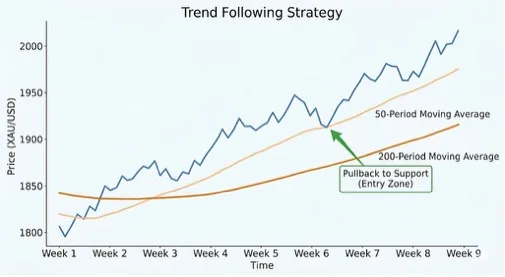
Chart 1: Example of a trend-following strategy. This image is for illustrative purposes only and does not constitute trading advice or a recommendation. The chart is hypothetical, not actual price data, and the same set-up can also lose money.
Trend followers go with the prevailing move, using tools such as moving averages or higher highs and higher lows to define it. The aim is to stay in while the trend holds and step aside when it breaks.
- Works with a clear directional trend rather than range-bound conditions
- Less effective in choppy, sideways markets where no clear trend is established
- Entries depend on signals rather than timing, so the approach requires patience
2. Breakout Strategy
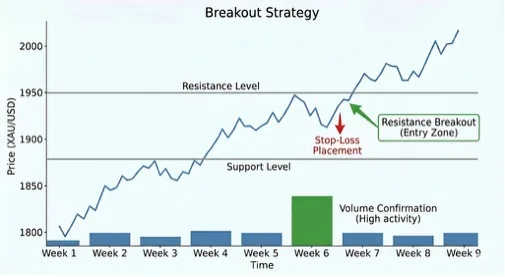
Chart 2: Example of a breakout strategy. This image is for illustrative purposes only and does not constitute trading advice or a recommendation. The chart is hypothetical, not actual price data, the price axis and activity bars are illustrative, and the same set-up can also lose money.
Breakout traders watch for gold to push decisively beyond a recent high, a recent low or a tight range, and open a position as it does. False breakouts, where price briefly exceeds a level before reversing, are common in gold, so waiting for a candle to close beyond the level can help filter some of them. Stop orders do not guarantee execution at the requested price during gaps or fast-moving conditions.
- Aims to catch directional moves at an early stage
- False breakouts are a known risk, so stop-loss discipline is important
- Can be applied to both intraday and swing timeframes
3. News Trading Strategy
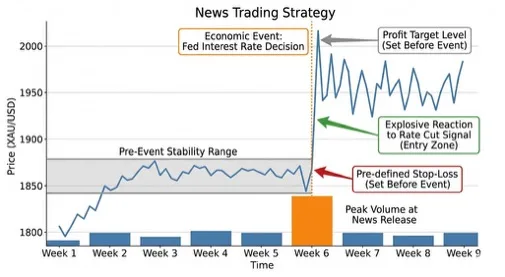
Chart 3: Example of a news trading strategy. This image is for illustrative purposes only and does not constitute trading advice or a recommendation. The chart is hypothetical, not actual price data, the price axis and activity bars are illustrative, and the same set-up can also lose money.
News trading involves taking positions in anticipation of, or in response to, events such as US inflation and jobs data, central bank decisions, and geopolitical developments. Spreads can widen and orders can fill away from the price you saw, so position size, costs, and a predefined exit plan are worth assessing before the event.
- Operates in fast-moving, high-volatility conditions
- Spreads may widen significantly around major news events, which affects entry and exit costs
- Pre-defined stop-loss and exit levels are set before the event triggers
4. Position Trading Strategy
Position traders hold for weeks or months and care more about big drivers such as the dollar, real yields, and central bank demand than about daily noise. A CFD held overnight can carry swap charges, so check the cost of holding before you commit to a longer view.
- Uses a longer time horizon and can involve sustained drawdowns
- Overnight swap costs accumulate over time and add to the cost of holding a position
- Involves fewer trades and less day-to-day monitoring
Related Article: XAU/USD Risk Management: Position Sizing, Margin, and Leverage Rules for Gold Traders
Worked Example: Lot Size and Margin
A worked example makes the risk concrete. It is illustrative only. It uses a round gold price of USD4,100 and a leverage of 1:100, a common illustrative ratio and the one Vantage uses in its own gold example 3. Actual leverage depends on the provider, account type, and jurisdiction. Spreads, commission, and swap are left out, and a real trade would include them.
| Item | Calculation | Result |
| Position size | 0.01 lot, about 1 troy ounce | 1 ounce |
| Notional value | 1 ounce x USD4,100 | USD4,100.00 |
| Margin at 1:100 | USD4,100 / 100 | USD41.00 |
| Stop-loss distance | A USD20 move against the position | USD20.00 loss before costs |
| Risk on a USD2,000 account | USD20 / USD2,000 | 1% |
Table 4: Illustrative margin and risk for a 0.01-lot XAU/USD position. Figures are examples, not a forecast or a recommendation.
The last row is the one to remember. Margin tells you how much of your account a position ties up. The stop-loss distance and the position size tell you how much you plan to risk before costs and gaps. Leverage lets a small deposit control a large position, so it magnifies losses as well as gains, and a stop-loss order may fill away from your price if the market gaps.
Why Gold Does Not Always Rise During a Crisis
Gold is widely viewed as a defensive asset, and it has earned some of that reputation. The World Gold Council counted 53 record highs on the LBMA PM gold price in 2025, with the average price up 44% on the year 5. Yet the spot gold bid was USD4,094.30 on 9 November 2026 1, well below the intraday record of about USD5,595 from 29 January 2. A geopolitical crisis does not automatically cause the US-dollar price of gold to rise.
Safe-haven demand may be offset by a stronger US dollar, rising real yields, liquidity-driven selling, or profit-taking after an earlier rally. Traders may also close gold positions to raise cash when other holdings are under pressure. A trader assessing a geopolitical event should examine how gold, the US dollar, bond yields, market liquidity, and positioning are moving together instead of treating the headline itself as a signal.
6 Tips for Applying XAU/USD Strategies
Understanding which market signals to watch can strengthen whichever strategy a trader chooses to use. The following tips focus on the key drivers of XAU/USD price and how they may be relevant when building a trading approach.
| Tip | What to Watch | Why It Matters for XAU/USD |
| Central Bank Buying | Quarterly World Gold Council data | Large-scale purchases add physical demand and can shift sentiment |
| US Dollar, Real Yields, and Geopolitics | US yields, the dollar index, major headlines | Gold often reacts to them, but the link is not automatic |
| Previous Highs and Lows | Historical support and resistance levels | XAU/USD tends to revisit prior levels; these may serve as reference points |
| Active London-New York Overlap | 06:00 to 10:00 or 07:00 to 11:00 Mexico City time* | Often more active, but spreads and execution can still vary |
| Symmetrical Triangle Pattern | Converging trendlines with equal slopes | May signal consolidation before a breakout |
| Industrial and Jewellery Demand | Consumer trends, electronics output data | Physical demand can influence price over the medium term |
Table 5: Six key signals to monitor when trading XAU/USD via CFDs, with their market relevance.
*Times are approximate. Daylight-saving changes, public holidays, and broker product hours can affect actual trading access and periods of higher activity.
1. Pay Attention to Central Bank Gold Purchases
Central banks hold gold as part of their foreign reserve strategies, and their buying can influence market sentiment around XAU/USD. The World Gold Council reports net purchases of 289 tonnes in the second quarter of 2026, after a first-quarter figure revised down to 57 tonnes, which the World Gold Council puts at 345 tonnes for the first half (the quarterly figures are rounded) 6. Quarterly figures get revised, so check the latest release instead of relying on an older number.
2. Compare Gold with the US Dollar and Real Yields
Gold is priced in dollars and pays no interest, so it often moves against the dollar and against real yields. When geopolitical risk increases, compare gold with the dollar and real yields rather than relying on the headline alone. A stronger dollar or higher real yields can offset safe-haven demand, while liquidity and positioning can also influence the immediate price response.
3. Use Previous Highs and Lows as Reference Points
Prices often pause or turn near levels where they turned before. Marking recent highs and lows gives you reference points for entries, stop-loss orders, and targets, and many traders set price alerts at support and resistance levels. A level is a guide, not a guarantee.
4. Consider Active Trading Periods and Liquidity
Activity tends to be heaviest when London and New York overlap 8, which is 06:00 to 10:00 or 07:00 to 11:00 in Mexico City depending on the season (Table 2). Greater activity can also bring faster reversals and slippage around US data releases, so check the live spread and the product specification before you open a position.
5. Use the Symmetrical Triangle Pattern for Breakout Confirmation
A symmetrical triangle forms when highs fall and lows rise, squeezing price into a narrowing range. A move out of the triangle can start a new trend, but false breaks are common, so many traders wait for a confirmed close beyond the line or a confirming indicator such as the Relative Strength Index (RSI).
6. Monitor Gold’s Industrial and Jewellery Demand
Gold is also used in jewellery and electronics. Changes in that demand usually act slowly, but they shape the longer-term picture that position traders care about. Comparing demand patterns with the gold price over time can show how gold has behaved across different market cycles.
Gold CFDs vs Physical Gold Coins
Physical gold, often as coins, is another way to own gold. A coin and a CFD give you very different exposure, so compare them before you decide which one fits your goal.
| Feature | Physical gold coins | Gold CFD |
| Ownership | You hold the metal | You hold a contract, not the metal |
| Price exposure | Moves with the gold price | Moves with the gold price, in either direction |
| Leverage | None | Yes, which magnifies gains and losses |
| Storage and security | You arrange it | Not needed |
| Costs | Dealer premium and spread | Spread, commission on some accounts, and swap |
| Typical use | Long-term holding | Short-term and medium-term trading |
Table 6: Coins and CFDs compared. Coin premiums vary by dealer and product, so check current quotes.
The value of a coin follows the gold price, and you cannot lose more than you paid for it. A leveraged CFD can lose money faster than the gold price alone suggests. Protections such as negative balance protection depend on the provider and account, so check what applies before you trade.
Learning More About Gold Trading
The strategies and tips in this article reflect common approaches traders use in the XAU/USD market. They are not recommendations on what to trade or when to trade. Each trader’s risk tolerance, time availability, and experience level are different, and no strategy removes the possibility of loss.
To keep learning, read the XAU/USD risk management guide, the guide to counting gold pips and how to trade gold and silver. This article is for educational purposes only and is not an offer or solicitation of any product or service to anyone in Mexico. This article does not imply that Vantage is licensed or authorised, or that its services are available, in any particular country. Anyone considering trading should use a provider that is authorised in their own jurisdiction and confirm hours, spreads, and leverage with that provider.
Frequently Asked Questions
What is XAU/USD in trading?
XAU/USD is the trading symbol for gold (XAU) priced against the US dollar (USD). It represents how much one troy ounce of gold is worth in US dollars at any given moment. In XAU/USD CFD trading, price movements are commonly measured in gold pips, which can help traders calculate potential movement, spread, and risk exposure.
What are the XAU/USD trading hours in Mexico City time?
Gold trades nearly 24 hours a day, five days a week 3. The busiest window, when London and New York overlap, is 06:00 to 10:00 (GMT-6) while the US is on daylight saving time and 07:00 to 11:00 (GMT-6) after the US clocks go back. Exact access depends on the broker’s product hours.
What is the best XAU/USD trading strategy?
There is no universally best strategy for trading XAU/USD. The most suitable approach depends on a trader’s time availability, risk tolerance, market knowledge, and goals. Trend-following trades in the direction of an established move, breakout trading tries to enter early in a new move, news trading reacts to scheduled events and fast price changes, and position trading takes a longer-term macro view. Each carries its own risks, and none removes the risk of loss. This is for educational purposes only and does not constitute financial advice.
Is XAU/USD a CFD?
XAU/USD can be traded through several instruments, including CFDs, futures contracts, ETFs, and physical gold. Some providers offer gold as a Contract for Difference (CFD), an agreement to exchange the difference in an asset’s price between the opening and closing of a trade. No physical gold changes hands.
What is a lot in XAU/USD trading?
A lot is the contract size. One standard lot of XAU/USD is 100 troy ounces, and the smallest size, 0.01 lot, is about one ounce on Vantage’s gold CFD page 3. The smaller the lot, the smaller the money value of each price move.
What factors affect gold prices?
Gold prices are influenced by a combination of macroeconomic and physical demand factors. Key drivers include US dollar strength (gold often moves inversely to the dollar), central bank interest rate decisions, inflation expectations, geopolitical risk, and central bank reserve buying. Physical demand from the jewellery industry and the technology sector also influences price over the medium term.
What is the difference between gold CFDs and physical gold?
With physical gold you own the metal and pay a dealer premium. A gold CFD is a leveraged contract with spread, possible commission, and swap costs, and no ownership.
How do I practise XAU/USD trading on a demo account?
Many providers offer demo accounts. Choose a provider authorised in your jurisdiction, select XAU/USD, and follow your written entry, stop-loss, and position-size rules over several sessions before you consider a live account. Past performance is not a reliable indicator of future results.
RISK WARNING: CFDs are complex financial instruments and carry a high risk of losing money rapidly due to leverage. You should ensure you fully understand the risks involved and carefully consider whether you can afford to take the high risk of losing your money before trading.
Disclaimer: The information is provided for educational purposes only and doesn’t take into account your personal objectives, financial circumstances, or needs. It does not constitute investment advice. We encourage you to seek independent advice if necessary. The information has not been prepared in accordance with legal requirements designed to promote the independence of investment research. No representation or warranty is given as to the accuracy or completeness of any information contained within. This material may contain historical or past performance figures and should not be relied on. Furthermore estimates, forward-looking statements, and forecasts cannot be guaranteed. The information on this site and the products and services offered are not intended for distribution to any person in any country or jurisdiction where such distribution or use would be contrary to local law or regulation.
Reference
- “Gold Price: Live Spot Gold Chart – Kitco” https://www.kitco.com/charts/gold Accessed on 9 November 2026 (bid USD4,094.30 at 03:58 ET)
- “Gold Nears $5,600 as Safe-Haven Rush Intensifies; Silver Blazes Past $120 – Kitco (Reuters)” https://www.kitco.com/news/off-the-wire/2026-01-29/gold-nears-5600-safe-haven-rush-intensifies-silver-blazes-past-120 Accessed on 9 November 2026
- “Gold Trading With CFDs – Vantage Markets” https://latam.vantagemarkets.com/commodities-trading/gold-trading/ Accessed on 9 November 2026
- “Gold’s Key Attributes: Liquidity – World Gold Council” https://www.gold.org/goldhub/research/relevance-of-gold-as-a-strategic-asset/key-attributes-liquidity Accessed on 26 October 2026
- “Gold Demand Trends: Q4 and Full Year 2025 – World Gold Council” https://www.gold.org/goldhub/research/gold-demand-trends/gold-demand-trends-full-year-2025 Accessed on 26 October 2026
- “Central Banks (Gold Demand Trends Q2 2026) – World Gold Council” https://www.gold.org/goldhub/research/gold-demand-trends/gold-demand-trends-q2-2026/central-banks Accessed on 26 October 2026
- “Time Zone in Mexico – Time and Date” https://www.timeanddate.com/time/zone/mexico Accessed on 26 October 2026
- “When Is the Best Time to Trade Gold? XAU/USD Hours & Sessions – Vantage” https://www.vantagemarkets.com/academy/best-time-to-trade-gold-xau-usd/ Accessed on 26 October 2026
- “Centenario (coin) – Wikipedia” https://en.wikipedia.org/wiki/Centenario_(coin) Accessed on 26 October 2026
Key Points In This Article

Latest Academy Articles


Market News Tags
- # Asian Market News Today
- # Crude Oil News Today
- # Earnings News Today
- # Economic News Today
- # Featured News
- # Federal Reserve News
- # Commodity Market News
- # Interest Rate News
- # Financial News
- # Forex News Today
- # Gold News Today
- # Market News Today
Related Articles
- Gold Trading Hours: When Does the Gold Market Open in Peru?
- Gold Trading Hours: When Does the Gold Market Open in Chile?
- Gold Trading Hours: When Does the Gold Market Open in Argentina?
- Gold Trading Hours: When Does the Gold Market Open in Mexico?
- 20 Chart Patterns: How They Form and How to Read Them
- What Is Trading Psychology? 5 Habits & 5 Pitfalls (Free PDF)
- What Moves Synthetic Indices? Unpacking Their Algorithmic Nature
- Best Copy Trading Apps and Platforms in Mexico: 8 Compared