Important Information
You are visiting the international Vantage Markets website, distinct from the website operated by Vantage Global Prime LLP
( www.vantagemarkets.co.uk ) which is regulated by the Financial Conduct Authority ("FCA").
This website is managed by Vantage Markets' international entities, and it's important to emphasise that they are not subject to regulation by the FCA in the UK. Therefore, you must understand that you will not have the FCA’s protection when investing through this website – for example:
- You will not be guaranteed Negative Balance Protection
- You will not be protected by FCA’s leverage restrictions
- You will not have the right to settle disputes via the Financial Ombudsman Service (FOS)
- You will not be protected by Financial Services Compensation Scheme (FSCS)
- Any monies deposited will not be afforded the protection required under the FCA Client Assets Sourcebook. The level of protection for your funds will be determined by the regulations of the relevant local regulator.
If you would like to proceed and visit this website, you acknowledge and confirm the following:
- 1.The website is owned by Vantage Markets' international entities and not by Vantage Global Prime LLP, which is regulated by the FCA.
- 2.Vantage Global Limited, or any of the Vantage Markets international entities, are neither based in the UK nor licensed by the FCA.
- 3.You are accessing the website at your own initiative and have not been solicited by Vantage Global Limited in any way.
- 4.Investing through this website does not grant you the protections provided by the FCA.
- 5.Should you choose to invest through this website or with any of the international Vantage Markets entities, you will be subject to the rules and regulations of the relevant international regulatory authorities, not the FCA.
Vantage wants to make it clear that we are duly licensed and authorised to offer the services and financial derivative products listed on our website. Individuals accessing this website and registering a trading account do so entirely of their own volition and without prior solicitation.
By confirming your decision to proceed with entering the website, you hereby affirm that this decision was solely initiated by you, and no solicitation has been made by any Vantage entity.
I confirm my intention to proceed and enter this website Please direct me to the website operated by Vantage Global Prime LLP regulated by the FCA in the United KingdomImportant Information
By providing your email and proceeding to create an account on this website, you acknowledge that you will be opening an account with Vantage Global Limited, regulated by the Vanuatu Financial Services Commission (VFSC), and not the UK Financial Conduct Authority (FCA).
-
Please enter a valid email address
-
Please tick the checkbox to proceed
-
Please tick the checkbox to proceed
Please tick all to proceed

Access Restricted
Your access to this website is restricted.
Our website and services are not available to, and are not intended for, individuals who are citizens or residents of the United States, or entities incorporated in or conducting business within the United States.
If this does not apply to you and you believe you have received this message in error, please contact us at support@vantagemarkets.com for further assistance.
If you fall into any of the above categories, please exit the site.
Important Information
Thank you for visiting the Vantage Markets website. Please note that this website is intended for individuals residing in jurisdictions where accessing it is permitted by Vantage and its affiliated entities do not operate in your home jurisdiction.
By clicking 'I CONFIRM MY INTENTION TO PROCEED AND ENTER THIS WEBSITE', you confirm that you are entering this website solely based on your initiative and not as a result of any specific marketing outreach. You wish to obtain information from this website based on reverse solicitation principles, in accordance with the applicable laws of your home jurisdiction.
I CONFIRM MY INTENTION TO PROCEED AND ENTER THIS WEBSITE
-

-


Download App
-


-

-

-
Search query too short. Please enter a full word or phrase.
-

Keywords
Popular Search








Language

 Market Analysis Currencies British Pound Came Under Pressure as Fed Hike Bets Built – GBPUSD Analysis
Currency Trading NewsFederal Reserve NewsForexForex NewsForex News TodayGBPUSD NewsInterest Rate NewsTechnical Analysis
British Pound Came Under Pressure as Fed Hike Bets Built – GBPUSD Analysis

Vantage Editorial Team >
19 November 2026 | Currencies | 17 min read
Vantage Editorial Team >
Vantage is a global, multi-asset broker with a team of experienced in-house writers, analysts, and market professionals. Together, they craft trusted, educational, and market-driven content tailored for traders at every stage—from beginner to pro.

Key Takeaways
- GBP/USD fell 2.15% between 10 and 17 November, from 1.3459 to 1.3169, its lowest level since 14 October.1
- The slide began after US consumer prices rose 0.40% in October against a 0.30% consensus, which lifted bets on a December Federal Reserve rate hike.2
- As of 09:48 (GMT+8) on 18 November 2026, GBP/USD traded at 1.32033 on the Vantage feed, back on its hourly 50-period moving average.
The pound to dollar rate stood at 1.32033 at 09:48 (GMT+8) on 18 November 2026, roughly five hours before the Office for National Statistics (ONS) publishes October inflation figures.3 Twelve hours after that, the US Federal Reserve (Fed) releases the minutes of its October meeting.4 Two top-tier releases inside one Asian trading day: the calendar is showing off a little.
Cable got here the hard way. GBP/USD fell 2.15% from 1.3459 on 10 November to 1.3169 on 17 November, the pair’s lowest level since 14 October.1 If you hold pound sterling exposure through today, two releases this close together raise the odds of fast moves and price gaps.
Here is the puzzle we set out to crack. The Bank of England (BoE) is raising rates, yet the British pound kept sliding. This is not a GBPUSD forecast; it is a walk through why the pound is falling, what the chart says about momentum, and what today’s UK print could change about the rate picture.
Quick Answer: Why Is the Pound Falling?
GBP/USD fell 2.15% between 10 and 17 November as hot US inflation lifted bets on a December Fed hike. The euro fell harder, which points to dollar strength rather than pound-specific weakness. UK inflation data at 15:00 (GMT+8) on 18 November is the next test.
As of 09:48 (GMT+8) on 18 November 2026, the GBPUSD price on the Vantage feed was 1.32033, little changed on the hour; the 52-week range on daily closes is 1.3077 to 1.3795.5
For this GBPUSD analysis today, we used a GBPUSD TradingView setup on the Vantage feed; the GBPUSD chart below shows hourly candles, 50 and 200-period moving averages, and a 14-period RSI.
Hot US Inflation Started the Slide
The selling started with an American data release, not a British one. US consumer prices rose 0.40% in October against a 0.30% consensus, and core prices rose 0.30% against 0.20%, extending a run of stronger-than-expected inflation data.2
GBP/USD dropped from above 1.3420 to 1.3320 after the 21:30 (GMT+8) release on 10 November, while two-year Treasury yields rose 12 basis points.2
Markets took the hint quickly. Christopher Hodge, an economist at Natixis, said a 50-basis-point December hike was “most certainly a live possibility”.2 Pound Sterling Live reported that money markets now treated a December hike as close to certain, with about a 13% chance attached to the larger move.2
The Fed had held at 3.75% to 4.00% on 28 October, with two members voting for an immediate hike.6 US shoppers then added to the case, lifting the retail sales control group that feeds into gross domestic product (GDP) by 0.60% in October.1
Deutsche Bank’s US economists now expect three more quarter-point hikes, in December, January, and March.1 We track each turn of that story on our Federal Reserve News page.
That explains why the dollar found buyers. It does not explain why a BoE that had just raised rates gave sterling so little cover.
Why Is the Pound Falling if the Bank of England Is Hiking?
The BoE raised Bank Rate to 4.00% from 3.75% on 5 November in an 8-1 vote, its first increase since 2023.7 The Bank’s projections show inflation reaching about 5% by mid-2027, with energy costs doing much of the lifting.8
Both central banks are tightening, and that is the whole point. A currency pair prices the gap in pace between two central banks, much as a race is decided by the distance between runners rather than by whether both are moving. Our explainer on how central banks affect forex covers the mechanism in more depth.
Since 10 November, the Fed has been the faster runner in the GBP vs USD race. Karl Schamotta, Chief Market Strategist at Corpay, noted that investors were upgrading expectations for back-to-back Fed hikes in December and January.1
UK pricing was less settled: money markets carried around 20 basis points of BoE tightening for 17 December before Tuesday’s jobs data. 9 That report was mixed, with payrolled employees down 34,000 in October and unemployment down to 4.60%.10 Regular pay growth slowed to 3.50% from 3.70%.9
Table 1: GBP / USD Policy Snapshot, Fed vs BoE
| Measure | Federal Reserve (USD) | Bank of England (GBP) |
|---|---|---|
| Policy Rate | 3.75% to 4.00% 6 | 4.00% 7 |
| Last Decision | Held on 28 October; two votes for a hike 6 | Raised 25 basis points on 5 November; 8-1 vote 7 |
| Latest Inflation Signal | October CPI rose 0.40% against 0.30% expected 2 | October CPI due 18 November; 3.60% expected 9 |
| Market Pricing for December | Hike treated as close to certain 2 | Around 20 basis points priced before the jobs data 9 |
| Next Decision | 9 December (10 December, 03:00 GMT+8) 4 | 17 December 9 |
Table 1 sources: Federal Reserve, Trading Economics, and Pound Sterling Live, accessed on 18 November 2026. Indicative only.
So is sterling broken? We checked the obvious suspect first, and the cross rates do not back it. The euro’s losses against the dollar were heavier, with EUR/USD falling to a 52-week low of 1.0968 while the pound climbed back above 1.20 against the euro.1
The pound slid 2.15% against the dollar in six sessions while the euro fell to a 52-week low against the same dollar.
A sterling-specific selloff would usually show up against the euro too, though UK factors such as the soft payroll count still matter. Our USD News page follows the dollar side. The macro story points at the dollar; the chart adds a detail the headlines left out.
Momentum Stopped Confirming the Lows
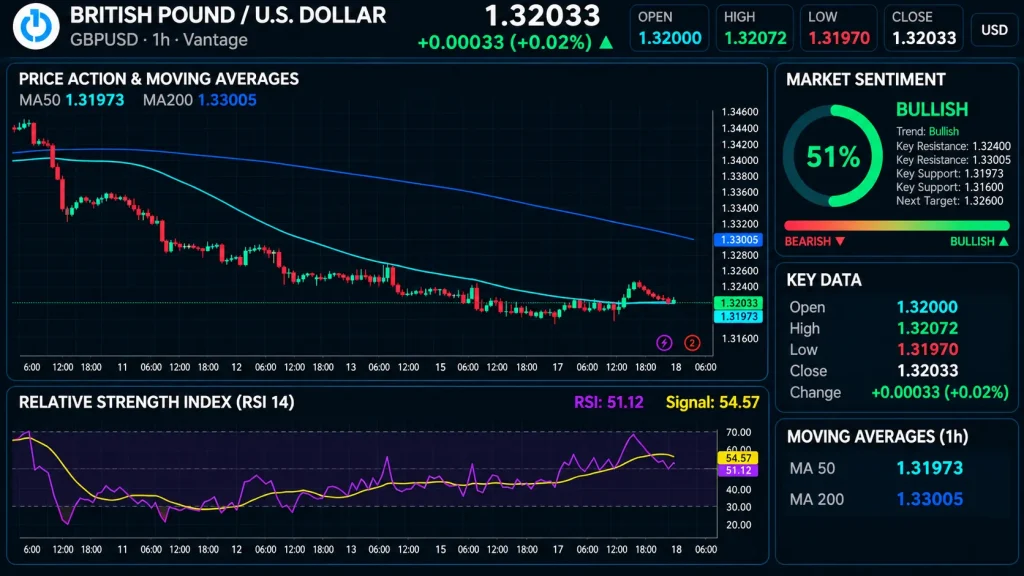
On the hourly chart, each leg lower carried less momentum than the one before. The 14-period Relative Strength Index (RSI) fell below 20 after the US inflation release on 10 November and sat in the low 20s on 12 November, according to the TradingView setup used for this analysis.
When the pair printed its low near 1.3170 early in the Asian session on 17 November, the same RSI read close to 40. RSI works a little like a speedometer for the selling: price kept reaching lower, but the needle dropped less each time.
That divergence describes slower downside momentum on this timeframe; it does not say the selling has ended. We would rather flag that limit than oversell a squiggle.
Price has also climbed back to its hourly 50-period moving average, which capped most rallies after 10 November. At the cut-off, GBP/USD sat 6 pips above that line at 1.31973 and 97 pips below the hourly 200-period moving average at 1.33005.
The 50-period average stayed below the 200-period average throughout, usually read as a short-term downtrend on that timeframe. RSI read 51.12 at the cut-off, just under its 54.57 signal line, after peaking in the mid-60s during a brief rise to about 1.3227 on 17 November.
Table 2: GBPUSD Levels Traders Are Watching as of 09:48 (GMT+8), 18 November 2026
| Level | Price | What It Marks |
|---|---|---|
| Level 2 Resistance | 1.33005 | Hourly 200-period moving average |
| Level 1 Resistance | 1.3227 | 17 November hourly high (approximate) |
| Reference | 1.31973 | Hourly 50-period moving average |
| Level 1 Support | 1.3169 | 17 November low, lowest since 14 October 1 |
| Level 2 Support | 1.3137 | Next support flagged by Pound Sterling Live 1 |
| Level 3 Support | 1.3077 | 52-week low on daily closes 5 |
Table 2 sources: Vantage GBPUSD feed via TradingView, Pound Sterling Live, and Macrotrends, as of 09:48 (GMT+8), 18 November 2026. Reference levels, not trade signals. Indicative only.
Levels map where the pair has traded; this month, the data calendar decided which got tested.
GBP USD Forecast Inputs: UK Inflation and Fed Minutes
Economists polled ahead of the release expect the UK consumer price index (CPI) to show headline inflation rising to 3.60% in October from 3.50%, with services inflation seen at 3.80% from 3.70%.9 The BoE’s own forecast is 3.73%, which Pound Sterling Live framed as the line between a December hike staying in play and a wait until February.9
Bank economists are split around that line. Goldman Sachs expects 3.70%, in line with the BoE, while Deutsche Bank sits higher at 3.80%.9 Sanjay Raja, Chief UK Economist at Deutsche Bank, kept his view short: “Looking ahead, more inflation is coming.” 9
Any British pound forecast, pound dollar forecast, or GBP to USD forecast written this week has to account for both prints, and neither had been published at the cut-off. Every decision from both central banks lands on our Interest Rate News page.
What to Watch
- UK CPI, 18 November, 15:00 (GMT+8): October headline and services inflation against the BoE’s 3.73% forecast; services is the gauge CIBC flagged for the December decision.9
- Federal Open Market Committee (FOMC) Minutes, 19 November, 03:00 (GMT+8): The record of the 28 October hold and the two dissents in favour of a hike.4
- Fed Decision, 10 December, 03:00 (GMT+8): The meeting money markets have priced for a hike since the US inflation release.4
- BoE Decision, 17 December, 20:00 (GMT+8): The first chance for a second UK hike in as many meetings.9
What would change the read: a services print at or below September’s 3.70% would weaken the case for a December BoE hike, on Pound Sterling Live’s analysis, while a headline figure at or above the Bank’s forecast would keep it alive.9 On the US side, Corpay’s Schamotta said the dollar “now looks technically overextended against the euro, pound, Canadian dollar, and yen”.1
For Asia-based desks, the UK data lands mid-afternoon and the Fed minutes arrive at 03:00, an hour few people schedule for reading. Those are the dates; the questions traders keep asking about the pair are simpler.
GBP/USD Questions Traders Are Asking
GBP to USD Today: What Is the Rate?
As of 09:48 (GMT+8) on 18 November 2026, one British pound bought about 1.3203 US dollars on the Vantage feed, so 1,000 pounds to dollars came to roughly USD1,320. Whether you search UK pound to USD, GBP to dollar, or pounds to USD, the rate sat about 1.90% below the 1.3459 level of 10 November.
Quotes move constantly, so this snapshot started ageing the moment we wrote it. Our GBPUSD News page collects every GBPUSD news and GBP USD news update, along with wider pound sterling news.
Is GBP USD Going Up Today?
We do not call direction, but the record is clear enough. As of 09:48 (GMT+8), the pair was little changed on the hour at 1.32033, after a rise to about 1.3227 on 17 November faded within hours. The next scheduled tests are UK inflation at 15:00 and the Fed minutes at 03:00 (GMT+8).
How Does UK Inflation Data Affect GBP v USD?
A stronger-than-expected print tends to lift bets on BoE hikes, which markets usually read as supportive for sterling; a softer one tends to do the opposite. This month, though, the dollar has done most of the moving.
Managing GBP/USD Trading Risk Through Data Releases
GBP/USD reached 18 November sitting on its 50-hour average, after a slide the cross rates tie mainly to the dollar and the hourly RSI shows losing momentum. Whether those readings hold depends on two releases 12 hours apart.
Scheduled releases can move GBP/USD sharply in a short time; the US inflation data on 10 November coincided with a drop of about 100 pips on the day.2 A Stop Loss can limit losses to a planned size, but around fast releases prices can gap through stop levels, so the fill may be worse than the level set. Holding positions through 15:00 on 18 November and 03:00 on 19 November (GMT+8) carries that gap risk in both directions.
Whether the horizon is a single session of GBP/USD trading or longer-term GBP USD investing, leverage magnifies both gains and losses. At a leverage ratio of 1:100, a 1.00% move in GBP/USD equals the full margin posted on a position, and the pair moved 2.15% in six sessions this month.1 Position size measured as a share of account equity, rather than by available margin, determines how much of the account a single release can affect.
Related Reading
- GBPUSD News
- CPI News
RISK WARNING: CFDs are complex financial instruments and carry a high risk of losing money rapidly due to leverage. You should ensure you fully understand the risks involved and carefully consider whether you can afford to take the high risk of losing your money before trading.
Disclaimer: The information is provided for educational purposes only and doesn’t take into account your personal objectives, financial circumstances, or needs. It does not constitute investment advice. We encourage you to seek independent advice if necessary. The information has not been prepared in accordance with legal requirements designed to promote the independence of investment research. No representation or warranty is given as to the accuracy or completeness of any information contained within. This material may contain historical or past performance figures and should not be relied on. Furthermore estimates, forward-looking statements, and forecasts cannot be guaranteed. The information on this site and the products and services offered are not intended for distribution to any person in any country or jurisdiction where such distribution or use would be contrary to local law or regulation.
References
[1] “Pound-to-Dollar Rate Kept Under Pressure by Resilient U.S. Spending – Pound Sterling Live” https://www.poundsterlinglive.com/usd/23887-pound-to-dollar-rate-us-retail-sales-fed-hikes Accessed on 18 November 2026.
[2] “GBP/USD Under Pressure as Hot U.S. Inflation Puts Bumper Fed Hike in Play – Pound Sterling Live” https://www.poundsterlinglive.com/usd/23864-pound-to-dollar-rate-us-cpi-hot-fed-december-hike Accessed on 18 November 2026.
[3] “Consumer Price Inflation, UK: October 2026 – Office for National Statistics” https://www.ons.gov.uk/releases/consumerpriceinflationukoctober2026 Accessed on 18 November 2026.
[4] “United States Fed Funds Interest Rate – Trading Economics” https://tradingeconomics.com/united-states/interest-rate Accessed on 18 November 2026.
[5] “Pound Dollar Exchange Rate – GBP USD (1971-2026) – Macrotrends” https://www.macrotrends.net/2549/pound-dollar-exchange-rate-historical-chart Accessed on 18 November 2026.
[6] “Federal Reserve Issues FOMC Statement – Board of Governors of the Federal Reserve System” https://www.federalreserve.gov/newsevents/pressreleases/monetary20261028a.htm Accessed on 18 November 2026.
[7] “BoE Raises Rates for 1st Time Since 2023 – Trading Economics” https://tradingeconomics.com/united-kingdom/interest-rate/news/598618 Accessed on 18 November 2026.
[8] “Interest Rates and Bank Rate: Our Latest Decision – Bank of England” https://www.bankofengland.co.uk/monetary-policy/the-interest-rate-bank-rate Accessed on 18 November 2026.
[9] “Bank of England Hike Now Rests on Inflation Hitting 3.7% – Pound Sterling Live” https://www.poundsterlinglive.com/economics/23886-bank-of-england-december-rate-hike-october-inflation-preview Accessed on 18 November 2026.
[10] “ONS Labour Market November 2026: UK Unemployment Rate Falls to 4.6% – FE News” https://www.fenews.co.uk/fe-voices/ons-labour-market-november-2026-uk-unemployment-rate-falls-to-4-6/ Accessed on 18 November 2026.
Key Points In This Article

Latest Financial Market Analysis


Market Analysis Tags
- # USD News
- # USDCAD News
- # USDJPY News
- # USDX News
- # Forex News
- # Forex News Today
- # GBPUSD News
- # EURUSD News
- # Currency Trading News
- # AUDUSD news
Related Articles
- Shekel Lost Ground to the Greenback as Israel’s Inflation Hit a Five-Year Low – USDILS Analysis
- Silver Sank Near a One-Year Low as Fed Hike Bets Built – XAGUSD Analysis
- Gold Slipped as Fed Hike Bets Firmed – XAUUSD Analysis
- Why the Nasdaq 100 Fell as Chip Curbs Hit Before Nvidia Earnings – NAS100 Analysis
- Canadian Dollar Hit a 19-Month Low as Bank of Canada Hike Bets Faded – USDCAD Analysis
- Sandisk Stock Price Falls 8.58% as Memory Slide Deepens Before Nvidia Earnings and the Stock Split
- Brent Crude Fell Faster Than WTI as Gulf Exports Recovered – UKOUSD and USOUSD Analysis
- Euro Fell to an 18-Month Low as Fed Hike Bets Built – EURUSD Analysis