Important Information
You are visiting the international Vantage Markets website, distinct from the website operated by Vantage Global Prime LLP
( www.vantagemarkets.co.uk ) which is regulated by the Financial Conduct Authority ("FCA").
This website is managed by Vantage Markets' international entities, and it's important to emphasise that they are not subject to regulation by the FCA in the UK. Therefore, you must understand that you will not have the FCA’s protection when investing through this website – for example:
- You will not be guaranteed Negative Balance Protection
- You will not be protected by FCA’s leverage restrictions
- You will not have the right to settle disputes via the Financial Ombudsman Service (FOS)
- You will not be protected by Financial Services Compensation Scheme (FSCS)
- Any monies deposited will not be afforded the protection required under the FCA Client Assets Sourcebook. The level of protection for your funds will be determined by the regulations of the relevant local regulator.
If you would like to proceed and visit this website, you acknowledge and confirm the following:
- 1.The website is owned by Vantage Markets' international entities and not by Vantage Global Prime LLP, which is regulated by the FCA.
- 2.Vantage Global Limited, or any of the Vantage Markets international entities, are neither based in the UK nor licensed by the FCA.
- 3.You are accessing the website at your own initiative and have not been solicited by Vantage Global Limited in any way.
- 4.Investing through this website does not grant you the protections provided by the FCA.
- 5.Should you choose to invest through this website or with any of the international Vantage Markets entities, you will be subject to the rules and regulations of the relevant international regulatory authorities, not the FCA.
Vantage wants to make it clear that we are duly licensed and authorised to offer the services and financial derivative products listed on our website. Individuals accessing this website and registering a trading account do so entirely of their own volition and without prior solicitation.
By confirming your decision to proceed with entering the website, you hereby affirm that this decision was solely initiated by you, and no solicitation has been made by any Vantage entity.
I confirm my intention to proceed and enter this website Please direct me to the website operated by Vantage Global Prime LLP regulated by the FCA in the United KingdomImportant Information
By providing your email and proceeding to create an account on this website, you acknowledge that you will be opening an account with Vantage Global Limited, regulated by the Vanuatu Financial Services Commission (VFSC), and not the UK Financial Conduct Authority (FCA).
-
Please enter a valid email address
-
Please tick the checkbox to proceed
-
Please tick the checkbox to proceed
Please tick all to proceed

Access Restricted
Your access to this website is restricted.
Our website and services are not available to, and are not intended for, individuals who are citizens or residents of the United States, or entities incorporated in or conducting business within the United States.
If this does not apply to you and you believe you have received this message in error, please contact us at support@vantagemarkets.com for further assistance.
If you fall into any of the above categories, please exit the site.
Important Information
Thank you for visiting the Vantage Markets website. Please note that this website is intended for individuals residing in jurisdictions where accessing it is permitted by Vantage and its affiliated entities do not operate in your home jurisdiction.
By clicking 'I CONFIRM MY INTENTION TO PROCEED AND ENTER THIS WEBSITE', you confirm that you are entering this website solely based on your initiative and not as a result of any specific marketing outreach. You wish to obtain information from this website based on reverse solicitation principles, in accordance with the applicable laws of your home jurisdiction.
I CONFIRM MY INTENTION TO PROCEED AND ENTER THIS WEBSITE
-

-


Download App
-


-

-

-
Search query too short. Please enter a full word or phrase.
-

Keywords
Popular Search








Language


Sector rotation in Forex: A guide for South African CFD traders

Vantage Editorial Team >
2 October 2026 | Academy | 18 min read
Vantage Editorial Team >
Vantage is a global, multi-asset broker with a team of experienced in-house writers, analysts, and market professionals. Together, they craft trusted, educational, and market-driven content tailored for traders at every stage—from beginner to pro.
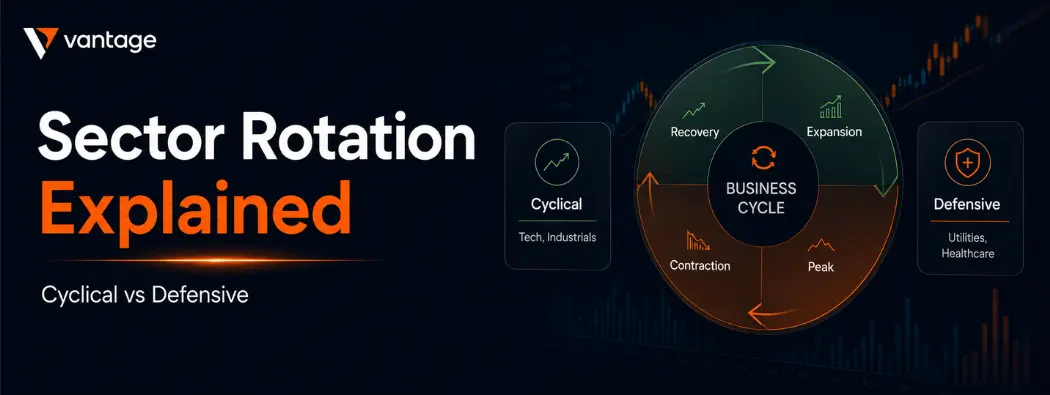
Many traders encounter the term sector rotation and wonder what it actually means.
At its core, sector rotation describes how capital tends to move between different parts of the market as economic conditions change. Certain sectors often attract attention during periods of growth, while others tend to become more prominent during slower or more uncertain periods.
Sector rotation is the tendency for money to move between market sectors as the business cycle changes. Cyclical sectors often lead during economic recoveries and expansions, while defensive sectors tend to attract attention during slower-growth phases. These are tendencies, not predictions.
This guide explains the business-cycle model behind sector rotation, how traders attempt to identify leadership changes, and how the same ideas can be applied to forex markets. The discussion is framed for South African CFD traders, with examples that connect sector rotation to currencies such as the rand.
What Is Sector Rotation?
Sector rotation is the process of capital moving between different parts of the market as the economy moves through its cycle.
The key idea is that market leadership changes over time. Sectors that perform strongly during one phase of the economy may lose momentum in another, while previously weaker sectors begin to attract more attention.
Importantly, sector rotation is usually a relative game.
The concept does not suggest that money leaves the market altogether. Instead, capital often shifts from one group of companies to another as investors and traders adjust their expectations for growth, inflation, interest rates, and business conditions.
For example, sectors closely tied to economic growth may attract greater interest during a recovery. Later in the cycle, investors may focus more on sectors viewed as stable during slower-growth periods.
This is why traders often study sector leadership rather than looking only at the broader market index.
Understanding sector rotation helps explain why different industries can move in different directions at the same time. It provides a framework for observing how capital flows through the market as economic conditions evolve.
The Business Cycle and the Sectors That Lead Each Phase
Sector rotation is closely linked to the business cycle. As economic conditions change, leadership often shifts from one sector to another.
The classic model uses four broad phases. The examples below describe commonly discussed historical tendencies and should not be interpreted as fixed rules or predictions of future market behaviour.
The framework is often credited to US strategist Sam Stovall, and the cycle phases draw on NBER definitions built from American market history.
| Business Cycle Phase | Sectors Often Associated With Leadership |
| Recovery (Early Cycle) | Financials, Consumer Discretionary, Industrials, Technology |
| Expansion (Mid Cycle) | Technology, Industrials, Communication Services |
| Peak (Late Cycle) | Energy, Materials, Consumer Staples |
| Contraction | Utilities, Consumer Staples, Healthcare |
During the recovery phase, economic activity begins to improve after a slowdown. Sectors linked to growth and consumer spending often attract attention first.
In the expansion phase, growth becomes more established. Technology, industrial, and communication-related businesses often benefit from stronger business activity and investment.
As the economy approaches a peak, inflation pressures can rise, and growth may begin to slow. Energy and materials companies can become more prominent, while defensive sectors start attracting interest.
During contraction, investors often focus on sectors linked to everyday needs and essential services. Healthcare, utilities, and consumer staples are common examples.
This leads to one of the most useful distinctions in sector rotation:
| Cyclical Sectors | Defensive Sectors |
| Technology | Utilities |
| Industrials | Healthcare |
| Consumer Discretionary | Consumer Staples |
| Financials | Essential Services |
Cyclical sectors tend to be more sensitive to economic growth. Defensive sectors are often viewed as more resilient when growth weakens.
The important point is that these relationships describe tendencies, not rules. Real-world market cycles rarely follow a perfect script.

Sector rotation on the JSE
Most sector rotation content is written through a US lens, but the JSE is structured differently.
The JSE groups All Share Index constituents into three broad SA sectors: Resources, Financials and Industrials, each with its own index. Resources carry a heavy weighting locally, so mining shares tied to gold, platinum and other commodities can dominate index movements.
Rotation between these groups is visible in ordinary conditions. In early 2026, for example, gold miners fell as metal prices retreated, while banks, retailers and telecoms gained. Moves like these describe past behaviour, not a pattern that must repeat.
Rand movements add another layer. A weaker rand can support miners that earn in dollars while raising costs for importers, which links local rotation directly to the currency themes below.
How to Spot a Sector Rotation
Sector rotation can never be observed with complete certainty in real time, but traders often look for clues that leadership is changing.
One of the most common signals is relative strength. If one sector consistently outperforms the broader market while another begins to lag, it may indicate that capital is rotating between them.
Traders also monitor money flow. Strong inflows into one sector, combined with weakening interest in another, can suggest that market participants are repositioning for a different stage of the cycle.
Another useful clue is a shift in market leadership and breadth. When a small group of sectors stops driving market performance and new sectors begin taking over, rotation may be underway.
Economic data can provide additional context. Changes in growth expectations, inflation trends, interest rates, and employment data often influence which sectors attract attention.
A simple checklist includes:
- Compare sector performance over time.
- Watch for changes in market leadership.
- Monitor money-flow trends.
- Follow major economic indicators.
- Assess whether market breadth is improving or narrowing.
The most practical tool is a relative strength ratio. Divide a sector index by the broader market index and chart the result. A rising line indicates outperformance, and a falling line indicates the sector is lagging. South African traders can compare the SA Resources, Financials or Industrials indices against the All Share Index. SARB decisions and Stats SA releases provide context for why leadership may be changing.
Does Sector Rotation Apply to Forex?
Forex has no sectors in the traditional stock-market sense, but the same business-cycle logic often applies to currencies.
The first framework is risk-on versus risk-off behaviour. During periods of stronger growth and higher risk appetite, currencies such as the Australian dollar (AUD), New Zealand dollar (NZD), Canadian dollar (CAD), and South African Rand (ZAR) often attract more attention. During periods of uncertainty, traders may favour currencies such as the US dollar (USD), Japanese yen (JPY), and Swiss franc (CHF).
The second framework is the carry and interest-rate cycle. Capital often seeks higher yields when investors are comfortable taking risks. As interest-rate expectations change, currency leadership can shift, resembling sector rotation in equities.
The third framework is the commodity cycle. Commodity-linked currencies, including the rand, can be influenced by changes in resource demand and global growth expectations.
For South African traders, the rand provides a useful example because it can reflect all three forces at once: risk sentiment, interest-rate expectations, and commodity trends.
It is important to remember that these relationships are not fixed. Politics, central banks, trade flows, and unexpected events influence currency markets. The same patterns that appear during one market cycle may behave differently during another.
Sector rotation does not translate directly to forex, but the underlying idea of shifting leadership can still provide a useful framework for understanding currency markets.
How Sector-Rotation Concepts May Appear Across Different Markets
Sector-rotation concepts may appear across different market types, including stocks, indices, and currencies.
Product availability, trading conditions, leverage, costs, and market access may vary between brokers and instruments. Traders should review the relevant Product Disclosure Statement, Terms and Conditions, and contract specifications before trading.
Similar relationships may sometimes be observed across stocks, indices, and currencies as market conditions change. These concepts are often discussed as a framework for understanding shifts in market leadership. However, historical relationships may not persist, and additional factors — including politics, central bank policy, trade flows, and broader economic conditions — can influence outcomes.
That does not make sector rotation easy to trade.
Short-selling carries risk, and market leadership can change unexpectedly. A sector that appears to be strengthening can quickly lose momentum if economic conditions change or new information emerges.
For that reason, a demo account can be a useful environment for observing how sectors, indices, and currencies behave under different market conditions before applying these concepts in practice.
The goal is not to predict every rotation correctly. It is to build a framework for understanding how capital moves and how those movements may appear across different markets.
Sector Rotation Strategies — and Their Limits
Most sector-rotation approaches fall into two broad categories.
The first is the business-cycle approach. Traders attempt to identify where the economy stands in the cycle and then focus on sectors that have historically led during that phase.
The second is the relative-strength approach. Instead of analysing the economy directly, traders compare sector performance and look for areas showing stronger momentum than the broader market. Both methods have strengths, but neither is foolproof.
Economic data is often released with a delay and can be revised later. By the time a change in the cycle becomes apparent, markets may already have adjusted.
Relative-strength signals can also be difficult to interpret. Strong performance does not always continue, and leadership can change quickly after major news events.
There are practical challenges as well. Frequent repositioning can increase trading costs, and unusual market environments can break relationships that worked well in previous cycles.
This is why sector rotation is best viewed as a framework rather than a formula.
It can help traders organise information and understand shifts in market leadership, but it cannot reliably identify every turning point or predict future market behaviour.
The Risks and What Sector Rotation Can’t Do
Sector rotation can be a useful way to think about markets, but it has important limitations.
The biggest misconception is that it can predict the next winning sector. In reality, sector rotation describes tendencies that have appeared across different market cycles. It does not forecast future market leadership with certainty.
The research record supports this caution. A frequently cited 2009 Massey University study of US returns from 1948 to 2007 found that rotating sectors across business cycles was unlikely to be an optimal approach.
Several US sector rotation ETFs have also underperformed the S&P 500 in recent years, despite systematic rules and professional management. Timing rotations well enough to beat a simple index is difficult, even for professionals. It is also important to recognise that sector rotation does not make trading safer.
If a trader misreads the cycle, follows a false signal, or enters a position too early or too late, losses can still occur. In some cases, a mistimed rotation can increase risk rather than reduce it. Market relationships can change as well. Economic shocks, policy decisions, and unexpected events may cause sectors to behave differently from historical patterns.
For that reason, sector rotation should be viewed as an analytical framework, not a prediction tool or a guarantee of results. Understanding the cycle can improve market awareness, but it cannot remove uncertainty from trading.
Conclusion
Sector rotation is a way of understanding how capital tends to move through the business cycle.
As economic conditions change, leadership often shifts between cyclical and defensive sectors. The same logic can also provide useful context for currencies, including the rand, through changes in risk sentiment, interest-rate expectations, and commodity trends.
The key point is that sector rotation is a framework, not a crystal ball.
It can help traders understand shifts in market leadership and organise market information, but it cannot predict the next rotation or guarantee trading outcomes.
For South African CFD traders, the concept can be applied across stocks, indices, and forex markets without owning the underlying assets.
Before applying sector-rotation ideas to trading decisions, take time to understand the concept, its limitations, and how it fits within a broader market framework.
Frequently Asked Questions
What is sector rotation?
Sector rotation is the movement of capital between market sectors as economic conditions change. Different sectors tend to lead during different phases of the business cycle.
How do you spot a sector rotation?
Traders often look for changes in relative strength, money flow, market leadership, breadth, and key economic indicators such as growth, inflation, and interest rates.
What is market-cycle sector rotation?
It is the idea that sector leadership changes as the economy moves through recovery, expansion, peak, and contraction phases.
Does sector rotation work?
It can provide a useful framework for understanding market behaviour, but it does not reliably predict future market movements or sector leadership.
Does sector rotation apply to forex?
Yes, in a different way. Traders often apply similar cycle logic through risk-on and risk-off currencies, interest-rate trends, and commodity-linked currencies.
Can I trade sector rotation with CFDs?
CFDs can provide exposure to stocks, indices, and currencies, with price movements influenced by changing market conditions. They also allow short positions, which carry additional risk.
What is the next sector rotation?
No one can know with certainty. Rather than predicting the next rotation, traders typically monitor economic conditions, leadership trends, and money flows.
What are sector ETFs and sector funds?
These are investment products that focus on specific sectors. They are separate from CFDs and are covered in the ETF section of the Academy.
Is sector rotation the same as market timing?
Not exactly. Sector rotation focuses on shifts in leadership between sectors, while market timing attempts to predict broader market moves.
Does sector rotation reduce risk?
No. Mistimed sector-rotation decisions can increase risk and lead to losses.
Risk Warning: CFDs are complex financial instruments and carry a high risk of rapid loss of money due to leverage. You should ensure you fully understand the risks involved and carefully consider whether you can afford to take the high risk of losing your money before trading.
Disclaimer: The information is provided for educational purposes only and doesn’t take into account your personal objectives, financial circumstances, or needs. It does not constitute investment advice. We encourage you to seek independent advice if necessary. No representation or warranty is given as to the accuracy or completeness of any information contained within.
This material may contain historical or past-performance figures and should not be relied upon. Furthermore, estimates, forward-looking statements, and forecasts cannot be guaranteed. The information on this site and the products and services offered are not intended for distribution to any person in any country or jurisdiction where such distribution or use would be contrary to local law or regulation.
Key Points In This Article

Latest Academy Articles


Market News Tags
- # Asian Market News Today
- # Crude Oil News Today
- # Earnings News Today
- # Economic News Today
- # Featured News
- # Federal Reserve News
- # Commodity Market News
- # Interest Rate News
- # Financial News
- # Forex News Today
- # Gold News Today
- # Market News Today
Related Articles
- What Are the Largest Stock Exchanges in the World?
- Candlestick Patterns: A Complete Guide to 16 Formations
- What Does Bullish and Bearish Mean? Definitions, Technical Indicators, and Market Examples
- What Is Slippage in Trading? Causes, Types, and How to Reduce It
- What Is the Ascending Triangle Pattern and How Do You Trade It?
- How to Read Stock Charts: Beginner’s 7-Step Checklist
- Google Stock (Alphabet/GOOGL): Price, 2026 Outlook & Forecast
- Forex Trading Signals Explained: How They Work and Risks