Important Information
You are visiting the international Vantage Markets website, distinct from the website operated by Vantage Global Prime LLP
( www.vantagemarkets.co.uk ) which is regulated by the Financial Conduct Authority ("FCA").
This website is managed by Vantage Markets' international entities, and it's important to emphasise that they are not subject to regulation by the FCA in the UK. Therefore, you must understand that you will not have the FCA’s protection when investing through this website – for example:
- You will not be guaranteed Negative Balance Protection
- You will not be protected by FCA’s leverage restrictions
- You will not have the right to settle disputes via the Financial Ombudsman Service (FOS)
- You will not be protected by Financial Services Compensation Scheme (FSCS)
- Any monies deposited will not be afforded the protection required under the FCA Client Assets Sourcebook. The level of protection for your funds will be determined by the regulations of the relevant local regulator.
If you would like to proceed and visit this website, you acknowledge and confirm the following:
- 1.The website is owned by Vantage Markets' international entities and not by Vantage Global Prime LLP, which is regulated by the FCA.
- 2.Vantage Global Limited, or any of the Vantage Markets international entities, are neither based in the UK nor licensed by the FCA.
- 3.You are accessing the website at your own initiative and have not been solicited by Vantage Global Limited in any way.
- 4.Investing through this website does not grant you the protections provided by the FCA.
- 5.Should you choose to invest through this website or with any of the international Vantage Markets entities, you will be subject to the rules and regulations of the relevant international regulatory authorities, not the FCA.
Vantage wants to make it clear that we are duly licensed and authorised to offer the services and financial derivative products listed on our website. Individuals accessing this website and registering a trading account do so entirely of their own volition and without prior solicitation.
By confirming your decision to proceed with entering the website, you hereby affirm that this decision was solely initiated by you, and no solicitation has been made by any Vantage entity.
I confirm my intention to proceed and enter this website Please direct me to the website operated by Vantage Global Prime LLP regulated by the FCA in the United KingdomImportant Information
By providing your email and proceeding to create an account on this website, you acknowledge that you will be opening an account with Vantage Global Limited, regulated by the Vanuatu Financial Services Commission (VFSC), and not the UK Financial Conduct Authority (FCA).
-
Please enter a valid email address
-
Please tick the checkbox to proceed
-
Please tick the checkbox to proceed
Please tick all to proceed

Access Restricted
Your access to this website is restricted.
Our website and services are not available to, and are not intended for, individuals who are citizens or residents of the United States, or entities incorporated in or conducting business within the United States.
If this does not apply to you and you believe you have received this message in error, please contact us at support@vantagemarkets.com for further assistance.
If you fall into any of the above categories, please exit the site.
Important Information
Thank you for visiting the Vantage Markets website. Please note that this website is intended for individuals residing in jurisdictions where accessing it is permitted by Vantage and its affiliated entities do not operate in your home jurisdiction.
By clicking 'I CONFIRM MY INTENTION TO PROCEED AND ENTER THIS WEBSITE', you confirm that you are entering this website solely based on your initiative and not as a result of any specific marketing outreach. You wish to obtain information from this website based on reverse solicitation principles, in accordance with the applicable laws of your home jurisdiction.
I CONFIRM MY INTENTION TO PROCEED AND ENTER THIS WEBSITE
-

-


Download App
-


-

-

-
Search query too short. Please enter a full word or phrase.
-

Keywords
Popular Search








Language


What Is ICT Trading? Meaning, Core Concepts, and Risks

Vantage Editorial Team >
2 October 2026 | Academy | 23 min read
Vantage Editorial Team >
Vantage is a global, multi-asset broker with a team of experienced in-house writers, analysts, and market professionals. Together, they craft trusted, educational, and market-driven content tailored for traders at every stage—from beginner to pro.

Trading charts can look orderly after the move has happened, yet far less certain while each candle is forming. For the uninitiated, ICT trading is a framework that gives traders a vocabulary for studying that uncertainty through market structure, liquidity, price imbalances, and time of day.
ICT stands for Inner Circle Trader, which refers to the online educator, Michael J. Huddleston, and to the body of chart-analysis ideas he developed and popularised. Some traders use those ideas to form a market hypothesis, but take note that the framework does not reveal future prices or remove the possibility of loss.
This guide explains what ICT means in trading, how its concepts connect, and how a beginner can study them without treating chart labels as guarantees. It also separates ICT terminology from standard market definitions and considers the practical effects of spreads, slippage, leverage, and subjective judgement.
Key Points
- ICT stands for Inner Circle Trader and describes a price-action framework associated with Michael J. Huddleston.
- The framework combines market structure, perceived liquidity areas, displacement, fair value gaps, order blocks, and session timing.
- ICT concepts involve judgement, so two traders can label the same chart differently and reach different conclusions.
- Historical testing, demo practice, defined risk limits, and a trading journal can help traders evaluate a rules-based interpretation before considering live CFD trading.
What Is ICT Trading?
ICT trading is a style of technical analysis that interprets price movements through a specific set of concepts rather than relying mainly on indicator signals.
Followers often study:
- Where orders may cluster
- How swing highs and lows change
- Whether price moves forcefully away from an area
- When activity occurs during major trading sessions
Keep scrolling to find out why the ICT methodology was created and why it remains highly popular till this day.
What Does ICT Stand For in Trading?
The full form of ICT in trading is Inner Circle Trader—not what some might mistaken as “information and communications technology” in this context. On his official website1, Huddleston identifies himself by that name and presents a library of price-action teaching materials.
Who Developed the ICT Methodology?
As mentioned earlier, Michael J. Huddleston developed and popularised the named ICT methodology through online lessons and mentorship material. Many related terms also appear in broader price-action communities, so a chart labelled as an ICT setup may combine Huddleston’s terminology with interpretations added by other educators.
That distinction matters when comparing resources. A course, book, or PDF may use familiar labels while changing the definition, adding entry conditions, or omitting risk controls. Traders should verify which rules come from the original material and which are the author’s own adaptation.
Is ICT a Strategy or a Broader Framework?
ICT is better understood as a framework than as one fixed strategy.
A fair value gap (FVG), order block (OB), or liquidity sweep is an observation within that framework; none is a complete trading plan by itself. A testable strategy still needs a defined market, timeframe, setup, trigger, invalidation point, position-size rule, exit method, and conditions for standing aside. This can be done with a demo trading account, like Vantage’s Demo Account.
This classification would also explain why searches for an ICT trading strategy can produce conflicting rules. Different traders select different concepts and combine them into their own models. The label alone does not establish how a position will be opened, managed, or closed.
How Does ICT Trading Work?
An ICT-style analysis normally moves from context to location and then to confirmation. The trader forms a directional view, marks areas where the framework expects orders to sit, and observes whether price behaviour supports or invalidates that view.
The process should remain a hypothesis—not a claim that a particular move would definitely occur.
Establishing a Market Bias
Market bias is the trader’s provisional view of direction.
It may be based on higher-timeframe swing structure, previous day or week ranges, nearby highs and lows, and scheduled events. A bullish bias does not mean every candle should rise; it simply frames the conditions the trader wants to see before considering a long setup.
Bias can become a source of confirmation bias when a trader keeps relabelling the chart to protect an earlier opinion. Writing down what would invalidate the view in a trading journal before a setup appears can make the decision more testable.
Mapping Liquidity
In standard market terminology, liquidity describes how readily an asset can be traded without materially changing its price. ICT uses the word more narrowly when it refers to expected clusters of stop and entry orders around obvious chart levels, such as equal highs, equal lows, or previous swing points.
Buy-side liquidity is an ICT label for orders expected above a reference high, while sell-side liquidity refers to orders expected below a reference low. Take note that these are inferred areas, as a normal price chart does not show every participant’s order or motive.
Waiting for Displacement and Confirmation
After price moves through a marked level, an ICT trader may wait for displacement—a decisive directional move—and a change in local structure. Huddleston’s official 2022 Mentorship material on internal range liquidity and market structure shifts2 presents those ideas as linked parts of the framework.
The confirmation rule must be defined precisely. A “strong move” is difficult to test unless the trader specifies what counts, such as:
- A close beyond a particular swing
- A minimum candle range
- Another repeatable condition
Remember, greater precision does not guarantee a reliable signal, but it can reduce inconsistent labelling.
Adding Time and Session Context
ICT analysis often gives extra attention to recurring periods around London and New York trading activity, commonly called “kill zones”. These windows are intended to narrow when a trader observes the market rather than predict that a setup will appear throughout the day so they don’t have to be constantly glued to their desks.
Depending on your country of residence, session times must be converted carefully because daylight-saving changes and platform time zones can shift chart labels. Economic releases can also produce rapid movements, wider spreads, and slippage, so the presence of a preferred time window should never replace risk controls.
A Hypothetical ICT Trading Workflow
Note: The example below is educational only, does not represent client performance, and is not a recommendation to open a position. Its purpose is to show how a trader could translate ICT vocabulary into conditions that can later be tested.
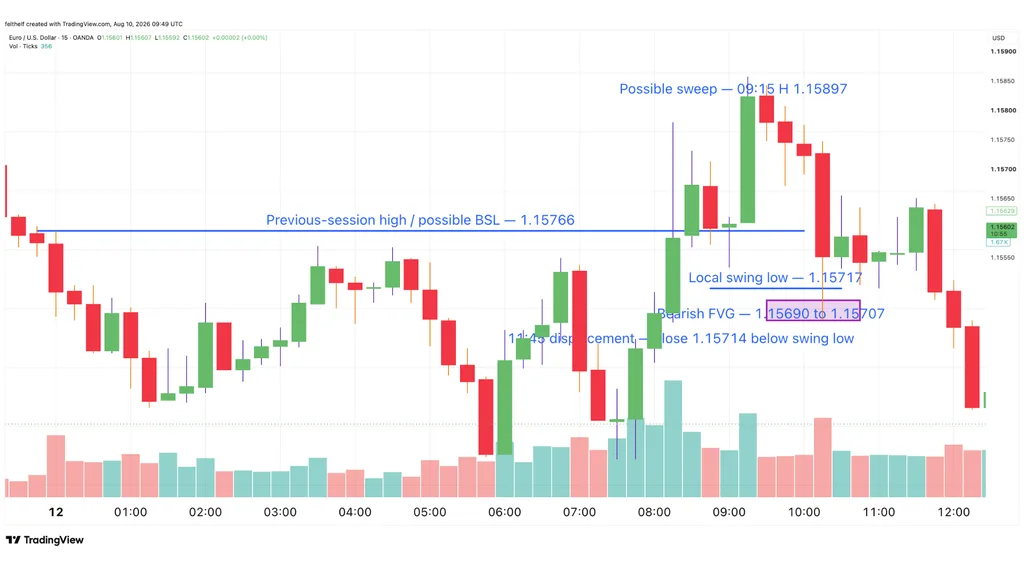
Consider a hypothetical EUR/USD chart.
- Define the Context: The trader records a provisional bearish higher-timeframe bias and marks the previous session high. The note also states what would cancel that bias.
- Mark the Observation Area: The previous high is labelled as a possible buy-side liquidity area under ICT terminology. No position is opened merely because price approaches it.
- Observe the Response: Price trades above the previous high and then closes back below it. The trader records this as a possible sweep, not as proof of deliberate stop hunting.
- Apply a Confirmation Rule: A later candle closes below a preselected local swing low with a range that meets the trader’s written displacement criterion.
- Identify an Area of Interest: The move leaves a three-candle fair value gap under the trader’s definition. The trader records how the zone is measured and how long it remains valid.
- Define Risk Before Any Hypothetical Entry: The plan includes an invalidation level, a maximum permitted loss, expected spread, possible slippage, and a rule for scheduled news.
- Record the Outcome: Whether the example succeeds or fails, the same definitions are applied to the next observation so the sample is not filtered in hindsight.
While a stop-loss can define a planned exit level, it cannot guarantee execution at that exact price during gaps or rapid market moves. The spread and other trading costs can also change the result, particularly when a setup uses a narrow price target.
What Are the 8 Core ICT Trading Concepts I Should Know?
The following concepts form part of the ICT price-action methodology developed by Michael J. Huddleston. They should be treated as analytical frameworks rather than proof of institutional activity or reliable forecasts. As their interpretation can vary between traders, each concept requires clearly defined rules and appropriate risk management.
1. Liquidity Sweep
ICT traders typically monitor visible swing highs and lows because these levels may coincide with clustered stop or breakout orders.
When price moves beyond one of these levels and then returns, the move may be described as a liquidity sweep. However, a price chart does not necessarily reveal every order or explain why the level was breached. The same initial move could develop into a sustained breakout, so a sweep should not be treated as a standalone reversal signal.

Source: https://www.tradingview.com/chart/Q1Ig5UVh/?symbol=OANDA%3AEURUSD&interval=15
2. Market Structure Shift
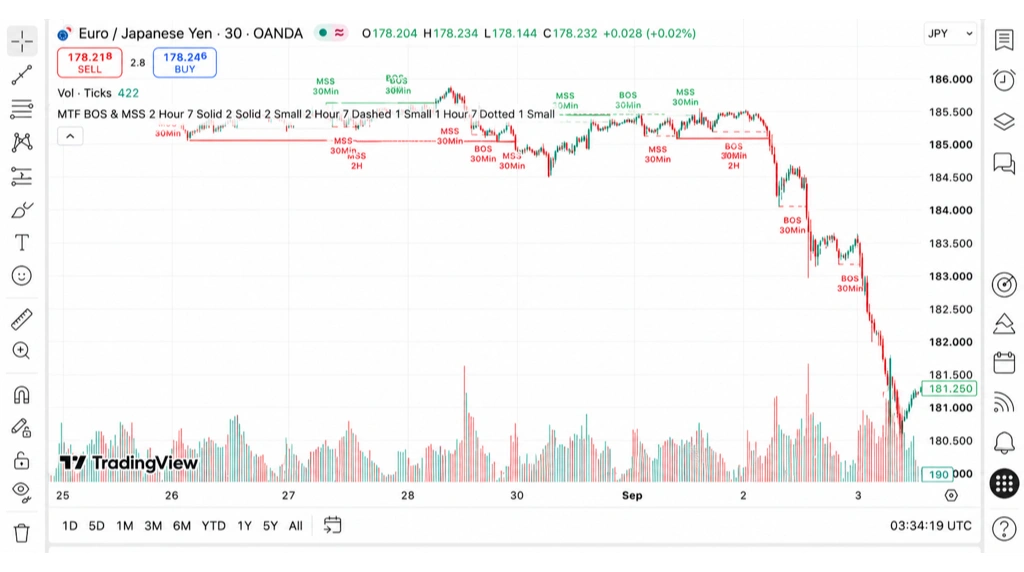
A market structure shift occurs when price breaks a selected swing point in the direction opposite to the preceding short-term move.
For example, a break below a recent higher low may be interpreted as a bearish shift after an advance. Its significance depends on the swings and timeframe selected: A bearish shift on a five-minute chart may be a mere retracement within a higher-timeframe uptrend.
Source: https://www.tradingview.com/chart/Q1Ig5UVh/?symbol=OANDA%3AEURJPY&interval=30
3. Displacement
Displacement describes a pronounced directional price expansion, often represented by one or more comparatively large candles with strong closes.
ICT traders may use it as evidence that short-term market behaviour has changed, particularly when it breaks a selected structural level. Bear in mind that descriptions such as ‘strong’ or ‘decisive’ are generally subjective unless the trader defines measurable criteria, such as candle-body size relative to recent candles.
Related Article: Candlestick Patterns: A Complete Guide to 16 Formations
4. Fair Value Gap (FVG)
An ICT fair value gap is a three-candle pattern:
- In a bullish formation, the first candle’s high is below the third candle’s low.
- In a bearish formation, the first candle’s low is above the third candle’s high.
Traders may monitor the non-overlapping price area if price later retraces. It’s not a literal absence of trading—the middle candle passed through the area—and the pattern does not guarantee that price will return to or react from it.
Related Article: What Does Bullish and Bearish Mean? Definitions, Technical Indicators, and Market Examples
5. Order Block (OB)
An order block is a candle or price zone selected before a displacement move. A commonly used example is the final bearish candle before bullish displacement, or the final bullish candle before bearish displacement.
ICT traders may monitor the zone during a later retracement, but the selection criteria vary and a candlestick pattern cannot confirm that institutional orders were placed there. Many marked order blocks are subsequently breached.
6. Breaker Block
A breaker block is an order-block zone that price has invalidated by trading or closing through it, depending on the trader’s rules. The former zone may then be monitored from the opposite side. For instance, a breached bearish order block may be treated as a potential bullish breaker.
This “role reversal” is an analytical interpretation rather than a guarantee that the area will become a reliable support or resistance zone.
7. Optimal Trade Entry
Optimal Trade Entry, or OTE, is an ICT retracement framework commonly mapped between the 62% and 79% Fibonacci levels of a selected price swing, with 70.5% often used as a reference level.
Traders look for specific price levels to enter this area while other conditions support their directional view. Take note that the levels have no predictive certainty, and the resulting zone depends on which swing high and low are chosen as anchors.
Related Article: Fibonacci Retracement in Trading: A Comprehensive Guide
8. Kill Zone
A kill zone is a recurring time window during which an ICT trader looks for other elements of a setup to align, often around active periods of the London or New York trading sessions.
The exact window depends on the market and ICT model being applied, so any published times should specify the relevant time zone and account for daylight-saving changes. A kill zone is a timing filter, not an entry signal, and activity can vary from one trading day to another.
What Are the Potential Advantages and Limitations of ICT Trading?
The usefulness of ICT trading depends less on memorising terms and more on whether those terms lead to a disciplined, testable process. Its potential advantages and limitations should therefore be considered together.
4 Potential Advantages of ICT Trading
- A shared ICT trading vocabulary can help traders describe chart observations and review them consistently.
- The context-location-confirmation sequence can discourage entries based on one isolated candle pattern.
- Session windows may reduce the amount of time spent monitoring charts, provided the trader accepts that no setup may appear.
- The ICT trading framework encourages attention to invalidation, opposing liquidity areas, and the relationship between higher and lower timeframes.
5 Important Limitations and Risks of ICT Trading
- Swing points, order blocks, fair value gaps, and displacement can be labelled differently by different traders.
- A visually convincing historical example may be selected because the outcome is already known, creating hindsight and selection bias.
- Claims about institutional intent are generally interpretations of price action, not direct evidence of why every market participant traded.
- A strategy can appear favourable before spreads, commissions, overnight funding (aka swap fees), and slippage are included.
- Past observations do not guarantee future results, and market behaviour can change across volatility regimes and sessions.
When ICT concepts are used for CFD trading, leverage can magnify potential gains and potential losses relative to the cash committed. An analytical framework cannot correct excessive position size, impulsive rule changes, or inadequate loss capacity. CFDs are high-risk products, and regulatory protections and leverage restrictions vary depending on the applicable entity and jurisdiction.
How Can Beginners Study ICT Trading? 5 Tips to Get Started
If you’re a beginner, you’d be relieved to hear that you don’t need to learn every ICT term at once. A narrower study plan actually makes it easier to see whether the definitions can be consistently applied and whether the resulting model remains workable after costs and losing outcomes are included.
1. Start With One Defined Model
Choose one market, one session, and a small set of conditions.
For example, a study model might require a preselected liquidity area, a defined structure shift, and one fair value gap rule. Write down every term in measurable language, including when the setup expires and when no trade should be considered.
2. Test Historical Examples Without Looking Ahead
Review a sufficiently broad sample across trending, ranging, volatile, and quieter conditions. TradingView states that its Replay Trading mode5 supports trading on historical data and can include initial capital, currency, commission settings, and session performance information.
Vantage Markets’ guide on how to backtest on TradingView also explains manual Bar Replay and automated Pine Script approaches. Discretionary ICT labels may be difficult to automate, but even a manual test should use fixed definitions, record every qualifying example, and include trading costs.
3. Practise in a Demo Environment
A Vantage Demo Account allows traders to practise chart analysis, order placement, and position monitoring with virtual funds. However, take note that demo conditions cannot fully reproduce live execution, liquidity, slippage, or the emotional pressure of real losses, so favourable demo results should not be treated as proof of future outcomes.
4. Keep a Trading Journal
For each example, record the market, date, session, higher-timeframe context, marked liquidity, confirmation rule, invalidation level, estimated costs, result, and whether the written rules were followed. Screenshots taken before and after the outcome can help reveal whether labels drift over time.

5. Evaluate ICT PDFs, Books, Courses, and Mentorships
Resources such as a polished ICT trading strategy PDF might be helpful for some beginners but they should not be perceived as evidence that their materials are wholly accurate or legitimate.
Check whether the resource identifies its source material, defines every condition, includes losing examples, explains costs and risk, and avoids guaranteed-return language. Confirm that any downloaded material is authorised and does not reproduce copyrighted content without permission.
The Commodity Futures Trading Commission’s forex advisory6 warns that many forex frauds begin through social media and highlights unrealistic or guaranteed-return claims as warning signs. Traders should also check the provider’s regulatory status and understand who controls the trading platform before depositing funds.
What to Remember About ICT Trading
ICT trading offers a structured vocabulary for studying price action, but it should not be thought of as a shortcut around uncertainty. Liquidity sweeps, order blocks, fair value gaps, and session windows become useful only when they are defined before the outcome, combined into a complete plan, and tested without excluding unfavourable examples.
Traders can practise the same rules through a Vantage Demo Account before deciding whether the framework fits their experience and risk controls to take on live markets.
FAQs About ICT Trading
The following answers address common questions about ICT meaning, strategy, and learning resources.
What Does ICT Stand For in Trading?
ICT stands for Inner Circle Trader. It’s the name used by Michael J. Huddleston and the common shorthand for the chart-analysis methodology associated with his educational material.
Who Created ICT Trading?
Michael J. Huddleston developed and popularised ICT methodology. Other educators have since adapted its concepts, so their definitions and setup rules may differ from the original material.
Is ICT Trading the Same as Smart Money Concepts?
They overlap, but the labels are not identical. ICT refers to a named body of material associated with Huddleston, while Smart Money Concepts is a broader online category that can include liquidity, structure, order blocks, supply and demand, and other price-action ideas.
Can Beginners Use ICT Trading?
Beginners can study ICT concepts, but the vocabulary and discretionary chart labelling can create a steep learning curve. Starting with one defined setup, testing it on historical data, practising in a demo environment, and keeping a journal can make the learning process more disciplined.
Does ICT Trading Guarantee Returns?
No. ICT trading cannot guarantee returns or remove losses. A pattern that appeared on historical charts may fail in future conditions, and live results can be affected by spread, slippage, leverage, funding costs, execution, and the trader’s application of the rules.
What Should an ICT Trading Strategy PDF or Course Include?
A useful resource should define the market and timeframe, setup conditions, confirmation rule, invalidation point, exit method, risk controls, trading costs, and circumstances for standing aside. It should include both favourable and unfavourable examples and avoid fixed-outcome or guaranteed-return claims.
RISK WARNING: CFDs are complex financial instruments and carry a high risk of losing money rapidly due to leverage. You should ensure you fully understand the risks involved and carefully consider whether you can afford to take the high risk of losing your money before trading.
Disclaimer: The information is provided for educational purposes only and doesn’t take into account your personal objectives, financial circumstances, or needs. It does not constitute investment advice. We encourage you to seek independent advice if necessary. The information has not been prepared in accordance with legal requirements designed to promote the independence of investment research. No representation or warranty is given as to the accuracy or completeness of any information contained within. This material may contain historical or past performance figures and should not be relied on. Furthermore estimates, forward-looking statements, and forecasts cannot be guaranteed. The information on this site and the products and services offered are not intended for distribution to any person in any country or jurisdiction where such distribution or use would be contrary to local law or regulation.
References
- “The Inner Circle Trader – Home Page.” The Inner Circle Trader. https://theinnercircletrader.com/. Accessed 5 August 2026.
- “2022 ICT Mentorship Episode 3.” The Inner Circle Trader, YouTube. 25 January 2022. https://www.youtube.com/watch?v=nQfHZ2DEJ8c. Accessed 5 August 2026.
- “2022 ICT Mentorship Episode 6.” The Inner Circle Trader, YouTube. 3 February 2022. https://www.youtube.com/watch?v=Bkt8B3kLATQ. Accessed 5 August 2026.
- “OTE Primer – Intro to ICT Optimal Trade Entry.” The Inner Circle Trader, YouTube. 29 September 2017. https://www.youtube.com/watch?v=Cg0-CFJOJvg. Accessed 5 August 2026.
- “Learn to Trade on Historical Data.” TradingView. https://www.tradingview.com/support/solutions/43000691889-learn-to-trade-on-historical-data/. Accessed 5 August 2026.
- “Eight Things You Should Know Before Trading Forex.” Commodity Futures Trading Commission. https://www.cftc.gov/LearnAndProtect/AdvisoriesAndArticles/CustomerAdvisory_MustKnowForex.html. Accessed 5 August 2026.
Key Points In This Article

Latest Academy Articles


Market News Tags
- # Asian Market News Today
- # Crude Oil News Today
- # Earnings News Today
- # Economic News Today
- # Featured News
- # Federal Reserve News
- # Commodity Market News
- # Interest Rate News
- # Financial News
- # Forex News Today
- # Gold News Today
- # Market News Today
Related Articles
- What Is the Ascending Triangle Pattern and How Do You Trade It?
- Head and Shoulders Pattern: A Trading Guide
- Doji Candlestick Pattern: Meaning, Types, and How to Read It
- Shooting Star Candlestick Pattern: Meaning and How to Identify It
- Inverted Hammer Candlestick Pattern: Meaning and Examples
- Fibonacci Retracement in Trading: A Comprehensive Guide