Important Information
You are visiting the international Vantage Markets website, distinct from the website operated by Vantage Global Prime LLP
( www.vantagemarkets.co.uk ) which is regulated by the Financial Conduct Authority ("FCA").
This website is managed by Vantage Markets' international entities, and it's important to emphasise that they are not subject to regulation by the FCA in the UK. Therefore, you must understand that you will not have the FCA’s protection when investing through this website – for example:
- You will not be guaranteed Negative Balance Protection
- You will not be protected by FCA’s leverage restrictions
- You will not have the right to settle disputes via the Financial Ombudsman Service (FOS)
- You will not be protected by Financial Services Compensation Scheme (FSCS)
- Any monies deposited will not be afforded the protection required under the FCA Client Assets Sourcebook. The level of protection for your funds will be determined by the regulations of the relevant local regulator.
If you would like to proceed and visit this website, you acknowledge and confirm the following:
- 1.The website is owned by Vantage Markets' international entities and not by Vantage Global Prime LLP, which is regulated by the FCA.
- 2.Vantage Global Limited, or any of the Vantage Markets international entities, are neither based in the UK nor licensed by the FCA.
- 3.You are accessing the website at your own initiative and have not been solicited by Vantage Global Limited in any way.
- 4.Investing through this website does not grant you the protections provided by the FCA.
- 5.Should you choose to invest through this website or with any of the international Vantage Markets entities, you will be subject to the rules and regulations of the relevant international regulatory authorities, not the FCA.
Vantage wants to make it clear that we are duly licensed and authorised to offer the services and financial derivative products listed on our website. Individuals accessing this website and registering a trading account do so entirely of their own volition and without prior solicitation.
By confirming your decision to proceed with entering the website, you hereby affirm that this decision was solely initiated by you, and no solicitation has been made by any Vantage entity.
I confirm my intention to proceed and enter this website Please direct me to the website operated by Vantage Global Prime LLP regulated by the FCA in the United KingdomImportant Information
By providing your email and proceeding to create an account on this website, you acknowledge that you will be opening an account with Vantage Global Limited, regulated by the Vanuatu Financial Services Commission (VFSC), and not the UK Financial Conduct Authority (FCA).
-
Please enter a valid email address
-
Please tick the checkbox to proceed
-
Please tick the checkbox to proceed
Please tick all to proceed

Access Restricted
Your access to this website is restricted.
Our website and services are not available to, and are not intended for, individuals who are citizens or residents of the United States, or entities incorporated in or conducting business within the United States.
If this does not apply to you and you believe you have received this message in error, please contact us at support@vantagemarkets.com for further assistance.
If you fall into any of the above categories, please exit the site.
Important Information
Thank you for visiting the Vantage Markets website. Please note that this website is intended for individuals residing in jurisdictions where accessing it is permitted by Vantage and its affiliated entities do not operate in your home jurisdiction.
By clicking 'I CONFIRM MY INTENTION TO PROCEED AND ENTER THIS WEBSITE', you confirm that you are entering this website solely based on your initiative and not as a result of any specific marketing outreach. You wish to obtain information from this website based on reverse solicitation principles, in accordance with the applicable laws of your home jurisdiction.
I CONFIRM MY INTENTION TO PROCEED AND ENTER THIS WEBSITE
-

-


Download App
-


-

-

-
Search query too short. Please enter a full word or phrase.
-

Keywords
Popular Search








Language


CFD vs Futures: Key Differences Explained

Vantage Editorial Team >
28 September 2026 | Academy | 12 min read
Vantage Editorial Team >
Vantage is a global, multi-asset broker with a team of experienced in-house writers, analysts, and market professionals. Together, they craft trusted, educational, and market-driven content tailored for traders at every stage—from beginner to pro.

Trying to compare CFDs and futures? Both let you gain exposure to price movements without buying the underlying asset outright, but they work in different ways. This guide explains the main differences in plain language, including structure, pricing, flexibility, costs, and what traders may want to consider before choosing between them.
Key Takeaways
- CFDs and futures are both derivatives, but they differ in how they are structured and traded.
- CFDs are usually offered through brokers and often provide more flexible position sizing.
- Futures are standardised contracts traded on exchanges, which can make pricing and contract terms more uniform.
- Costs are not always charged in the same way, so the lower-cost option can depend on the market, product, and holding period.
What Are CFDs?
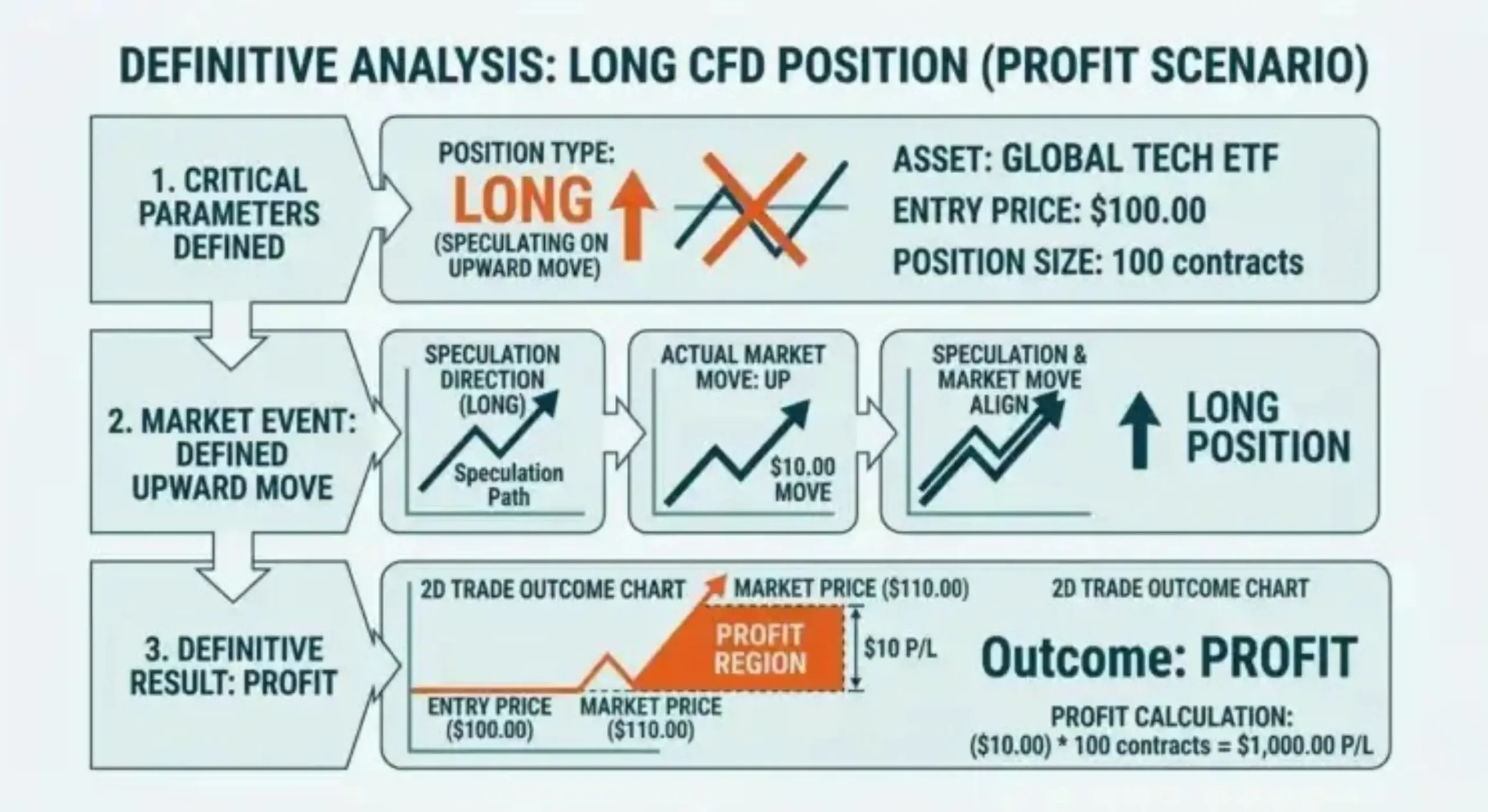
A Contract for Difference, or CFD, is a derivative contract between a trader and a provider. Instead of buying the underlying asset itself, the trader gains exposure to the price movement of that asset. If the market moves in the chosen direction, the position may generate a profit. If it moves the other way, the position may generate a loss.
In practice, CFDs are commonly used to speculate on products such as forex, indices, shares, commodities, and sometimes cryptocurrencies. One of their best-known features is flexibility. Many CFD products allow traders to adjust position size more precisely than standardised exchange contracts, which can make them easier to compare for smaller accounts.
CFDs are complex and high risk, and use leverage, which can magnify both gains and losses.
What Are Futures?
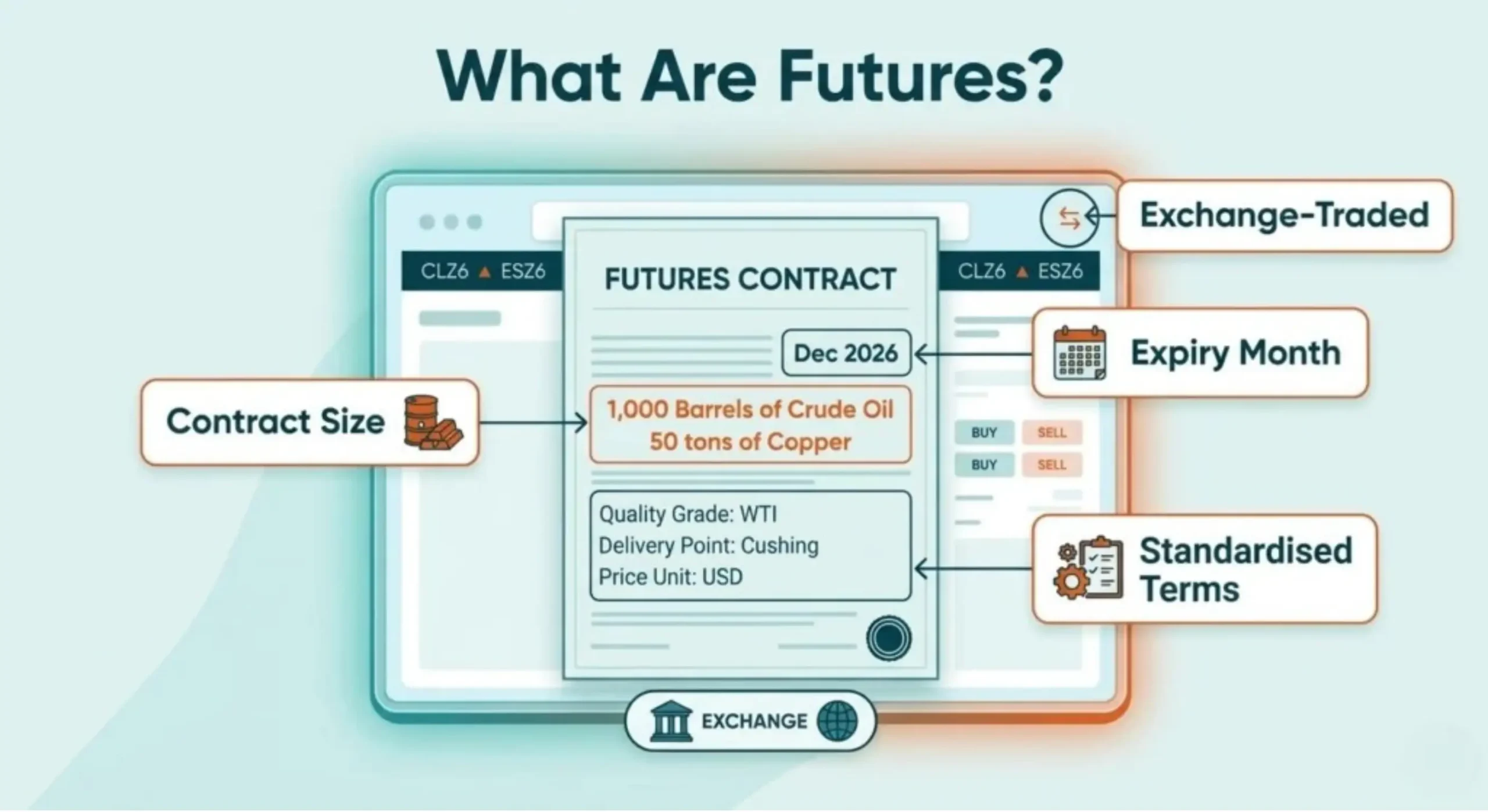
A futures contract is a standardised agreement to buy or sell an underlying asset at a future date on terms set by the contract. Unlike CFDs, futures are traded on exchanges rather than being structured as over-the-counter broker products.
This exchange-based structure is one of the main reasons futures are often described as more standardised. Contract size, expiry date, and settlement terms are defined in advance.
Futures are used for different purposes, including speculation and hedging. Depending on the market, they may cover instruments such as equity indices, interest rates, energy products, or other commodities.
Key Differences Between CFDs and Futures

Market Structure
One of the clearest differences is how the two products are traded. CFDs are generally over-the-counter products offered by brokers or providers. Futures are traded on exchanges, where contract terms are standardised and the market operates within a centralised framework.
This difference in structure can affect how traders think about pricing, execution, transparency, and market access. For some readers, the broker-based structure of CFDs feels more straightforward. For others, the exchange-based nature of futures is an important advantage.
Contract Size and Flexibility
CFDs often allow more flexible sizing. This can make them easier to tailor to different account sizes, especially when a trader wants smaller exposure.
Futures are usually based on fixed contract sizes. In practical terms, this means a trader may have less flexibility when trying to fine-tune position size. Smaller contracts may exist in some futures markets, but the structure remains standardised rather than fully adjustable.
Expiry and Rollover
Most CFD products do not have a fixed expiry date in the same way futures contracts do, although holding terms and financing charges may still apply.
Futures contracts usually have a defined expiry month or settlement cycle. Traders who want to maintain exposure beyond that point may need to close the existing contract and move into a later one, depending on the market.
Pricing and Transparency
Because futures trade on exchanges, contract terms and price formation are generally more standardised. ASX describes its futures market as regulated and transparent, which is part of the appeal for some market participants.
CFDs, by contrast, are provider-issued products. That does not automatically make them unsuitable, but it does mean traders need to understand how the provider prices the product, what spread applies, and whether other charges are involved.
Costs and Charges
The cost comparison between CFDs and futures is not always simple. With CFDs, traders may face spreads, commissions in some cases, and overnight financing or swap charges when positions are held beyond the trading day.
With futures, traders may face brokerage, exchange-related costs, and margin requirements. There may also be practical costs linked to rolling positions if a trader wants to stay in the market across contract expiries.
For short-term trades, the cost difference may look one way. For longer-held positions, it may look another. That is why the lower-cost choice is not always the same for every trader.
Capital Requirements and Leverage
Both CFDs and futures can involve leverage, which means traders gain market exposure with a smaller upfront amount than the full notional value of the position. That can increase efficiency, but it also increases risk.
Moneysmart warns that leveraged products can magnify losses as well as gains.
Trading Hours and Market Access
CFDs often provide broad weekday access across major markets such as forex, indices, commodities, and shares, depending on the provider and product.
Futures trading hours depend on the exchange and the contract session. Some futures markets operate for long hours, but they still follow exchange-defined trading schedules rather than a broker-led product model.
| Feature | CFDs | Futures |
| Market structure | Usually traded through a broker or provider | Traded on an exchange |
| Contract terms | Product terms can vary by provider | Standardised contract specifications |
| Position sizing | Often more flexible | Based on fixed contract sizes |
| Expiry | Often no fixed expiry in the same way as futures | Usually has a set expiry or settlement cycle |
| Pricing | Depends on provider pricing model and market feed | Exchange-traded pricing |
| Common costs | Spread, commission in some cases, overnight financing | Commission, exchange or clearing-related costs, margin requirements |
| Holding period | Often used for short- to medium-term trading | Can be used for short-term speculation or longer hedging, depending on contract |
| Access for smaller accounts | Often more accessible because of flexible size options | Can be less flexible because of standardised contracts |
Table 1: Comparison between CFD and Futures
CFD vs Futures: Which is More Suitable for You?
Neither market is automatically better in every situation. The better fit usually depends on what the trader values most.

Traders Looking for More Flexible Position Sizing
CFDs may appeal more to traders who want smaller or more adjustable trade sizes. This can make them easier to compare for readers with tighter capital constraints or those who want more precision in exposure.
Traders Who Prefer Standardised Contracts
Futures may appeal more to traders who value exchange-based pricing, fixed contract terms, and a more standardised market structure. For some readers, this is one of the main reasons futures stand out in the comparison.
Traders Comparing Holding Costs and Structure
Readers planning to hold positions for longer may pay closer attention to how financing, expiry, rollover, or contract-related costs work in practice. In those cases, the decision is often less about which product sounds simpler and more about how the product behaves over time.
Traders Comparing Market Access
Some readers prefer the breadth of markets often available through CFD platforms. Others focus on specific futures contracts and prefer the discipline of exchange-defined products. The better fit depends on whether flexibility or standardisation matters more to the individual trader.
Conclusion
When comparing CFDs and futures, the main distinction usually comes down to flexibility versus standardisation. CFDs may appeal to readers who want adjustable position sizing and broad broker-led market access, while futures may suit those who prefer exchange-based pricing and fixed contract terms. The more suitable choice depends on account size, market preference, cost sensitivity, and how the trader wants to manage exposure.
Frequently Asked Questions
What is the difference between CFDs and futures?
Both are derivatives, but they are structured differently. CFDs are commonly offered through brokers and often allow more flexible position sizing, while futures are standardised exchange-traded contracts with defined specifications.
Are CFDs or futures more flexible for smaller accounts?
CFDs are often seen as more flexible for smaller accounts because position size can usually be adjusted more easily. Futures may be less flexible because they are based on standardised contracts.
Are futures more transparent than CFDs?
Some readers view futures as more transparent because they trade on exchanges with standardised terms. CFDs are provider-issued products, so it is important to understand the provider’s pricing model, spread structure, and other product terms.
Can traders access both CFDs and futures?
Availability depends on the provider, platform, and account type. In broad terms, traders may be able to access both, but access conditions and product terms can differ.
Are CFDs regulated?
CFDs are highly regulated, but there is no universal global standard. The safety and legality of trading them depend entirely on the regulatory body overseeing the specific broker and the country in which the trader resides.
RISK WARNING: CFDs are complex financial instruments and carry a high risk of losing money rapidly due to leverage. You should ensure you fully understand the risks involved and carefully consider whether you can afford to take the high risk of losing your money before trading.
Disclaimer: The information is provided for educational purposes only and doesn’t take into account your personal objectives, financial circumstances, or needs. It does not constitute investment advice. We encourage you to seek independent advice if necessary. The information has not been prepared in accordance with legal requirements designed to promote the independence of investment research. No representation or warranty is given as to the accuracy or completeness of any information contained within. This material may contain historical or past performance figures and should not be relied on. Furthermore estimates, forward-looking statements, and forecasts cannot be guaranteed. The information on this site and the products and services offered are not intended for distribution to any person in any country or jurisdiction where such distribution or use would be contrary to local law or regulation.
Key Points In This Article

Latest Academy Articles


Market News Tags
- # Asian Market News Today
- # Crude Oil News Today
- # Earnings News Today
- # Economic News Today
- # Featured News
- # Federal Reserve News
- # Commodity Market News
- # Interest Rate News
- # Financial News
- # Forex News Today
- # Gold News Today
- # Market News Today
Related Articles
- What Are the Largest Stock Exchanges in the World?
- Candlestick Patterns: A Complete Guide to 16 Formations
- What Does Bullish and Bearish Mean? Definitions, Technical Indicators, and Market Examples
- What Is Slippage in Trading? Causes, Types, and How to Reduce It
- What Is the Ascending Triangle Pattern and How Do You Trade It?
- How to Read Stock Charts: Beginner’s 7-Step Checklist
- Google Stock (Alphabet/GOOGL): Price, 2026 Outlook & Forecast
- AI Stock Trading: Can Machines Really Beat Markets?