Register
 PRACTICE TRADING
 Login
Login





The Bovespa Index (BVSPX), also known as the Ibovespa, is Brazil’s primary stock market index. It represents the largest companies traded on the São Paulo Stock Exchange, offering investors a snapshot of the country’s economic vitality. It acts as a benchmark and captures the performance of over 80% of Brazil’s equity market, spanning sectors like finance, energy, and consumer goods [1]. For investors, BVSPX serves as both an indicator of Brazil’s market health and an accessible route to participate in Latin America’s largest economy.
What is the Bovespa Index?
As the premier Latin American stock market benchmarket, the Ibovespa deploys a free-float-adjusted market-cap weighting — this means each stock’s influence on the index is capped by the respective number of freely traded shares in the market. Updated every four months, the index includes approximately 90 companies, emphasising liquid, highly traded stocks.
The Ibovespa mirrors the strengths and weaknesses of the Brazilian economy, acting as a barometer for investor sentiment. Changes in the index often reflect broader market trends, such as fluctuations in commodity prices or domestic economic policies, offering insights into the country’s growth trajectory.
What Companies are in the Bovespa Index?
The BVSPX is dominated by sectors central to Brazil’s economy, such as mining, agriculture and manufacturing. Some of the most prominent companies in the index include
- Petrobras (oil and gas)
- Vale (mining)
- Itaú Unibanco (banking), and
- Bradesco (banking)
This sectoral representation means that the index is influenced by commodity prices, global demand for resources, and the health of the domestic financial sector. In 2023, these four firms alone made up roughly 40% of the index’s weight, underlining the index’s close ties to both domestic and international economic conditions [2].
Why Trade and Invest in the Bovespa Index?
1. Growth potential
Brazil, with its vast natural resources, surging services industry and growing consumer base, presents long-term growth potential. The country is a top exporter of iron ore, soybeans, and crude oil, giving it a unique edge in the global commodity market. Additionally, Brazil’s real GDP grew by 2.9% in 2023, with projections indicating a 2.8% increase in 2024. This growth is fueled by strong consumer spending, a healthy job market, and government fiscal policies [3].
2. Diversification benefits
For international investors, the BVSPX offers exposure to a market less correlated with U.S. or European indices, providing a means to diversify a global portfolio. Due to the country’s status as a developing economy, Brazilian stocks often move independently of developed markets, allowing investors to balance risks across regions.
3. Exposure to emerging markets
As one of the BRICS nations, Brazil holds a prominent position amongst emerging markets. Investing in BVSPX offers exposure to the growth opportunities and unique challenges of emerging economies—higher volatility but also higher growth potential. However, factors such as exchange rate fluctuations and regulatory changes should be considered.
Understanding the Bovespa Market Factors
- Economic indicators
Key indicators like GDP growth, inflation rates, and interest rates strongly influence BVSPX. For instance, when inflation rises, central banks may increase interest rates, which can dampen stock prices. Currency exchange rates, especially the USD/BRL pair, also impact BVSPX, as Brazil relies heavily on exports. When the Brazilian real weakens against the Dollar, many of its top stocks may be negatively affected.
- Political events
Brazil’s political landscape, marked by shifting policies and elections, can significantly impact the index. Major policy changes or political uncertainty often trigger market volatility.
- Industry trends
Commodity prices, especially for oil and iron ore, influence the index heavily. For instance, a 10% rise in global iron ore prices can translate to a notable gain in BVSPX due to the weight of mining companies like Vale in the index.
How to Trade and Invest in the Bovespa Index?
1. Open a Live Account: Get started by creating a live trading account with Vantage.
2. Deposit Funds: Fund your account from a variety of payment methods.
3. Select BVSPX as an Asset to Trade: Access the index through Vantage’s platform.
4. Monitor and Adjust: Regularly assess the performance of your trades and adjust your strategy accordingly.
If you’re not ready to go live, you can practice trading BVSPX with a Vantage demo account to build confidence and test strategies risk-free.
Trade the Bovespa (BVSPX) Index with CFD
Contracts for Difference (CFDs) allow traders to speculate on the price movements of BVSPX without owning the index directly. This type of trading provides flexibility to capitalise on both rising and falling markets, giving traders the potential for profits without directly participating in the Brazilian stock market.
CFDs may be traded with a variety of tools, such as leverage, which enables traders to gain greater exposure with smaller capital. With leverage, investors can control larger positions with modest upfront capital, engendering greater capital efficiency. Furthermore, CFDs allow both long and short positions to be taken. This opens up the potential for profits in all market directions. Additionally, some platforms allow CFD trading outside regular market hours for higher flexibility.
It’s worth noting that while leverage can magnify returns, it can equally increase potential losses. When trading too large a position on leverage, traders may lose more than their initial capital should the trade go awry. The volatility of BVSPX, along with the complexity of leverage, requires prudent risk management to avoid significant losses. Strategies like stop-loss orders and position sizing are essential for managing exposure effectively.
Bovespa Index Trading Strategies
When trading the Bovespa Index, investors can use various strategies to capitalise on different market opportunities. Here are some common strategies for trading the BVSPX:
- Buy and hold
Buy and hold is a long-term strategy focused on acquiring shares and holding them for extended periods. This strategy is best deployed by investors with high confidence in Brazil’s long-term economic growth. This approach minimises reaction to short-term market shifts and can suit investors aiming for gradual capital appreciation.
- Swing trading
Swing traders target profits from price swings over days or weeks, relying heavily on technical analysis to identify and act on momentum shifts. This strategy is well-suited for traders comfortable with moderate risks and a medium-term outlook.
- Day trading
This fast-paced strategy involves buying and selling shares within a single trading day, aiming to profit from intraday price movements. Day trading requires market expertise and quick reflexes, and often employs leverage to amplify gains. The volatile nature of Ibovespa translates to higher risk when executing short-term strategies like day trading.
- Index futures trading
By trading index futures, investors speculate on BVSPX’s future performance, which can serve as a hedge or for profit. This approach demands a strong grasp of futures markets and risk management due to the added complexity and leverage involved.
Analysing the Bovespa Market
Trading the Bovespa Index Using Fundamental Analysis
Fundamental analysis involves evaluating Brazil’s key economic indicators, such as GDP growth, inflation rates, and corporate earnings reports. For example, a strong GDP growth rate often signals economic expansion, which can be reflected in the performance of BVSPX. Monitoring earnings reports from key companies in the index helps identify undervalued stocks, while sectoral trends, like shifts in energy or technology, can provide insights into broader market movements.
Trading the Bovespa Index Using Technical Analysis
Technical analysis uses historical price data and indicators to predict future price movements. Tools like moving averages, Relative Strength Index (RSI), and Bollinger Bands are commonly applied to identify trends, momentum, and market volatility. For BVSPX, technical analysis helps uncover price patterns, such as support and resistance levels, and provides signals for entry and exit points. This approach is ideal for traders who prefer data-driven, short-term decision-making.
Risk Management
In volatile markets like BVSPX, managing risk is essential to avoid significant losses. Effective strategies include using stop-loss orders to limit potential downside and employing position sizing to control exposure based on individual risk tolerance. Risk management techniques are crucial when trading in a dynamic market environment, as they provide a framework for protecting capital while still allowing for profitable trades.
Best Time to Trade the Bovespa Index
Market hours
The Bovespa Index (BVSPX) trades from 1:00 PM to 8:30 PM UTC [4]. The market tends to be most active during the overlap with U.S. trading hours, which often results in higher liquidity and tighter spreads.
Economic news releases
Brazilian economic updates, such as GDP reports, inflation data, and interest rate decisions, frequently influence market sentiment. Planning trades around these releases can offer strategic opportunities.
Historical Trends of the Bovespa Index
Over the years, various events have significantly influenced the BVSPX.
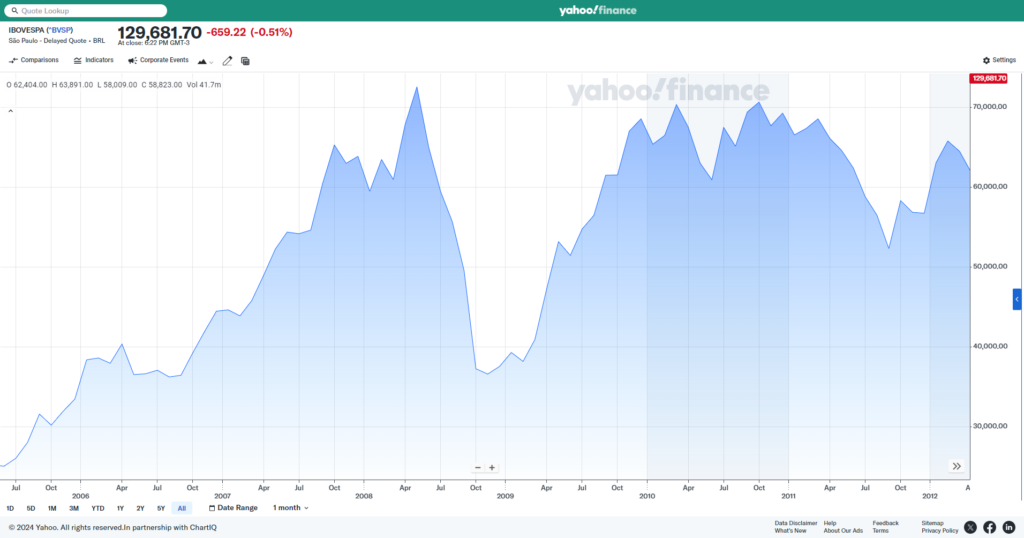
Major events such as the global financial crisis of 2008 led to a sharp decline in the BVSPX, with the index dropping by over 30% as investor confidence plummeted.
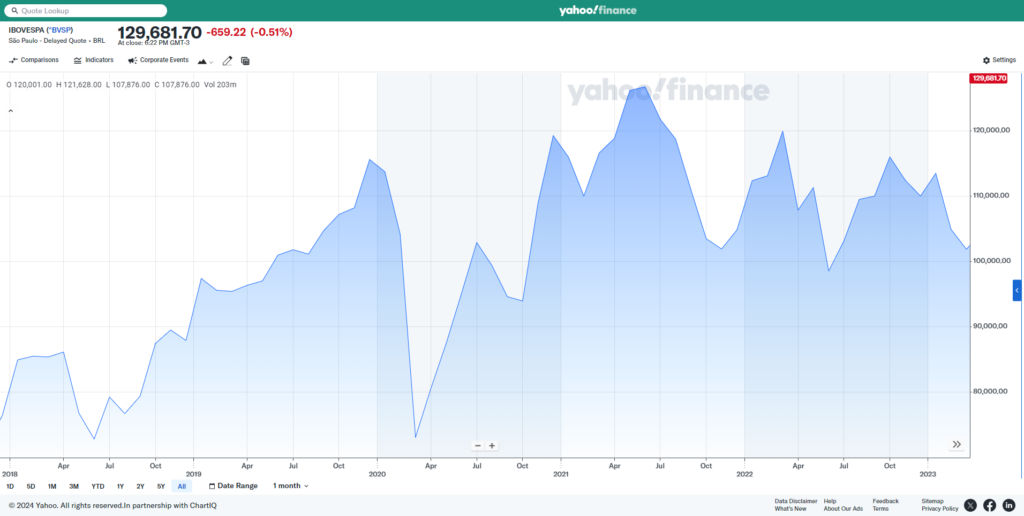
More recently, the COVID-19 pandemic in 2020 caused widespread economic disruption, leading to a temporary but sharp decline in the index.
Political instability, such as the impeachment of President Dilma Rousseff in 2016, caused significant volatility in the market. The index initially fell but later recovered as market-friendly policies were anticipated. The recent re-election of Luiz Inácio Lula da Silva in 2022 also brought market fluctuations as investors reacted to his economic policies.
Long-term trends
Since its inception, the BVSPX has exhibited various long-term trends.

Periods of increase
The early 2000s saw substantial growth due to economic reforms and a commodities boom, with the index rising significantly. More recently, the index has shown resilience, recovering from the pandemic-induced lows and reaching new highs in 2023.
Periods of decline
The index experienced declines during economic downturns, such as the early 2010s when Brazil faced a recession. In 2024, the index has been down by 2.86% year-to-date, reflecting ongoing economic challenges [5].
Key turning points
Several key turning points have shaped the BVSPX’s history:
- 1994 Real Plan
The Real Plan, introduced in 1994, was a set of measures aimed at stabilising the Brazilian economy, which had been plagued by hyperinflation. The plan included the introduction of a new currency, the Brazilian Real (BRL), and fiscal reforms to control inflation. This stabilisation led to a period of economic growth and positively impacted the BVSPX, as investor confidence increased.
- 2002 Presidential Election
The 2002 election of Luiz Inácio Lula da Silva initially caused market jitters due to fears of his leftist policies. However, once in office, Lula adopted more moderate economic policies, which reassured investors and led to a recovery and subsequent growth in the BVSPX. His administration focused on social programs and economic stability, which contributed to the index’s performance.
- 2016 Impeachment of Dilma Rousseff
The impeachment of President Dilma Rousseff in 2016 was a significant political event that initially caused the BVSPX to fall due to uncertainty. However, the anticipation of new economic policies under her successor, Michel Temer, led to a recovery in the index. Temer’s administration implemented reforms aimed at stabilizing the economy, which helped restore investor confidence.
- 2022 Re-election of Luiz Inácio Lula da Silva
Lula’s re-election in 2022 has caused fluctuations in the BVSPX as investors react to his economic policies. While some investors are cautious due to his leftist background, others are optimistic about his experience and potential to implement effective economic measures. The market’s response has been mixed, reflecting the uncertainty and anticipation surrounding his policies.
Final Thoughts
In conclusion, the Bovespa Index offers investors a dynamic view of Brazil’s economy, encompassing a broad spectrum of sectors and responding to various economic and political shifts. With its blend of growth potential, diversification opportunities, and exposure to emerging markets, BVSPX remains an attractive option for global investors. Understanding the factors that influence the index, along with key historical events, can provide investors with valuable insights. Whether through long-term investment or strategic trading, BVSPX presents diverse opportunities within the evolving landscape of Brazil’s economy.
Start Trading the Bovespa Index CFD with Vantage
Take a position on the Bovespa Index with CFDs at Vantage and enjoy competitive spreads designed for active traders. Access Brazil’s top index with flexible leverage and a streamlined trading experience.
Open a live account now and start trading BVSPX with a deposit bonus.
FAQs for Trading and Investing the Bovespa Index
What are the costs involved in trading BVSPX at Vantage?
You can trade the BVSPX via CFDs with low commissions and competitive spreads at Vantage, ensuring you keep your costs down. Plus, there are no deposit fees or hidden charges, so you can trade with confidence knowing exactly what you’re paying.
What is the spread on BVSPX at Vantage?
Vantage offers competitive spreads on BVSPX CFDs to help optimise your trading. For the most up-to-date spread information, click here.
What are the popular platforms to trade the Bovespa (BVSPX) Index?
At Vantage, you can easily trade the BVSPX Index via CFDs on a variety of popular platforms, including MetaTrader 4, MetaTrader 5, TradingView, and the Vantage app, providing you with flexibility and convenience for your trading experience.
How can I stay updated on the Bovespa (BVSPX) news and analysis?
You can stay updated on the Bovespa (BVSPX) news and analysis by leveraging Vantage’s market news and real-time market insights.
References
- “Bovespa Index (Ibovespa) – b3”. https://www.b3.com.br/en_us/market-data-and-indices/indices/broad-indices/ibovespa.htm. Accessed 8 November 2024.
- “Bovespa Index (Ibovespa) – b3”. https://www.b3.com.br/en_us/market-data-and-indices/indices/broad-indices/indice-ibovespa-ibovespa-composition-index-portfolio.htm. Accessed 8 November 2024.
- “The World Bank In Brazil – World Bank Group”. https://www.worldbank.org/en/country/brazil/overview#:~:text=Brazil%E2%80%99s%20real%20GDP%20expanded%20by%202.9%20percent%20in,by%20a%20robust%20labor%20market%2C%20and%20fiscal%20transfers. Accessed 8 November 2024.
- “Opening hours of the Brazil stock exchange (2024) – Trading.info”. https://trading.info/brazil-trading-hours/. Accessed 8 November 2024.
- “Bovespa Cash CFD (BRL) – TradingView”. https://www.tradingview.com/symbols/VANTAGE-BVSPX/”. Accessed 8 November 2024.