Important Information
You are visiting the international Vantage Markets website, distinct from the website operated by Vantage Global Prime LLP
( www.vantagemarkets.co.uk ) which is regulated by the Financial Conduct Authority ("FCA").
This website is managed by Vantage Markets' international entities, and it's important to emphasise that they are not subject to regulation by the FCA in the UK. Therefore, you must understand that you will not have the FCA’s protection when investing through this website – for example:
- You will not be guaranteed Negative Balance Protection
- You will not be protected by FCA’s leverage restrictions
- You will not have the right to settle disputes via the Financial Ombudsman Service (FOS)
- You will not be protected by Financial Services Compensation Scheme (FSCS)
- Any monies deposited will not be afforded the protection required under the FCA Client Assets Sourcebook. The level of protection for your funds will be determined by the regulations of the relevant local regulator.
If you would like to proceed and visit this website, you acknowledge and confirm the following:
- 1.The website is owned by Vantage Markets' international entities and not by Vantage Global Prime LLP, which is regulated by the FCA.
- 2.Vantage Global Limited, or any of the Vantage Markets international entities, are neither based in the UK nor licensed by the FCA.
- 3.You are accessing the website at your own initiative and have not been solicited by Vantage Global Limited in any way.
- 4.Investing through this website does not grant you the protections provided by the FCA.
- 5.Should you choose to invest through this website or with any of the international Vantage Markets entities, you will be subject to the rules and regulations of the relevant international regulatory authorities, not the FCA.
Vantage wants to make it clear that we are duly licensed and authorised to offer the services and financial derivative products listed on our website. Individuals accessing this website and registering a trading account do so entirely of their own volition and without prior solicitation.
By confirming your decision to proceed with entering the website, you hereby affirm that this decision was solely initiated by you, and no solicitation has been made by any Vantage entity.
I confirm my intention to proceed and enter this website Please direct me to the website operated by Vantage Global Prime LLP regulated by the FCA in the United KingdomImportant Information
By providing your email and proceeding to create an account on this website, you acknowledge that you will be opening an account with Vantage Global Limited, regulated by the Vanuatu Financial Services Commission (VFSC), and not the UK Financial Conduct Authority (FCA).
-
Please enter a valid email address
-
Please tick the checkbox to proceed
-
Please tick the checkbox to proceed
Please tick all to proceed

Access Restricted
Your access to this website is restricted.
Our website and services are not available to, and are not intended for, individuals who are citizens or residents of the United States, or entities incorporated in or conducting business within the United States.
If this does not apply to you and you believe you have received this message in error, please contact us at support@vantagemarkets.com for further assistance.
If you fall into any of the above categories, please exit the site.
Important Information
Thank you for visiting the Vantage Markets website. Please note that this website is intended for individuals residing in jurisdictions where accessing it is permitted by Vantage and its affiliated entities do not operate in your home jurisdiction.
By clicking 'I CONFIRM MY INTENTION TO PROCEED AND ENTER THIS WEBSITE', you confirm that you are entering this website solely based on your initiative and not as a result of any specific marketing outreach. You wish to obtain information from this website based on reverse solicitation principles, in accordance with the applicable laws of your home jurisdiction.
I CONFIRM MY INTENTION TO PROCEED AND ENTER THIS WEBSITE
-

-


Download App
-


-

-

-
Search query too short. Please enter a full word or phrase.
-

Keywords
Popular Search








Language

 Market Analysis Currencies Offshore Yuan Bounced Back as Exporters Converted Dollars – USDCNH Analysis
Asian Market News TodayCurrency Trading NewsEconomic news todayForexForex NewsForex News TodayInterest Rate NewsMarket News TodayTechnical AnalysisUSDX News
Offshore Yuan Bounced Back as Exporters Converted Dollars – USDCNH Analysis

Vantage Editorial Team >
25 November 2026 | Currencies | 17 min read
Vantage Editorial Team >
Vantage is a global, multi-asset broker with a team of experienced in-house writers, analysts, and market professionals. Together, they craft trusted, educational, and market-driven content tailored for traders at every stage—from beginner to pro.
- USDCNH rose as much as 0.50% to 6.6999 on 19 November, then traded back at 6.6656 by 09:12 (GMT+8) on 24 November.
- Exporters accelerated year-end conversions of dollar earnings into yuan, after China’s January to October trade surplus reached $1.04 trillion.
- The PBOC set its 24 November USDCNY fixing at 6.7111, 354 pips weaker for the yuan than the Reuters estimate of 6.6757.
USDCNH traded at 6.6656 as of 09:12 (GMT+8) on 24 November 2026, 343 pips below its 19 November spike to 6.6999 and about 0.35% above its 52-week low.1,2 The offshore yuan took a four-session round trip and finished slightly ahead of where it set off.
That bounce is what this piece unpacks. Most coverage this week leaned on the dollar, so we went looking at the yuan side instead, and found exporters converting a record pile of dollars and a central bank fixing quietly leaning against yuan strength. That changes where the risk sits into December.
The offshore yuan bounced back because Chinese exporters converted dollar earnings into yuan after a thin-market spike on 19 November, while the PBOC kept fixing USDCNY well above model estimates to slow yuan gains. USDCNH traded at 6.6656 at 09:12 (GMT+8) on 24 November 2026.
As of 09:12 (GMT+8) on 24 November 2026, Vantage USDCNH Contract for Difference (CFD) traded at 6.6656, 0.01% lower on the current four-hour bar; the 52-week range is 6.6422 to 7.1116.2
A 343-Pip Round Trip in Four Sessions
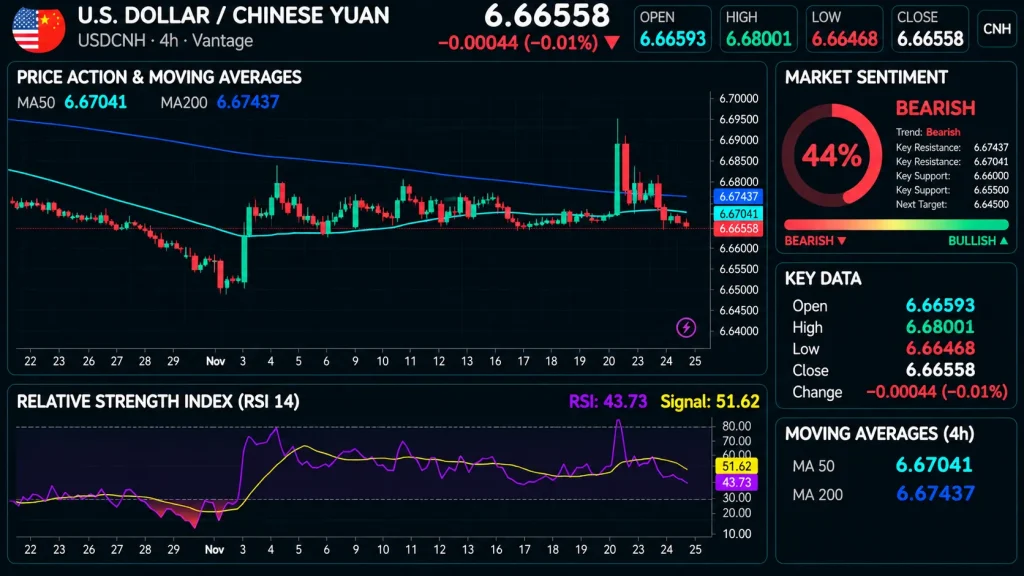
On the USDCNH TradingView chart in Figure 1, the USDCNH historical data from 22 October tell a tidy story. After a tall candle at the start of November lifted the pair off lows near 6.6425, the USDCNH price spent 4 to 18 November boxed between about 6.6610 and 6.6855.
Then came 19 November. The USDCNH Bloomberg coverage that day showed the pair up as much as 0.50% at 6.6999 as risk appetite shrank and emerging-market currencies fell together.1 Most USDCNH news treated it as a dollar story. The Relative Strength Index (RSI) in the TradingView setup used for this analysis hit about 79, checked into overbought territory, and checked out two bars later.
By the 09:12 (GMT+8) cut-off on 24 November, USDCNH spot had handed the whole move back. The RSI read 43.73 against a signal line of 51.62, with price below the 50-period moving average near 6.6704 and the 200-period near 6.6744. A USDCNH live chart looks different by the time anyone reads this; ours is a snapshot.
The dollar explains the jump. It does not explain the trip home.
Year-End Exporter Conversions Absorbed the Spike
The dollar had help. The US Dollar Index peaked at 104.53 on 23 November, near a 20-month high, and Commonwealth Bank of Australia strategist Carol Kong called the AI narrative “a crucial pillar of the US exceptionalism story” behind it.3 Yet USDCNH ended that day well below its spike.
An Investing.com analysis found the 19 November move came without a pickup in onshore turnover, a sign of stop-loss orders triggering in thin trading, and noted that exporters tend to convert dollar earnings once onshore trading resumes.4 By 23 November, Trading Economics reported exactly that, with conversions accelerating for year-end accounting and pre-Lunar New Year bonuses.5
The pool of dollars is enormous. October exports rose 35.20% year-on-year to $412.30 billion, taking China’s January to October trade surplus to $1.04 trillion.6 Goldman Sachs economists list “continued exporter conversion of FX receipts” among the yuan’s supports.7
In plain terms: when the USD to CNH rate jumps, exporters get a better conversion rate, and the yuan finds demand on the dip. That explains who absorbed the spike, not why the yuan has stopped climbing. For that, look at the central bank’s morning routine.
The People’s Bank of China Fixing Leans Against Yuan Strength
At about 09:15 (GMT+8) each trading day, the People’s Bank of China (PBOC) sets a midpoint for onshore USDCNY, and onshore trading may move 2% either side of it.8 Traders call it the USDCNH fix, though strictly it anchors USD CNY. On 24 November, just after our cut-off, the PBOC fixing came in at 6.7111 against a Reuters estimate of 6.6757.8
Here is the part we did not expect: that is 354 pips weaker for the yuan than models implied, the opposite of a defence. We checked eight November fixings, and every one landed 336 to 464 pips on the weak side of the estimate.8,9,10,11,12
Over those eight prints, the fixing moved just 80 pips, from 6.7191 to 6.7111, while USDCNH covered 343 pips in four sessions. The fix is the slowest-moving number on the screen, which appears to be the point.
The stance has a paper trail. On 3 November, the onshore yuan ended 13 straight days of gains, its longest run since 1996, after the PBOC raised banks’ foreign-exchange reserve requirement ratio.13 The ratio rose to 6% from 4% from 15 November, trimming the supply of dollars.14
The pressure is real. Eric Lin, head of Asia Pacific research at UBS, said easing outflows and stronger appreciation expectations had created “self-reinforcing appreciation momentum”.15 If that is the engine, the PBOC appears to have a foot on the brake, and that is how the fixing feeds into the USDCNH rate.
Put together, USDCNH appears to sit between two brakes: a central bank leaning against a fast yuan rally, and exporters converting dollars whenever the pair spikes.
The fix moved 80 pips in eight prints. USDCNH moved 343 pips in four sessions.
Two prices for one currency can trip up anyone new to the pair, so here is a side-by-side.
CNH vs CNY: Two Prices for One Currency
What is USDCNH? It is the US dollar priced in offshore yuan, also written USD/CNH. What is CNH? China’s currency traded outside the mainland, mainly in Hong Kong, under a different rulebook from onshore CNY, one reason the pair features so often in currency trading news 5
| Feature | CNY (Onshore) | CNH (Offshore) |
|---|---|---|
| Where It Trades | Mainland China | Outside the mainland, mainly Hong Kong |
| Daily Limit | 2% either side of the PBOC fixing | No band |
| Pair Quoted | USDCNY | USDCNH |
| Reference on 24 November | PBOC fixing at 6.7111; spot near 6.6615 | 6.6656 at 09:12 (GMT+8) |
| Main Influence | PBOC fixing and onshore flows | Global dollar moves, offshore liquidity, and the onshore signal |
Table 1: CNH vs CNY at a glance. Sources: investingLive (fixing and band), Trading Economics (USDCNY spot and offshore market), TradingView Vantage feed (USDCNH). Data as of 24 November 2026, indicative only.
The USDCNH forward adds one more layer. With the US Fed funds rate at 4.00% and the PBOC’s overnight policy rate at 1.25%, dollar rates sit well above yuan rates,5,10 which usually puts USDCNH forward points below spot and shows up in overnight financing too. Offshore funding rates can differ from onshore ones, so this is a rough guide; our interest rate news tracks both sides.
With the plumbing mapped, the chart levels make more sense.
USDCNH Levels Traders Are Watching
These USDCNH exchange rate levels come from the USDCNH chart in Figure 1. They are reference points, not signals.
USDCNH reference levels as of 09:12 (GMT+8), 24 November 2026
| Label | Level | What It Marks |
|---|---|---|
| Resistance 2 | 6.6999 | 19 November high, the weakest yuan level since mid-October 1 |
| Resistance 1 | 6.6855 | 4 November swing high on the four-hour chart |
| Moving averages | 6.6744 / 6.6704 | 200-period and 50-period moving averages, four-hour chart |
| Cut-off price | 6.6656 | Vantage feed at 09:12 (GMT+8) |
| Support 1 | 6.6610 | Lower edge of the 4 to 18 November range |
| Support 2 | 6.6422 | 52-week low 2 |
Table 2: Levels read from the Vantage USDCNH four-hour chart on TradingView; 19 November high from Bloomberg; 52-week low from Investing.com. Data as of 24 November 2026, indicative only.
At the cut-off, the USD CNH rate sat about 0.68% stronger for the yuan than the 6.7111 onshore fixing.
Looking for a USDCNH forecast? Vantage does not publish one, but bank views lean towards a firmer yuan: Goldman Sachs projected onshore USDCNY at 6.30 in 12 months, and UBS sees 6.25 by end-2027.7,15 Any USD CNH forecast still meets the same two brakes.
The two-brake read weakens if USDCNH holds above the 19 November high near 6.70, or if fixings start landing close to the Reuters estimate. Both tests run into a busy fortnight. Read the analysis on USDJPY, NAS100, USDCAD, and Crude Oil here.
USDCNH Checklist for the Next Two Weeks
Thanksgiving thins the US desk just as the calendar fills up. Times are GMT+8; we follow each item in forex news today and Asian markets news today, where the next round of USD CNH news lands first.
- PBOC Fixing, Daily at About 09:15: A shrinking gap to the Reuters estimate would be the first sign the brake is easing.8
- Exporter Conversions, Into Late December: Year-end and pre-Lunar New Year needs drove this month’s conversions.5
- US Q3 GDP and October PCE, 25 November: Growth and Personal Consumption Expenditures (PCE) inflation data land in the US session.
- US Thanksgiving, 26 and 27 November: US markets close, then close early; thin trading set the scene for the 19 November spike.4
- China Official PMIs, 30 November: October’s manufacturing Purchasing Managers’ Index (PMI) was 49.30, a three-month low.14
- Fed Decision, 10 December, 03:00: The Federal Open Market Committee (FOMC) statement lands in Asian hours.16
- US-China Trade Truce, January 2027: The Washington-Beijing truce runs into January.17
Managing Risk Between Two Brakes
The week opened with the yuan at its weakest since mid-October. Four sessions later it was back near its strongest level in a year, with USDCNH at 6.6656 at 09:12 (GMT+8) on 24 November, held between exporter conversions and a PBOC fixing leaning against rapid gains. The read changes if either brake comes off.
The 19 November move showed how a range-bound pair can travel 0.50% in hours, much of it in thin trading.4 USD CNH live prices can gap when liquidity thins, and a Stop Loss limits losses to a planned size but may be filled at a worse price than the level set. USDCNH exposure can also overlap with other dollar-linked or China-linked positions that react to the same headline.
Leverage amplifies losses as readily as potential returns. On a position using 1:100 leverage, the 0.50% swing of 19 November equals roughly 50% of the margin committed, before costs, in either direction. Position size measured as a share of account equity, rather than set by the maximum leverage available, is one way traders limit how much a single fixing surprise or overnight gap can affect an account balance.
RISK WARNING: CFDs are complex financial instruments and carry a high risk of losing money rapidly due to leverage. You should ensure you fully understand the risks involved and carefully consider whether you can afford to take the high risk of losing your money before trading.
Disclaimer: The information is provided for educational purposes only and doesn’t take into account your personal objectives, financial circumstances, or needs. It does not constitute investment advice. We encourage you to seek independent advice if necessary. The information has not been prepared in accordance with legal requirements designed to promote the independence of investment research. No representation or warranty is given as to the accuracy or completeness of any information contained within. This material may contain historical or past performance figures and should not be relied on. Furthermore estimates, forward-looking statements, and forecasts cannot be guaranteed. The information on this site and the products and services offered are not intended for distribution to any person in any country or jurisdiction where such distribution or use would be contrary to local law or regulation.
References
[1] “Offshore Chinese Yuan Drops to Weakest Level in Over a Month – Bloomberg” https://www.bloomberg.com/news/articles/2026-11-19/offshore-chinese-yuan-drops-to-weakest-level-in-over-a-month-mwnvjmz2 Accessed on 24 November 2026.
[2] “USD/CNH – US Dollar Chinese Yuan Offshore – Investing.com” https://www.investing.com/currencies/usd-cnh Accessed on 24 November 2026.
[3] “Dollar perky as renewed AI euphoria fuels Fed hike bets – Reuters via Investing.com” https://au.investing.com/news/forex-news/dollar-climbs-as-renewed-ai-euphoria-fuels-fed-hike-bets-4791826 Accessed on 24 November 2026.
[4] “Offshore yuan dip looks like a liquidity blip, not a trend shift – Investing.com via Yahoo Finance” https://sg.finance.yahoo.com/news/offshore-yuan-dip-looks-liquidity-195425979.html Accessed on 24 November 2026.
[5] “Chinese Yuan – Quote – Chart – Historical Data – News – Trading Economics” https://tradingeconomics.com/china/currency Accessed on 24 November 2026.
[6] “China says 2026 trade surplus surpassed $1 tn in October – Hurriyet Daily News” https://www.hurriyetdailynews.com/amp/china-says-2026-trade-surplus-surpassed-1-tn-in-october-229211 Accessed on 24 November 2026.
[7] “Why Goldman Thinks Chinese Exporters Will Keep Selling Dollars For Yuan – ExchangeRates.org.uk” https://www.exchangerates.org.uk/news/47773/2026-11-14-why-goldman-thinks-chinese-exporters-will-keep-selling-dollars-for-yuan.html Accessed on 24 November 2026.
[8] “PBOC sets USD/CNY central rate at 6.7111 (vs. estimate at 6.6757) – investingLive” https://investinglive.com/central-banks/pboc-sets-usd-cny-central-rate-at-6-7111-vs-estimate-at-6-6757/ Accessed on 24 November 2026.
[9] “PBoC is expected to set yuan midpoint at 6.6771 (prev. 6.7152) – Newsquawk” https://www.newsquawk.com/headlines/pboc-is-expected-to-set-yuan-midpoint-at-66771-prev-67152 Accessed on 24 November 2026.
[10] “PBoC is expected to set yuan midpoint at 6.6715 (prev. 6.7141) – Newsquawk” https://www.newsquawk.com/headlines/pboc-is-expected-to-set-yuan-midpoint-at-66715-prev-67141 Accessed on 24 November 2026.
[11] “PBoC sets USD/CNY midpoint at 6.7118 vs exp. 6.6654 (prev. 6.7132) – Newsquawk” https://www.newsquawk.com/headlines/pboc-sets-usdcny-midpoint-at-67118-vs-exp-66654-prev-67132 Accessed on 24 November 2026.
[12] “PBoC sets USD/CNY midpoint at 6.7120 vs exp. 6.6775 (prev. 6.7131) – Newsquawk” https://www.newsquawk.com/headlines/pboc-sets-usdcny-midpoint-at-67120-vs-exp-66775-prev-67131 Accessed on 24 November 2026.
[13] “Onshore Yuan Snaps Winning Streak as PBOC Lifts FX Reserve Ratio – Bloomberg” https://www.bloomberg.com/news/articles/2026-11-03/offshore-yuan-weakens-after-pboc-moves-to-cool-currency-rally Accessed on 24 November 2026.
[14] “Offshore Yuan Returns to 32-Month Peak (news stream) – Trading Economics” https://tradingeconomics.com/china/currency/news/516827 Accessed on 24 November 2026.
[15] “UBS Group Sees Yuan Rising to 6.25 in Most Bullish Market Call – Bloomberg” https://www.bloomberg.com/news/articles/2026-11-18/ubs-group-sees-yuan-rising-to-6-25-in-most-bullish-market-call Accessed on 24 November 2026.
[16] “Meeting calendars and information – Federal Reserve” https://www.federalreserve.gov/monetarypolicy/fomccalendars.htm Accessed on 24 November 2026.
[17] “China’s trade surplus crosses $1 trillion for second year, AI exports drive boom – WION” https://www.wionews.com/world/china-trade-surplus-1-trillion-ai-exports-2026-1794288641740 Accessed on 24 November 2026.
Key Points In This Article

Latest Financial Market Analysis


Market Analysis Tags
- # USD News
- # USDCAD News
- # USDJPY News
- # USDX News
- # Forex News
- # Forex News Today
- # GBPUSD News
- # EURUSD News
- # Currency Trading News
- # AUDUSD news
Related Articles
- New Zealand Dollar Extended its Losing Streak to a 17-Year Low as the RBNZ Paused and Stocks Slid – NZDUSD Analysis
- Canadian Dollar Fell to a 19-Month Low as Oil Slid and Growth Stalled – USDCAD Analysis
- Why the Pound Fell to a One-Year Low as UK Data Cooled – GBPUSD Analysis
- Euro Slid to a 19-Month Low as Europe’s Energy Shock Outran ECB Hikes – EURUSD Analysis
- Gold Price Rises as Fed Hike Bets Ease: What It Means for XAUUSD Traders
- Dow Jones Came Under Heavy Selling Pressure as AI Sell-Off Hit Banks and Industrials – DJ30 Analysis
- Hewlett Packard Enterprise (NYSE: HPE) Stock Price and Forecast: November 2026 Outlook
- Shekel Lost Ground to the Greenback as Israel’s Inflation Hit a Five-Year Low – USDILS Analysis