Important Information
You are visiting the international Vantage Markets website, distinct from the website operated by Vantage Global Prime LLP
( www.vantagemarkets.co.uk ) which is regulated by the Financial Conduct Authority ("FCA").
This website is managed by Vantage Markets' international entities, and it's important to emphasise that they are not subject to regulation by the FCA in the UK. Therefore, you must understand that you will not have the FCA’s protection when investing through this website – for example:
- You will not be guaranteed Negative Balance Protection
- You will not be protected by FCA’s leverage restrictions
- You will not have the right to settle disputes via the Financial Ombudsman Service (FOS)
- You will not be protected by Financial Services Compensation Scheme (FSCS)
- Any monies deposited will not be afforded the protection required under the FCA Client Assets Sourcebook. The level of protection for your funds will be determined by the regulations of the relevant local regulator.
If you would like to proceed and visit this website, you acknowledge and confirm the following:
- 1.The website is owned by Vantage Markets' international entities and not by Vantage Global Prime LLP, which is regulated by the FCA.
- 2.Vantage Global Limited, or any of the Vantage Markets international entities, are neither based in the UK nor licensed by the FCA.
- 3.You are accessing the website at your own initiative and have not been solicited by Vantage Global Limited in any way.
- 4.Investing through this website does not grant you the protections provided by the FCA.
- 5.Should you choose to invest through this website or with any of the international Vantage Markets entities, you will be subject to the rules and regulations of the relevant international regulatory authorities, not the FCA.
Vantage wants to make it clear that we are duly licensed and authorised to offer the services and financial derivative products listed on our website. Individuals accessing this website and registering a trading account do so entirely of their own volition and without prior solicitation.
By confirming your decision to proceed with entering the website, you hereby affirm that this decision was solely initiated by you, and no solicitation has been made by any Vantage entity.
I confirm my intention to proceed and enter this website Please direct me to the website operated by Vantage Global Prime LLP regulated by the FCA in the United KingdomImportant Information
By providing your email and proceeding to create an account on this website, you acknowledge that you will be opening an account with Vantage Global Limited, regulated by the Vanuatu Financial Services Commission (VFSC), and not the UK Financial Conduct Authority (FCA).
-
Please enter a valid email address
-
Please tick the checkbox to proceed
-
Please tick the checkbox to proceed
Please tick all to proceed

Access Restricted
Your access to this website is restricted.
Our website and services are not available to, and are not intended for, individuals who are citizens or residents of the United States, or entities incorporated in or conducting business within the United States.
If this does not apply to you and you believe you have received this message in error, please contact us at support@vantagemarkets.com for further assistance.
If you fall into any of the above categories, please exit the site.
Important Information
Thank you for visiting the Vantage Markets website. Please note that this website is intended for individuals residing in jurisdictions where accessing it is permitted by Vantage and its affiliated entities do not operate in your home jurisdiction.
By clicking 'I CONFIRM MY INTENTION TO PROCEED AND ENTER THIS WEBSITE', you confirm that you are entering this website solely based on your initiative and not as a result of any specific marketing outreach. You wish to obtain information from this website based on reverse solicitation principles, in accordance with the applicable laws of your home jurisdiction.
I CONFIRM MY INTENTION TO PROCEED AND ENTER THIS WEBSITE
-

-


Download App
-


-

-

-
Search query too short. Please enter a full word or phrase.
-

Keywords
Popular Search








Language


Big Tech Earnings This Week: 3 AI Capex Numbers to Check

Vantage Editorial Team >
28 October 2026 | Market Analysis | 18 min read
Vantage Editorial Team >
Vantage is a global, multi-asset broker with a team of experienced in-house writers, analysts, and market professionals. Together, they craft trusted, educational, and market-driven content tailored for traders at every stage—from beginner to pro.

Key Takeaways
- Meta guided 2026 capital expenditure (capex) to $135bn to $145bn, narrowed from $130bn to $145bn.[1]
- Microsoft and Alphabet report on 28 October[2,3], Amazon on 29 October[4] and Apple on 2 November.[5]
- Last-reported cloud growth: Google Cloud +82%[6], Azure and other cloud services +43%[7] and AWS +37%.[8]
One quarter, two numbers, opposite directions. In its 21 October release Meta reported capital expenditure (capex, the money spent on data centres and equipment) of $34.91bn and free cash flow of negative $2.12bn.[1] Big tech earnings this week let you run the same check on Microsoft, Alphabet and Amazon, line by line. Each has told investors how much it plans to spend on Artificial Intelligence (AI) in 2026, and the guidance is already public. The answer sits in the filings, not in a forecast: what have they said they will spend, and which numbers show that spending reaching revenue and cash flow?
Big Tech Earnings Calendar
Meta reported on 21 October. Microsoft and Alphabet report on 28 October, Amazon on 29 October and Apple on 2 November. Meta guided 2026 capital spending to $135 billion to $145 billion, so the check is whether cloud growth and free cash flow keep pace.
| Company | Date | Call time (PT or ET) | Call time (GMT+8) | Status |
| Meta | Wed 21 Oct, after the close (reported) | 13:30 PT / 16:30 ET | 04:30, Thu 22 Oct | ✅ Confirmed |
| Microsoft (FY27 Q1) | Wed 28 Oct, after the close | 14:30 PT webcast | 05:30, Thu 29 Oct | ✅ Confirmed |
| Alphabet | Wed 28 Oct | 13:30 PT / 16:30 ET | 04:30, Thu 29 Oct | ⚠️ Verify: third-party calendar |
| Amazon | Thu 29 Oct | 14:00 PT / 17:00 ET | 05:00, Fri 30 Oct | ✅ Confirmed (call time) |
| Apple (fiscal Q4) | Mon 2 Nov | 14:00 PT | 06:00, Tue 3 Nov | ⚠️ Verify: secondary source |
Table 1: Earnings calendar for big tech earnings this week. When is Microsoft earnings, when is Google earnings, when is Amazon earnings? Dates, call times and status. Sources: Meta, Microsoft and Amazon investor relations notices; Alphabet and Apple dates from secondary calendars, accessed 27 October 2026. Call times are converted from US Pacific Time; US clocks change on 1 November.
What Meta’s 21 October Results Showed

Start with the receipt. The Meta earnings date was 21 October, and the third-quarter release reports capex of $34.91bn, including $0.96bn of finance lease principal (repayment on equipment and buildings leased on terms that count like a purchase).[1] Revenue was $64.60bn, up 26% year on year. Net income was $9.86bn in a quarter that also carried a $9.89bn legal charge tied to an August agreement with 52 state attorneys general.[1]
Now zoom out, because this is the line that stops the scroll. Free cash flow, the cash left once capital spending is paid for, was negative $2.12bn, against positive $10.63bn a year earlier.[1]
Then to the promise it made about the rest of the year. Meta narrowed its 2026 capex outlook to $135bn to $145bn from $130bn to $145bn, and raised its total expenses outlook to $175bn to $179bn to include the legal charge.[1] It expects Reality Labs losses to narrow to about $15bn in 2027 and gave no 2027 capex figure.[1] Vantage’s coverage of Meta’s third-quarter release and the Meta News page carry the rest.
Meta earnings settle the first layer: the spend is big and it is guided. What they cannot show is whether it has become revenue, because Meta sells no cloud capacity to compare it against. It is like marking a bake-off by the grocery receipt. Microsoft and Alphabet have a dish to taste, and both report on 28 October.
What Microsoft and Alphabet Can Confirm on 28 October

Microsoft is the best place to start, because it spells things out, which is rare in earnings season. Its last report covered the quarter to 30 June, fiscal 2026’s fourth. Revenue was $90.0bn, up 18%, and Azure and other cloud services grew 43%.[7] On the call, capex was $41bn and total finance leases were $5.6bn, and finance chief Amy Hood said “customer demand continues to exceed available capacity”.[9]
The guidance is specific. For the September quarter Microsoft guided Azure growth of about 45% in constant currency (exchange-rate effects removed) and capex of over $50bn, including the effect of a lease reclassification.[9] For calendar 2026 Hood gave about $175bn after a shift from finance to operating leases.[9] Microsoft’s year ends in June, so FY27 is not calendar 2026. The Microsoft earnings date is 28 October, and the Microsoft earnings report can be read against those figures. The Microsoft earnings call webcast starts at 14:30 PT, 05:30 (GMT+8) on 29 October.[2] Vantage’s analysis of Microsoft’s previous quarter, the Microsoft News page and its Maia 300 AI chip note add context.
Alphabet pairs the fastest cloud growth in this group with negative cash flow. Its second quarter, reported on 22 July, showed Google Cloud revenue of $24.8bn, up 82%.[6] Capex was $44.9bn and free cash flow was negative $5.9bn.[6] A Nasdaq summary of the call adds a $514bn cloud backlog (contracted revenue not yet recognised, like a diary full of booked tables), a 2026 capex range raised to $195bn to $205bn from $180bn to $190bn, and finance chief Anat Ashkenazi describing Alphabet as supply constrained.[10]
Google earnings are Alphabet earnings, so the Google earnings date and the Alphabet earnings date are both 28 October, with the call at 13:30 PT, 04:30 (GMT+8) on 29 October.[3] The Google earnings report can be held up against the range, the backlog and the growth rate; the Google Stock News page has more.
Amazon on 29 October, and Where Apple Fits
Amazon’s last report, for the second quarter, showed net sales of $200.6bn, up 20%, AWS (Amazon Web Services) sales of $42.2bn, up 37%, and total operating income of $27.5bn.[8] For the third quarter it guided net sales of $197.0bn to $202.0bn and operating income of $22.5bn to $26.5bn.[8] Those two ranges are the checkpoints to hold it to: the Amazon earnings report either lands inside them or it does not.
Amazon’s cash picture is the one to read slowly, because it is trailing, a year of grocery receipts rather than one trolley. Free cash flow for the 12 months to 30 June was negative $7.6bn, against $173.0bn of gross purchases of property and equipment.[8] Fortune reported that Amazon raised its 2026 capex guidance to about $220bn from $200bn on higher memory costs, and that chief executive Andy Jassy said capacity would still fall short of demand in 2026.[11]
The Amazon earnings date is 29 October, a day later, and the Amazon earnings call starts at 14:00 PT, which is 05:00 (GMT+8) on 30 October.[4]
Apple is the quiet one, arriving after everyone else has finished talking. It reports fiscal fourth-quarter results on 2 November. The Apple earnings date and a 14:00 PT call come from a secondary report of Apple’s investor relations page, so Table 1 flags them.[5] After US clocks change on 1 November, the call falls at 06:00 (GMT+8) on 3 November. No Apple capex claim is made here. The next section lines up the other four.
Reading Capex Against Cloud Growth, Backlog and Cash Flow
Picture a restaurant. Spend is the lease and the ovens. Capacity is whether the ovens work: each company says demand outruns its data centres, so the queue is out of the door. Revenue is cloud growth and backlog, the tables booked. Cash is free cash flow, what is in the till once the ovens are paid for. Guidance is the budget on the fridge; cash flow is the bank statement.
Figure 1 lines the companies up by layer. It does not add them, because the bases differ: Meta and Microsoft figures include finance leases, Amazon quotes gross purchases of property and equipment, and Microsoft’s year ends in June. Operating leases, which sit outside capex altogether, are left out of every figure.
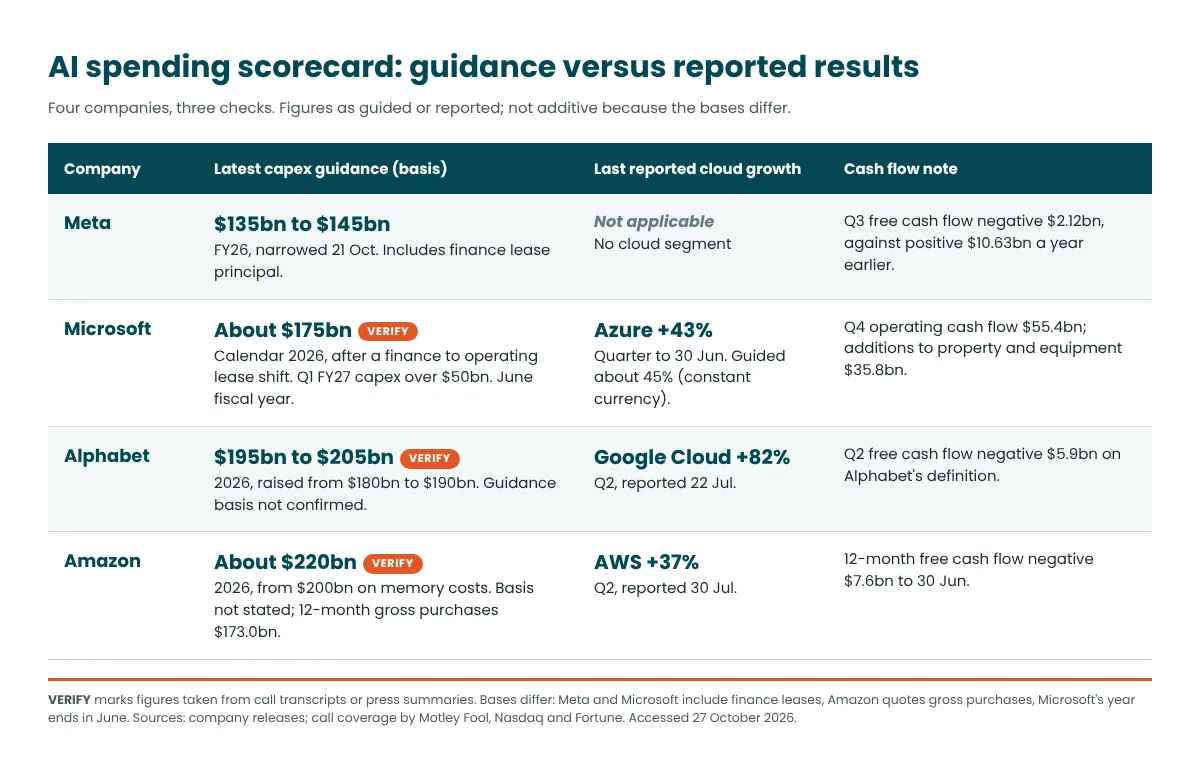
Here is the part headline totals hide. Hood said the shift from finance to operating leases moved Microsoft’s calendar 2026 expectation to about $175bn, with investment expectations otherwise unchanged.[9] Think of a mortgage and a long rental: both can house the same family, but only one shows up as a purchase. Same roof, different paperwork.
Capex is not one number: the same data centre can sit inside it or outside it, depending on the lease.
Now rewind and watch the AI spending guidance move. By 22 July Alphabet had raised its 2026 range from $180bn to $190bn to $195bn to $205bn.[10] On 30 July Amazon moved from $200bn to about $220bn, citing memory costs.[11] On 21 October Meta narrowed from $130bn to $145bn to $135bn to $145bn, which raised the floor and kept the ceiling.[1] Each move is context for what this week’s reports are read against, not a pattern to extend.
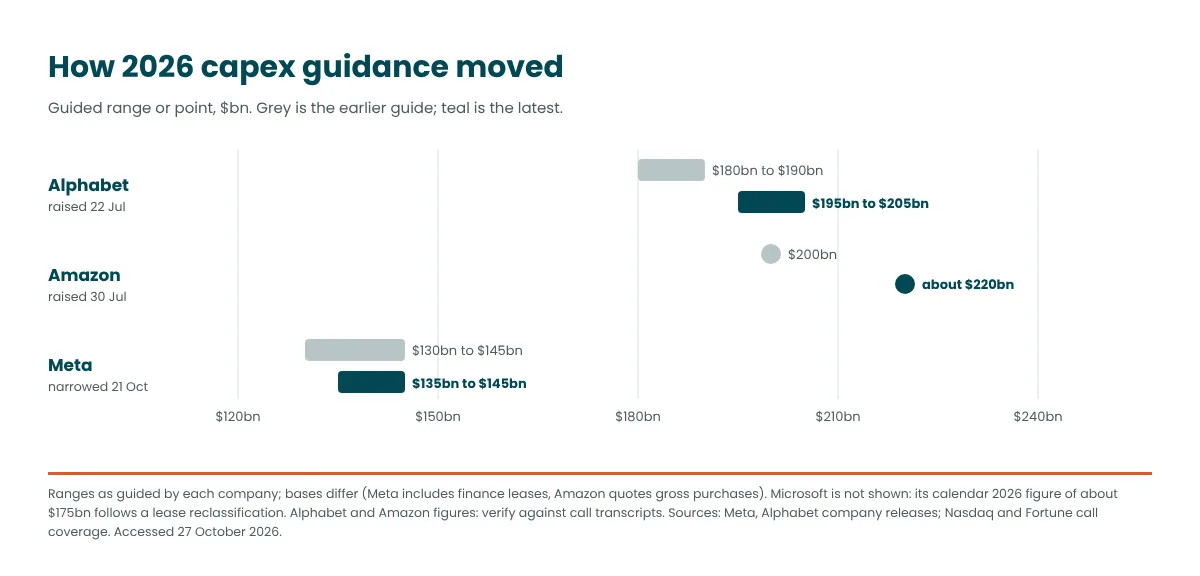
Reported numbers can fill those links. They cannot settle the louder argument, which comes next.
What the Numbers Cannot Settle About the AI Bubble Question
Two loud camps are already sure what this week means, some of them before breakfast. One says record AI spending proves an AI bubble. The other says cloud growth proves the spending pays. The numbers support neither alone, so this piece rules out both as conclusions.
Spending is a cost figure. A bubble is a claim about price against value, and a capex line does not measure that. Cloud growth does not close the case either. Google Cloud grew 82% in the same quarter Alphabet reported negative free cash flow of $5.9bn, and Alphabet described itself as supply constrained.[6,10] Growth and negative cash flow arrived together, and one quarter cannot show how they relate, like judging a marathon at the 5km mark.
Third-party estimates stretch the range without settling it. A Morgan Stanley report led by Nicholas Lentini, dated 15 October and covered by Fortune on 19 October, estimated hyperscaler and AI cloud spending of $1.58tn in 2027, up about 60% from about $980bn in 2026.[12] The report adds that “buying power-dependent equipment that cannot be turned on is hard to sustain”.[12]
A Goldman Sachs Research note dated 7 August said its US portfolio strategy team had flagged that “consensus capex projections for 2027 are likely too conservative”, while arguing that even large upward revisions would leave AI investment within past technology-cycle norms as a share of GDP.[13] Both are third-party views. Neither says what the money earns.
Where the Useful Signal Sits for Traders in Big Tech Earnings This Week
If you are scanning big tech earnings news today, three things carry the most information in each release: guidance changes against Figure 1, free cash flow set against capex, and capacity language. Mag 7 earnings arrive as a cluster: the Magnificent Seven includes all four here plus Apple. Tech earnings this week sit inside earnings season, and Vantage’s week-ahead preview maps the calendar around them.
All three land overnight in Asia, so befriend the coffee machine. Leverage works in both directions: on Contracts for Difference (CFDs) over US shares it magnifies losses as well as gains.
The scorecard so far: the four have guided heavy 2026 AI spending, cloud growth is strong where reported, and cash flow is mixed because periods and definitions differ. The useful comparison is whose lease treatment lines up, not who spends most: think of comparing phone plans when one includes the handset. The read weakens if capex guidance rises while cloud growth slows, or capacity language shifts from shortage to surplus.
Checklist: What to Check in Each Release
- Alphabet, 28 October: Cloud growth, the $514bn backlog and the $195bn to $205bn range.
- Microsoft, 28 October: Azure growth against about 45% guided; capex against over $50bn.
- Amazon, 29 October: Sales and operating income against the guided ranges.
- Apple, 2 November: Fiscal fourth-quarter results.
- Nvidia, mid-November (unconfirmed): Its last report is the supplier-side reference.
A Stop Loss can help limit a loss to a planned size, but a share that gaps through the level on an overnight release can fill the order at a worse price.
A position sized for a quiet session can be too large for an earnings gap. Position size and margin held set how much that gap can cost.
RISK WARNING: CFDs are complex financial instruments and carry a high risk of losing money rapidly due to leverage. You should ensure you fully understand the risks involved and carefully consider whether you can afford to take the high risk of losing your money before trading.
Disclaimer: The information is provided for educational purposes only and doesn’t take into account your personal objectives, financial circumstances, or needs. It does not constitute investment advice. We encourage you to seek independent advice if necessary. The information has not been prepared in accordance with legal requirements designed to promote the independence of investment research. No representation or warranty is given as to the accuracy or completeness of any information contained within. This material may contain historical or past performance figures and should not be relied on. Furthermore estimates, forward-looking statements, and forecasts cannot be guaranteed. The information on this site and the products and services offered are not intended for distribution to any person in any country or jurisdiction where such distribution or use would be contrary to local law or regulation.
References
[1] “Meta Reports Third Quarter 2026 Results – Meta Investor Relations” https://investor.atmeta.com/investor-news/press-release-details/2026/Meta-Reports-Third-Quarter-2026-Results/default.aspx Accessed on 27 October 2026.
[2] “Microsoft Announces Quarterly Earnings Release Date – Microsoft (via Finviz)” https://finviz.com/news/400058/microsoft-announces-quarterly-earnings-release-date Accessed on 27 October 2026.
[3] “Alphabet Earnings – Days To” https://days.to/alphabet-earnings Accessed on 27 October 2026.
[4] “Q3 2026 Amazon.com, Inc. Earnings Conference Call – Amazon Investor Relations” https://ir.aboutamazon.com/events/event-details/2026/Q3-2026-Amazoncom-Inc-Earnings-Conference-Call/default.aspx Accessed on 27 October 2026.
[5] “Apple to Report Q4 2026 Earnings on November 2 – MacRumors” https://macrumors.com/2026/10/06/apple-q4-2026-earnings-nov-2 Accessed on 27 October 2026.
[6] “Alphabet Q2 2026 Earnings Release – Alphabet Investor Relations” https://s206.q4cdn.com/479360582/files/doc_financials/2026/q2/2026q2-alphabet-earnings-release.pdf Accessed on 27 October 2026.
[7] “FY26 Q4 Press Release and Webcast – Microsoft Investor Relations” https://www.microsoft.com/en-us/investor/earnings/fy-2026-q4/press-release-webcast Accessed on 27 October 2026.
[8] “Amazon.com Announces Second Quarter Results – Amazon Investor Relations” https://ir.aboutamazon.com/news-release/news-release-details/2026/Amazon-com-Announces-Second-Quarter-Results Accessed on 27 October 2026.
[9] “Microsoft (MSFT) Q4 2026 Earnings Call Transcript – The Motley Fool” https://www.fool.com/earnings/call-transcripts/2026/08/07/microsoft-msft-q4-2026-earnings-call-transcript/ Accessed on 27 October 2026.
[10] “Alphabet Q2 Earnings Call Highlights – Nasdaq” https://www.nasdaq.com/articles/alphabet-q2-earnings-call-highlights Accessed on 27 October 2026.
[11] “Andy Jassy said Amazon will spend $220 billion this year and still won’t have enough capacity to meet demand – Fortune” https://fortune.com/2026/07/30/andy-jassy-amazon-capex-demand-aws-pga-tour/ Accessed on 27 October 2026.
[12] “Morgan Stanley’s favorite AI stock is 92% exposed to the $1.6 trillion buildout it’s bullish on – Fortune (republished by DNYUZ)” https://dnyuz.com/2026/10/19/morgan-stanleys-favorite-ai-stock-is-92-exposed-to-the-1-6-trillion-buildout-its-bullish-on/ Accessed on 27 October 2026.
[13] “Global AI Investment Is Forecast to Exceed $1 Trillion in 2026 – Goldman Sachs” https://www.goldmansachs.com/insights/articles/global-investment-is-forecast-to-exceed-1-trillion-in-2026 Accessed on 27 October 2026.
Key Points In This Article

Latest Financial Market Analysis


Market Analysis Tags
- # USD News
- # USDCAD News
- # USDJPY News
- # USDX News
- # Forex News
- # Forex News Today
- # GBPUSD News
- # EURUSD News
- # Currency Trading News
- # AUDUSD news
Related Articles
- Gold On a Roller Coaster Ride Alongside Wall Street Before Payrolls – XAUUSD Analysis
- Why AppLovin Stock Rose 31% as Q3 Earnings Cleared Its Own Guidance – APP Analysis
- McDonald’s Stock Rose as Q3 Earnings Beat Outweighed a US Sales Dip – MCD Analysis
- Gold Rose as Oil Slid on US-Iran Peace Hopes – XAUUSD Analysis
- Nasdaq 100 Climbs as Chip Stocks Rebound Without Nvidia – NAS100 Analysis
- Dollar Index Slipped as Oil Fell and Hike Bets Rose – USDX Analysis
- Stocks bounce hard as crude falls, even as NVDA sinks
- Why USD/CAD Fell to a Seven-Week Low as the Dollar Outweighed Oil – USDCAD Analysis